Uranus is the one planet most people have never seen, and the only tool it needs is a pair of binoculars and a landmark. At magnitude 5.6 it is at the naked-eye limit under a dark sky and an easy, steady, faintly green point in 7×50 or 10×50 binoculars once you know which point it is. The landmark this season is the Pleiades: Uranus sits about 5.5 degrees to their lower left, in Taurus, and reaches opposition on November 25, 2026, its closest and brightest of the year. This guide gives the star-hop, the best nights, what you will and will not see, and how to prove to yourself it is a planet.
Where it is
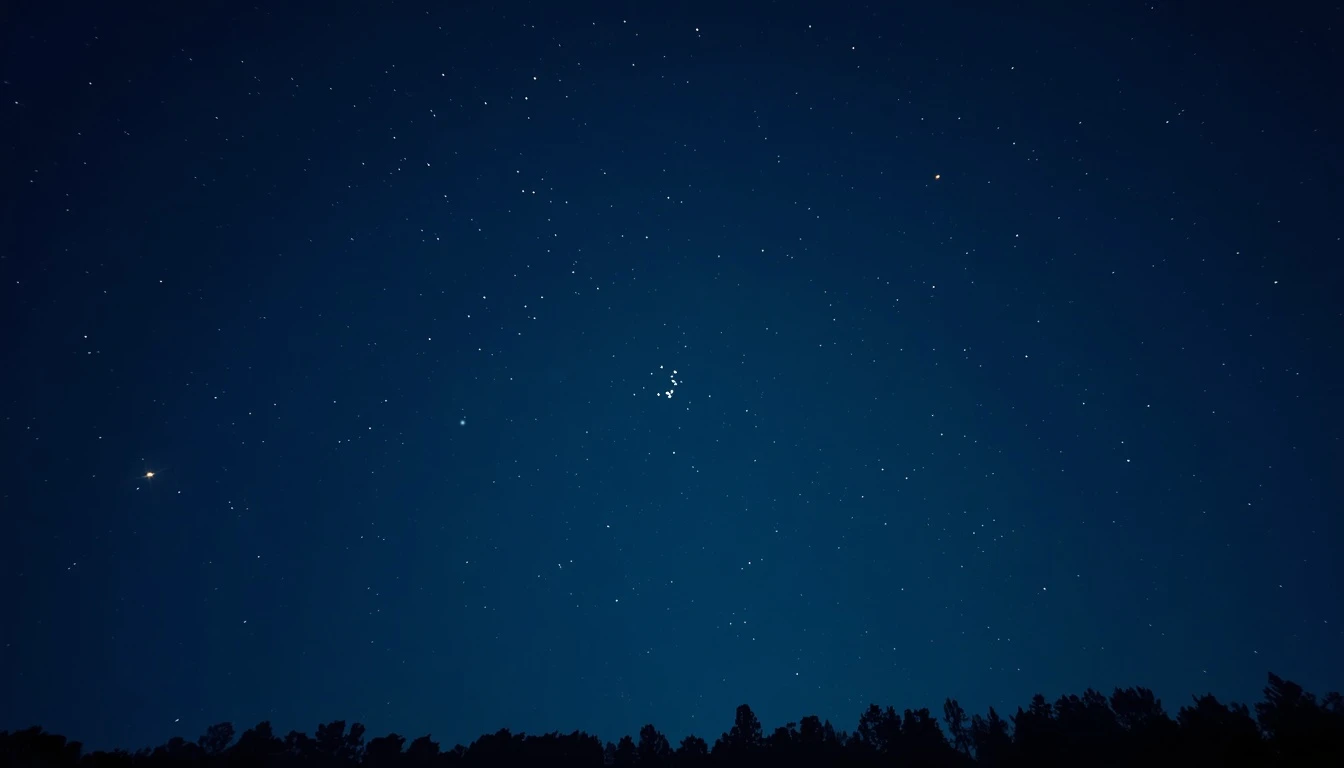
Find the Pleiades, the small bright cluster that rises in the east by mid-evening in November. Then find Aldebaran, the orange star of the Hyades, about 14 degrees to the lower left of the Pleiades. Uranus lies on the line between them, about 40 percent of the way from the Pleiades toward Aldebaran, roughly one binocular field below and left of the cluster. In the binoculars it is the brightest point in that patch of sky that is not part of an obvious pattern, with a slightly steadier, cooler light than the stars around it. It does not twinkle the way they do, because it is a disc rather than a point, even if the disc is too small to see.
From Dallas on November 12 it is 22 degrees up in the east at 8 PM, 47 degrees by 10 PM and nearly overhead at 1 AM; by November 25 it is 20 degrees up at 7 PM and overhead by midnight. It stays in the same part of Taurus all winter, drifting only about 2 arcminutes a day, so a position learned this month holds good into the new year. The Uranus page gives its altitude for any hour from your city.
The best nights
Moonlight is the enemy of a magnitude-5.6 object. Two windows in the coming month are dark:
- November 9 to 17: the Moon sets before midnight every night and Uranus is high by then. The best stretch of the season.
- November 24 and 25, opposition: the worst nights, oddly. The full Beaver Moon passes within 5 to 7 degrees of Uranus on the night of the 24th, drowning it completely.
- December 1 to 14: moonless evenings again, with Uranus a week or two past opposition and no fainter.
Opposition on the 25th at 22:23 UTC matters for the numbers, 18.44 astronomical units or about 2.76 billion kilometres from Earth, but the planet is within a hundredth of a magnitude of that brightness for two months either side. Pick the dark nights. The opposition page has the moment for your zone.
What you will see
- Naked eye: from a genuinely dark site, with the Pleiades high and your eyes adapted, a very faint star where the chart says. Most people need averted vision. From a town, nothing.
- Binoculars: an obvious star-like point, slightly blue-green to some eyes, steady. This is the realistic goal and it is satisfying.
- Small telescope, 100x and up: a tiny disc, 3.8 arcseconds across, pale grey-green and featureless. A star at the same power stays a point; Uranus swells into a bead. That is the moment it becomes a planet.
- Large telescope: the two biggest moons, Titania and Oberon, at magnitude 14, within half an arcminute of the planet. A target for 250 mm and up.
How to be sure
Sketch or photograph the field, Uranus and the half dozen stars around it, on one night. Come back three or four nights later. Everything will be in the same place except one point, which will have shifted by about a tenth of a degree against the others. That slow westward creep, called retrograde motion because the Earth is overtaking Uranus on the inside, is the proof, and it is exactly how William Herschel knew in 1781 that his “comet” was something new. Uranus was the first planet discovered rather than known since antiquity, and it had been catalogued as a star several times before anyone noticed it moved. A phone camera on a tripod with a 10-second exposure captures the field well enough to compare.
Facts worth knowing while you look
- Uranus is four times the diameter of Earth and takes 84 years to orbit the Sun, so it has completed fewer than three circuits since its discovery.
- It rolls around the Sun on its side, its axis tilted 98 degrees, so each pole gets 42 years of sunlight followed by 42 of darkness.
- Its colour comes from methane in the atmosphere absorbing red light; the pale green-blue you may catch in binoculars is real.
- It has 13 known rings, dark and narrow, discovered in 1977 when astronomers watched the planet pass in front of a star and saw the star blink several times before and after. They are far too faint for any amateur telescope.
- Only one spacecraft, Voyager 2, has visited, in January 1986, for a few hours, and most of what we know about the planet’s weather comes from Hubble and from ground-based telescopes since.
Our guide to finding the Pleiades gets you to the starting point, and the moon calendar tells you which nights the Moon is out of the way from your city.