The Pleiades are back in the evening sky. The little cluster known as the Seven Sisters rises in the east-north-east before 9 PM in mid-October and a few minutes earlier each night, and from now until spring it is one of the easiest and loveliest things to find without a telescope. This is also a good month to get to know it for another reason: on the evening of Tuesday, October 27, the nearly full Moon passes in front of the cluster for much of North America. Times below are for Dallas in Central Time; the pattern is the same anywhere in the northern hemisphere.
When and where to look
On October 11 the Pleiades rise at about 8:50 PM, are well up in the east by 10:30 PM, and pass almost overhead, 81 degrees high, just before 4 AM. By the end of the month they rise before 8 PM. The cluster comes up roughly four minutes earlier each day, so by late November it is rising as the Sun sets and is visible all night. With the new moon on October 10, this week’s evenings are moonless and ideal.
How to find it
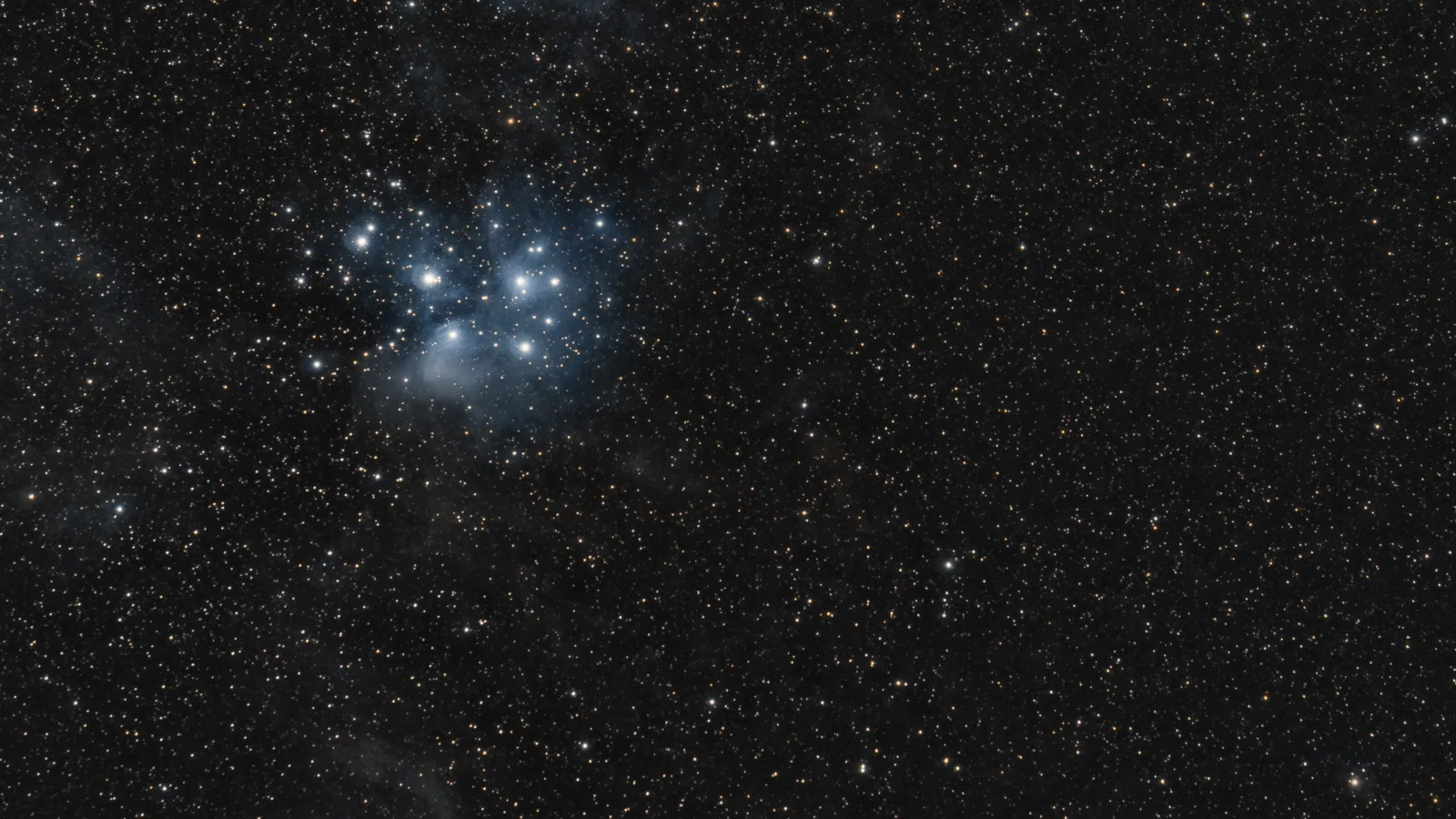
You are looking for a tight little knot of stars shaped like a tiny dipper, much smaller than people expect: the whole group would hide behind your thumb held at arm’s length. Many people mistake it for the Little Dipper, which is far larger and in a different part of the sky.
- Look east-north-east after 10 PM for a small, hazy cluster of stars, low at first and a third of the way up the sky by 11:30 PM. On a dark night it catches the eye on its own.
- Later in the night, use Orion. Once Orion is up, after about 1 AM, follow the line of the three Belt stars up and to the right. It leads first to the bright orange star Aldebaran, the eye of Taurus the Bull, and then on to the Pleiades, about the same distance again.
- Use averted vision. Look slightly to one side of the cluster and more stars appear, because the edge of your retina is more sensitive to faint light.
How many stars can you see?
Despite the name, most people count six stars with the naked eye, not seven. Under a truly dark sky, with patience, sharp-eyed observers reach nine or more. The brightest is Alcyone, at magnitude 2.9. From the suburbs you may see only a small fuzzy patch with three or four points in it. Try counting on a moonless night after your eyes have had ten minutes to adapt; it is a good test of both your eyesight and your sky.
Binoculars transform it. Any pair shows dozens of blue-white stars filling the field, with the dipper shape obvious and chains of fainter stars running off it. The Pleiades are too wide for most telescopes; binoculars give the best view there is.
What the Pleiades are
The Pleiades, catalogued as M45, are an open cluster of more than a thousand stars about 440 light years away. They formed together around 100 million years ago, which makes them young: the dinosaurs were already old when these stars first shone. The brightest members are hot blue stars many times more luminous than the Sun. Long-exposure photographs show a blue haze around them, a cloud of interstellar dust the cluster happens to be passing through, lit up by the stars’ light. The eye does not see the haze, though on an exceptional night binoculars hint at it around the star Merope.
A cluster every culture noticed
Few objects in the sky have as many names. To the Greeks they were the seven daughters of Atlas and Pleione. In Japan the cluster is Subaru, which is why six stars appear on the badge of the car maker. For Māori it is Matariki, and its return to the dawn sky marks the new year in New Zealand. Farmers from the Andes to ancient Greece used its risings and settings to time planting and harvest. A cluster this small and this distinctive has been a calendar for as long as people have watched the sky.
October 27: the Moon covers the Pleiades
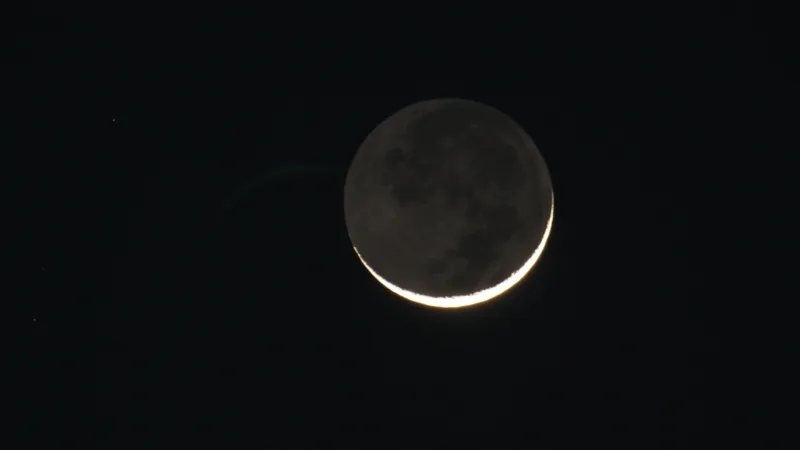
On the evening of Tuesday, October 27, the Moon, two days past the Hunter’s Moon and still about 95% lit, passes directly in front of the Pleiades. From Dallas the Moon rises at 7:38 PM with the cluster right beside it, and the two are closest at about 9 PM. From the eastern half of North America the Moon covers several of the cluster’s bright stars one after another over the course of the evening; farther west it passes very close without covering as many. Which stars disappear, and when, depends on exactly where you are.
The Moon’s glare will overwhelm the cluster to the naked eye, so this is an event for binoculars or a small telescope. Watch a star at the Moon’s bright edge: it does not fade, it vanishes in an instant, because stars are points of light and the Moon has no atmosphere to dim them gradually. A planetarium app set to your location will give the times for each star.
While you are looking
Two more targets are close by. Uranus is 6 to 7 degrees from the Pleiades, below the cluster as they rise, at magnitude 5.6; binoculars show it as a faint star with a slight green-blue tint, on its way to opposition on November 25. And below the Pleiades, Aldebaran sits in front of the V-shaped Hyades, a second and much closer star cluster that is also a fine binocular field. For the rest of the month’s sky see our October guide, and check the moon calendar to pick a dark night.