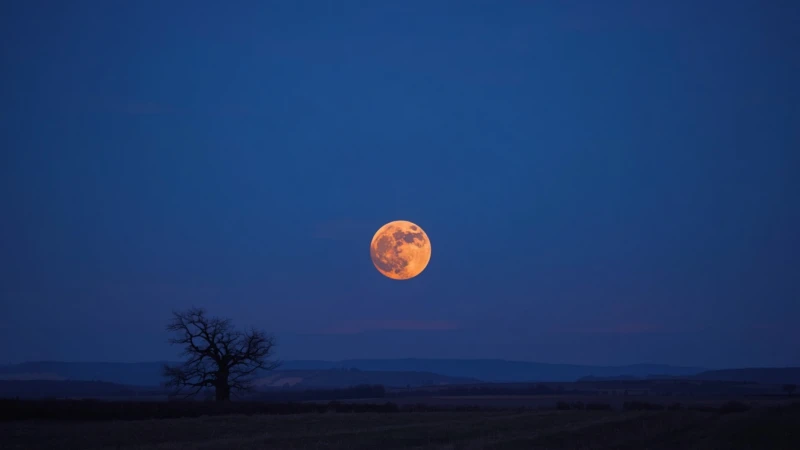
A rising Moon looks orange for the same reason a setting Sun does: its light reaches you through the thickest possible slice of the atmosphere, and air scatters blue light far more than red. By the time the Moon is a couple of hands above the horizon the colour has drained to its usual white-grey. This guide explains the physics, why some nights are redder than others, how the colour relates to the famous size illusion, and what makes the deep red of a lunar eclipse a different effect altogether.
The atmosphere as a colour filter
Air molecules scatter light by a process called Rayleigh scattering, and its strength rises steeply as the wavelength gets shorter: in proportion to one over the wavelength to the fourth power. Blue light at 450 nanometres is scattered nearly six times as strongly as red light at 700. Looking straight up, moonlight crosses one atmosphere’s worth of air and loses only a little blue, so the Moon looks white. Looking at the horizon, the line of sight runs through the atmosphere sideways and crosses about 38 times as much air. Most of the blue and much of the green is scattered out of the beam before it reaches you, and what is left is orange. The scattered blue is not lost; it is what makes the sky blue for someone a few hundred kilometres further along the path.
This is why the rising Moon and the setting Sun share the same colours. The Moon is simply reflected sunlight, and the atmosphere does not care where the light started.
How fast the colour fades
The thickness of air along your line of sight falls quickly as the Moon climbs. At 5 degrees altitude the beam crosses about 10 atmospheres, at 10 degrees about 5.6, at 30 degrees about 2. So the deep orange lasts only while the Moon is within a few degrees of the horizon, perhaps twenty minutes on a typical night, and by the time it is a hand’s width up, about 10 degrees, it is a pale yellow. From Dallas on the night of the Beaver Moon, November 24, 2026, the Moon rises at 5:17 PM and is 10 degrees up by about 6:15 PM; the orange show is the first half hour. The moon calendar gives the moonrise time for any night from your city.
Why some nights are redder than others
Molecules give the baseline orange. Anything larger in the air pushes it toward red:
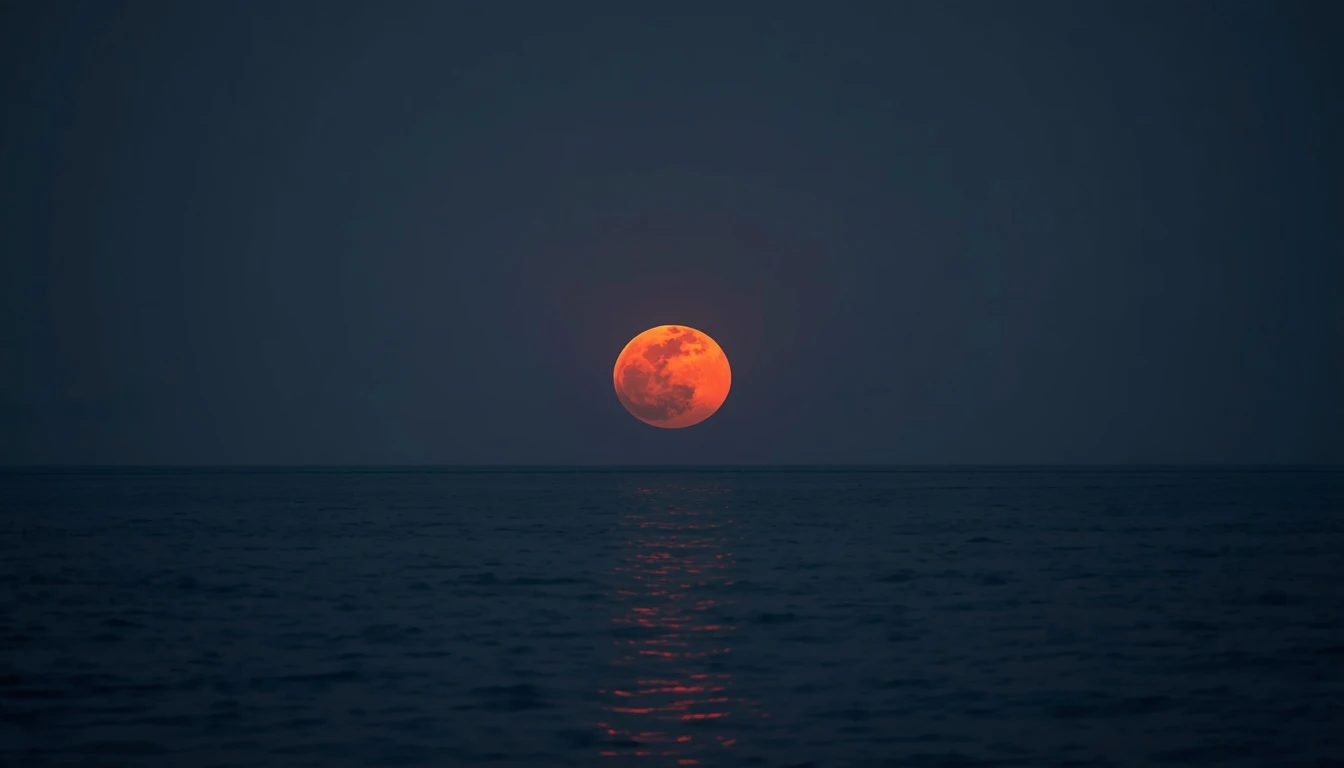
- Dust, smoke and haze. Particles larger than molecules scatter by a different mechanism, Mie scattering, which affects all colours more evenly but still removes more blue than red and dims the whole disc. Wildfire smoke, Saharan dust and city haze all produce the deep red, dim, sometimes blurred Moons that get photographed.
- Humidity. Water vapour and the tiny droplets of a humid evening add to the scattering, which is why summer moonrises over the sea are often more coloured than dry winter ones.
- Volcanic eruptions. Sulphate aerosols high in the stratosphere after a large eruption can keep moonrises and sunsets blood-red for months, and in extreme cases turn the Moon blue by scattering red preferentially; that is one origin of the phrase “once in a blue moon”.
The flattened shape you sometimes see at the horizon is a separate effect, refraction: the air bends the light from the lower limb more than the upper, squashing the disc by a few arcminutes. Refraction also lifts the whole Moon by about its own diameter, so when the lower edge appears to touch the horizon the Moon is geometrically already fully below it.
Colour versus size
People often say the rising Moon is both huge and orange, and the two get bundled together, but they have different causes. The colour is physical, as above. The size is in your head: the Moon’s apparent diameter at the horizon is in fact a fraction smaller than when it is overhead, because you are then further from it by the Earth’s radius. The brain enlarges it by comparing it with trees and buildings. Our guide to the Moon illusion covers that; the quick test is to look at the risen Moon through a cardboard tube that hides the landscape, and watch it shrink.
The red of a lunar eclipse is something else
During a total lunar eclipse the Moon is high in a dark sky and still turns deep red or copper. There the filter is not the air between you and the Moon but the ring of Earth’s atmosphere seen from the Moon: sunlight grazing the edge of the Earth is reddened and bent inward by the atmosphere into the shadow, so the eclipsed Moon is lit by the combined light of every sunrise and sunset on Earth at once. The same physics, applied at the far end of the path. How dark and how red the eclipse gets depends on how much dust and cloud is in Earth’s atmosphere that day, which is why eclipse colours are graded on a scale and compared between events. The next total lunar eclipses are listed on our eclipses page.
Seeing it well
- Catch the Moon on the horizon, which means knowing the time and direction of moonrise. The night after full moon is best, since the Moon rises after sunset into a dark sky; our guide on where the Moon rises explains the direction.
- A low, flat, distant horizon, over sea or plain, shows the deepest colour, because the Moon is visible at the lowest altitude where the air path is longest.
- For photographs, a long lens, a short exposure for the disc, and a few frames a minute as the colour changes. The orange Moon is bright enough to photograph handheld at 1/250 second; the dim red smoke-filtered Moon is not.
The orange does not mean anything about the weather to come, the Moon, or the harvest. It means you are looking through a lot of air, which on a clear night is a fine thing to be doing.