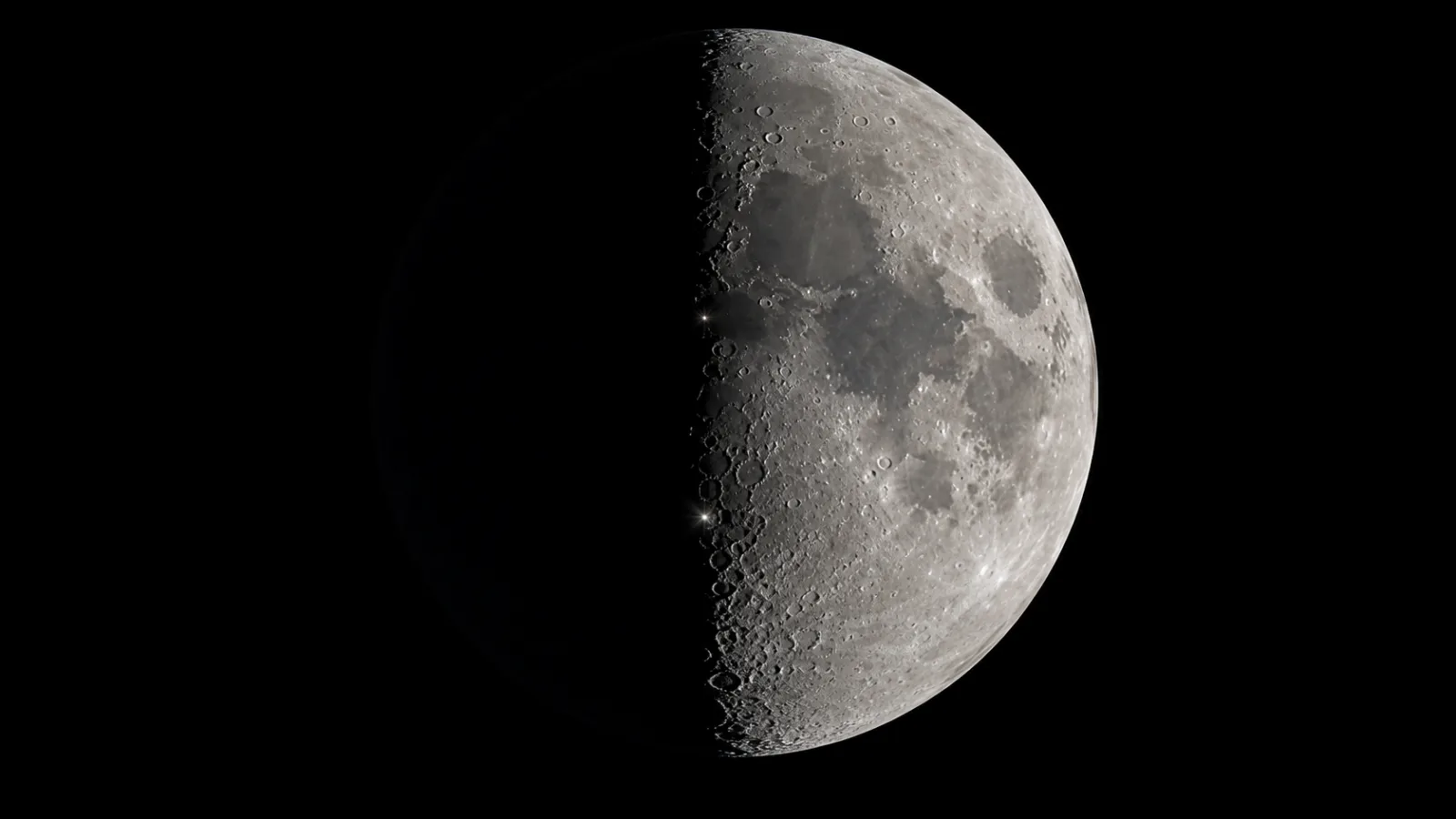
Three of the Moon’s best-known tricks of light are the Lunar X, the Lunar V and the Jewelled Handle. None of them is a real structure. Each is a few crater rims or mountain peaks catching the first sunlight while the ground around them is still dark, so each lasts only a few hours and depends on the exact position of the terminator. The X and V appear together a few hours to a day before first quarter; the Handle appears two to four days after it. This guide explains what they are, how to work out the time from a first-quarter date, and when the next ones fall.
What you are looking at
The Lunar X, also called the Werner X or Purbach Cross, forms where the rims of three craters meet: Blanchinus, La Caille and Purbach, in the southern highlands just east of the Moon’s central meridian, about 25 degrees south of the lunar equator. When the sunrise terminator lies a degree or two east of that spot, the high rims are lit from the side while the crater floors are still in shadow, and the lit ridges form a bright, slightly lopsided X. Any small telescope shows it; large binoculars on a tripod can just catch it as a bright speck on the terminator.
The Lunar V appears at the same time near the equator, a little north of the X, at the crater Ukert and the small hills around it. Look along the terminator from the X toward the Moon’s centre and the V is the bright chevron about a third of the way up the disc.
The Jewelled Handle, sometimes called the Golden Handle, is a different effect in the north-west. Sinus Iridum, the Bay of Rainbows, is a bay on the edge of Mare Imbrium rimmed by the Jura Mountains. When the terminator sits just west of the bay, the mountain tops are lit while the bay floor is still dark, and the lit arc of peaks hangs off the terminator like the handle of a cup. It is bigger and brighter than the X, easy in 10×50 binoculars, and lasts most of a night.
Why the timing is not simply “at first quarter”
The X is lit when the sunrise terminator reaches selenographic longitude 1 to 2 degrees east. First quarter, the moment the Moon is exactly half lit as seen from Earth, happens when the terminator passes through the centre of the disc as we see it. Those two things would coincide if the centre of the Moon’s disc always sat on the Moon’s zero meridian. It does not. Because of libration, the slow wobble of the Moon’s face, the apparent centre of the disc can lie up to about 8 degrees east or west of the zero meridian on any given date.
The terminator sweeps westward across the Moon at about 0.5 degrees an hour, so every degree of offset moves the X by roughly two hours. When the disc centre is displaced to the west (negative libration in longitude), the terminator reaches the X’s longitude long before it reaches the apparent centre of the disc, and the X appears well before first quarter, sometimes 18 hours before. With a large eastward libration the X can turn up after first quarter. That is why published lists of X times range from a dozen hours before first quarter to several hours after, and why “the night of first quarter” sometimes misses it entirely.
A practical rule you can run yourself:
- Take the first-quarter time from our first quarter page or the moon calendar.
- Subtract about four hours. That is the X for a month with no libration in longitude.
- Look up the libration in longitude for that date (NASA’s Dial-a-Moon page gives it for any hour). For each degree west, subtract a further two hours; for each degree east, add two hours.
- The X is visible for roughly four hours around that moment, the V for about the same, and the X fades once the floors of the three craters fill with light.
The next Lunar X: November 16, 2026
First quarter falls on Tuesday, November 17, 2026 at 11:47 UTC (5:47 AM Central). The libration in longitude that day is about 5 degrees west, which pulls the X well ahead of first quarter. NASA’s ephemeris puts the Sun’s colongitude at 358 degrees, the classic value for the X, at about 20:00 UTC on Monday, November 16, and a UK observers’ table lists the peak at 18:45 UTC the same evening, so the X should be in view from roughly 18:00 to 22:00 UTC on November 16.
Who gets to see it:
- Europe, Africa and the Middle East: the best seats. The 41%-lit Moon is in the evening sky in full darkness while the X is at its peak.
- The Americas: the window falls between noon and 4 PM Central. In Dallas the Moon rises at 12:45 PM that day, so the X is up, but in daylight. A telescope will show it against the blue sky if you can find the Moon, and the eastern United States has the better chance toward the end of the window; by nightfall the X has gone.
- Asia and Australia: the Moon has set before the X forms. The V and X are gone by the next evening, but the terminator will show plenty else.
The Jewelled Handle follows two to four days later, on the evenings of November 19 to 21, when the Moon is a 65 to 85 percent gibbous in the evening sky for everyone. Look at the north-western edge of the lit part for the bright arc.
The month after, the UK table gives the X at about 08:50 UTC on December 16, a morning event for Asia and Australia and a daylight one for Europe, with the Moon set from the Americas. Because the cycle of phases takes 29.5 days, each month’s X comes about 12 hours later by the clock, and libration can shift it by most of a day either way, so observers in any one time zone get a good, dark-sky X only a few times a year. Check the first-quarter times on this site, apply the rule above, and you will know your next one.
Observing tips
- Find the terminator first. The X is on the dark side of the line, which is why it looks like a lit letter floating in shadow. Start at the middle of the terminator and move south about a quarter of the way to the limb.
- Use moderate power. 50x to 100x in a small telescope frames the X with the craters around it. More power shows the three rims separately and spoils the illusion.
- Watch it change. Over an hour the arms of the X thicken as sunlight creeps down the crater walls. By the end of the window the floors are lit and the pattern dissolves into ordinary craters.
- Photograph it with a phone. Hold the phone to the eyepiece, use the 2x or 3x lens if you have one, and take a burst; the sharpest frame will show the X clearly.
- Daylight is not a dealbreaker. If your X falls in the afternoon, the Moon is still there. Contrast is low but a telescope at 80x will show the terminator features. A polarising filter helps.
Other clair-obscur effects worth a look
Astronomers call these shadow plays clair-obscur effects, after the painting term for strong contrasts of light and dark. Beyond the three above, keep an eye out for the Eyes of Clavius, two craters on Clavius’s floor that light up like eyes just after the big crater’s rim emerges from the night, around nine days after new moon; and the Curtiss Cross near Fra Mauro, a fainter X visible around 10 days after new moon. All of them are reasons to look at the Moon on the nights when it is half lit rather than full. The full moon is the worst time for detail, because the Sun is overhead everywhere on the near side and there are no shadows at all. For what the terminator looks like on any night, see our explainer on why the Moon has phases.