
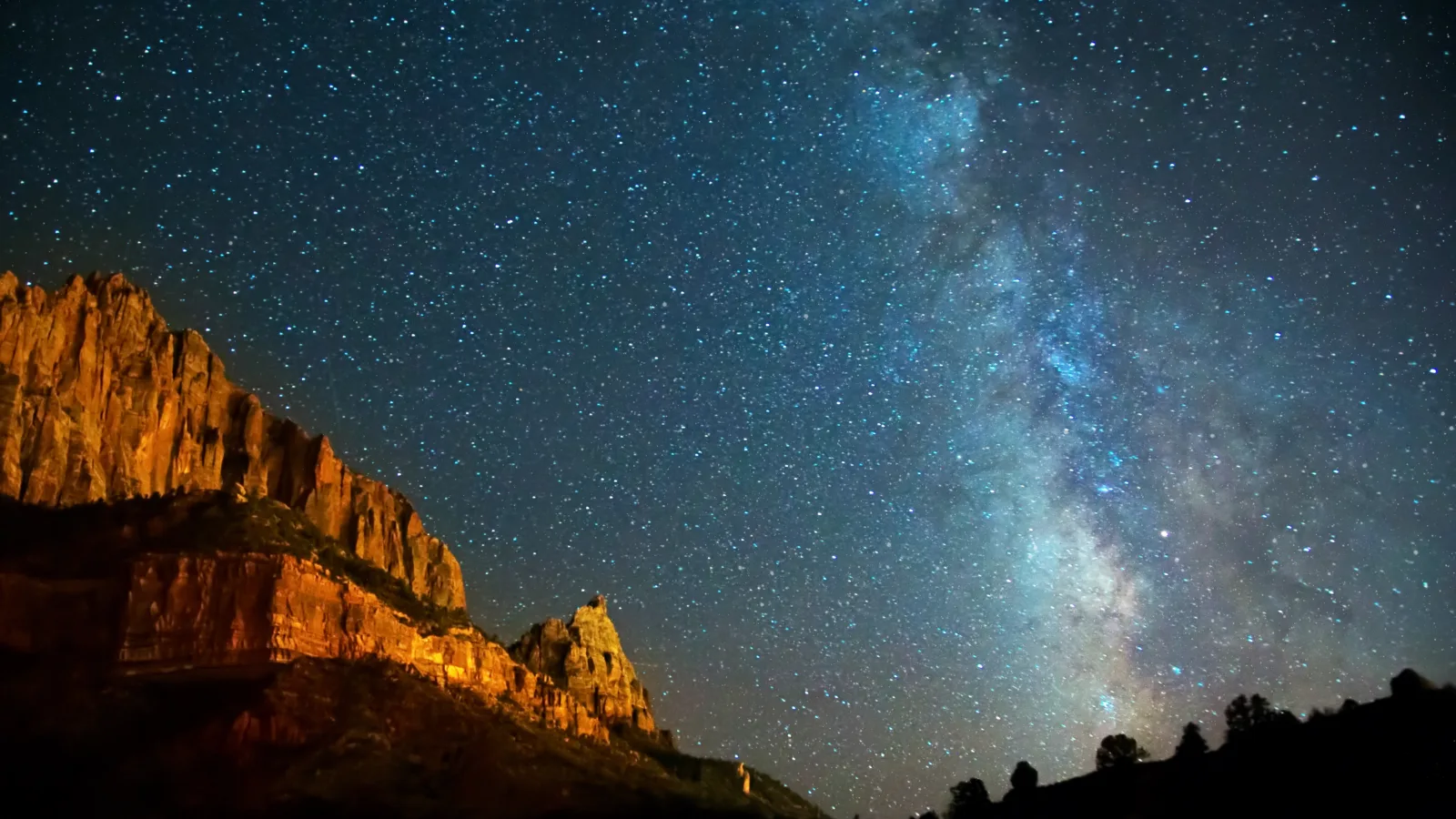
This is a good week to get reacquainted with the evening sky. A young Moon slides past Venus on Monday, grows to first quarter on Friday, and by the weekend Saturn is rising at nightfall and climbing high after midnight, three weeks from its brightest of the year. Here is what to look for each evening from September 14 to 20, 2026, with times from this site’s engine. All times below are UTC unless a city is named; the event pages convert them to your time zone.
Monday, September 14: the Moon meets Venus
Low in the west after sunset, a three-day-old crescent Moon passes Venus. Our calculation puts the closest approach at 11:35 UTC on September 14, with the two just half a degree apart, about the width of the full Moon. From the Americas that moment falls in daylight, so the pairing is widest at dusk on Sunday and Monday evenings; from Asia and Australia the Monday evening view is the closer one. Venus is dazzling at magnitude −4.5, but it is sinking toward the Sun ahead of its inferior conjunction on October 24, so it sits low. From Manila it is still about 22 degrees up at the end of twilight; from Dallas only 11 degrees. Find a clear western horizon and look within the first hour after sunset. Earthshine, the faint glow on the Moon’s dark side, is easy to see through binoculars at this age.
Tuesday to Thursday: the crescent climbs past Antares
Each evening the Moon stands higher and further left, thickening from crescent toward half. On Tuesday and Wednesday it passes above Antares, the red heart of Scorpius, low in the south-west. Compare the colours: the star is distinctly orange next to the Moon’s grey-white. These are also the last good evenings for the Sagittarius Teapot, the asterism that marks the direction of the Milky Way’s centre, before it drops into the twilight for the year.
Friday, September 18: first quarter
The Moon reaches first quarter at 20:43 UTC, 3:43 PM in Dallas and 4:43 AM Saturday in Manila. This is the best phase for a small telescope or binoculars. Along the terminator, the line between the lit and dark halves, the low Sun throws long shadows across the craters, and the view changes visibly over a single evening. Look for the great crater Copernicus just emerging into sunlight over the next two nights.
Saturn: rising at nightfall
Saturn reaches opposition on October 4 at 14:04 UTC, so this week it rises as darkness falls and is up all night. From Dallas on September 15 it stands 42 degrees high in the south-east by midnight and is still 24 degrees up in the west at dawn; from Manila it climbs to 69 degrees by midnight. At magnitude 0.7 it is the brightest point in its patch of sky in Aquarius, steady and yellowish where stars twinkle. Any telescope shows the rings, which are opening again after appearing edge-on in 2025.
Neptune, too, is at its best
Neptune reaches opposition on September 26 at 01:08 UTC, so it is as close and bright as it gets this year, though “bright” for Neptune means magnitude 7.8, a binocular object at best. It lies near Saturn in the same part of the sky, which makes this an unusually easy year to find it: sweep the area with binoculars or a small telescope using a finder chart, and look for a faint, slightly blue star that does not appear on the chart.
Before dawn: Jupiter and Mars
The morning sky belongs to Jupiter, blazing at magnitude −1.8 about 30 degrees up in the east before sunrise from both Dallas and Manila, with Mars higher still at magnitude 1.2 but much fainter. Jupiter is heading toward its own opposition next year; for now it is a superb pre-dawn target, its four large moons visible in any binoculars held steady against a wall.
Looking ahead
The Harvest Moon comes on September 26 at 16:49 UTC, and the Moon puts on a run of planet encounters in early October: near Mars on October 5, extremely close to Jupiter on October 6, and near Venus and Mercury on October 12, the same day Mercury reaches its greatest evening elongation. The Draconid meteor shower peaks on October 8 with a nearly moonless sky. All of these are on the events calendar, and you can check moonrise, moonset and the planets for your own city on the home page and the planets page.