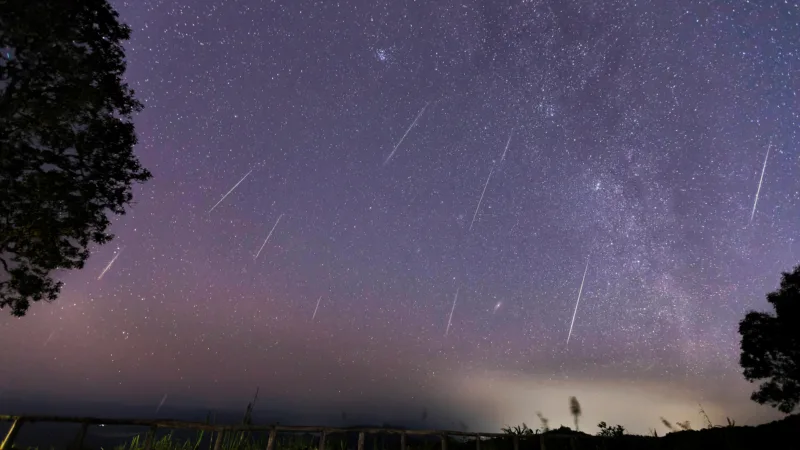
The Orionid meteor shower peaks before dawn on Wednesday, October 21, 2026. These are pieces of Halley’s Comet, hitting the atmosphere at 66 kilometres a second, and at their best they produce about 20 fast meteors an hour under a dark sky. A waxing gibbous Moon, 78% lit, is up in the evening this year, but it sets before 3 AM on the peak morning, leaving three hours of dark sky with the radiant high: the best part of the night is moon-free. Times below are for Dallas in Central Time; the Orionids 2026 page converts them to your city.
When to watch
Our calculation puts the peak at 4:24 AM Central Time on October 21 (09:24 UTC), which falls conveniently in the pre-dawn hours for North America. The radiant, the point the meteors appear to come from, rises around 11 PM the evening before and climbs all night, reaching 73 degrees high in the south just before 6 AM. Astronomical dawn begins at 6:13 AM.
- Morning of Tuesday, October 20: the Moon, 69% lit, sets at 1:54 AM. Dark from then until dawn.
- Morning of Wednesday, October 21, the peak: the Moon, 78% lit, sets at 2:54 AM. Watch from 3 AM to 6 AM.
- Morning of Thursday, October 22: the Moon, 86% lit, sets at 3:53 AM. Two dark hours before dawn.
The Orionids do not have a sharp peak. Rates stay close to maximum for several nights around the 21st, so if the peak morning is cloudy, the mornings either side are nearly as good. The shower is active from October 2 to November 7, and a few Orionids can be seen on any dark morning in that span.
Where to look
The radiant lies in the raised club of Orion, a little north of the bright orange star Betelgeuse, near the border with Gemini. You do not need to find it precisely. Face south-east to south after 3 AM with Orion in view and look about halfway up the sky, a hand-span or two away from the radiant itself. Meteors close to the radiant are short; the long, dramatic streaks appear 40 degrees or more away from it, anywhere in the sky.
What Orionids look like
Orionids are among the fastest meteors of the year. At 66 kilometres a second they are quick, often faint, and a good fraction leave a glowing trail, called a train, that hangs for a second or two after the meteor has gone. The brighter ones can be yellowish or greenish. Because many are faint, a dark site makes a large difference: under suburban skies expect perhaps 5 to 10 an hour at the peak instead of 20.
Pieces of Halley’s Comet
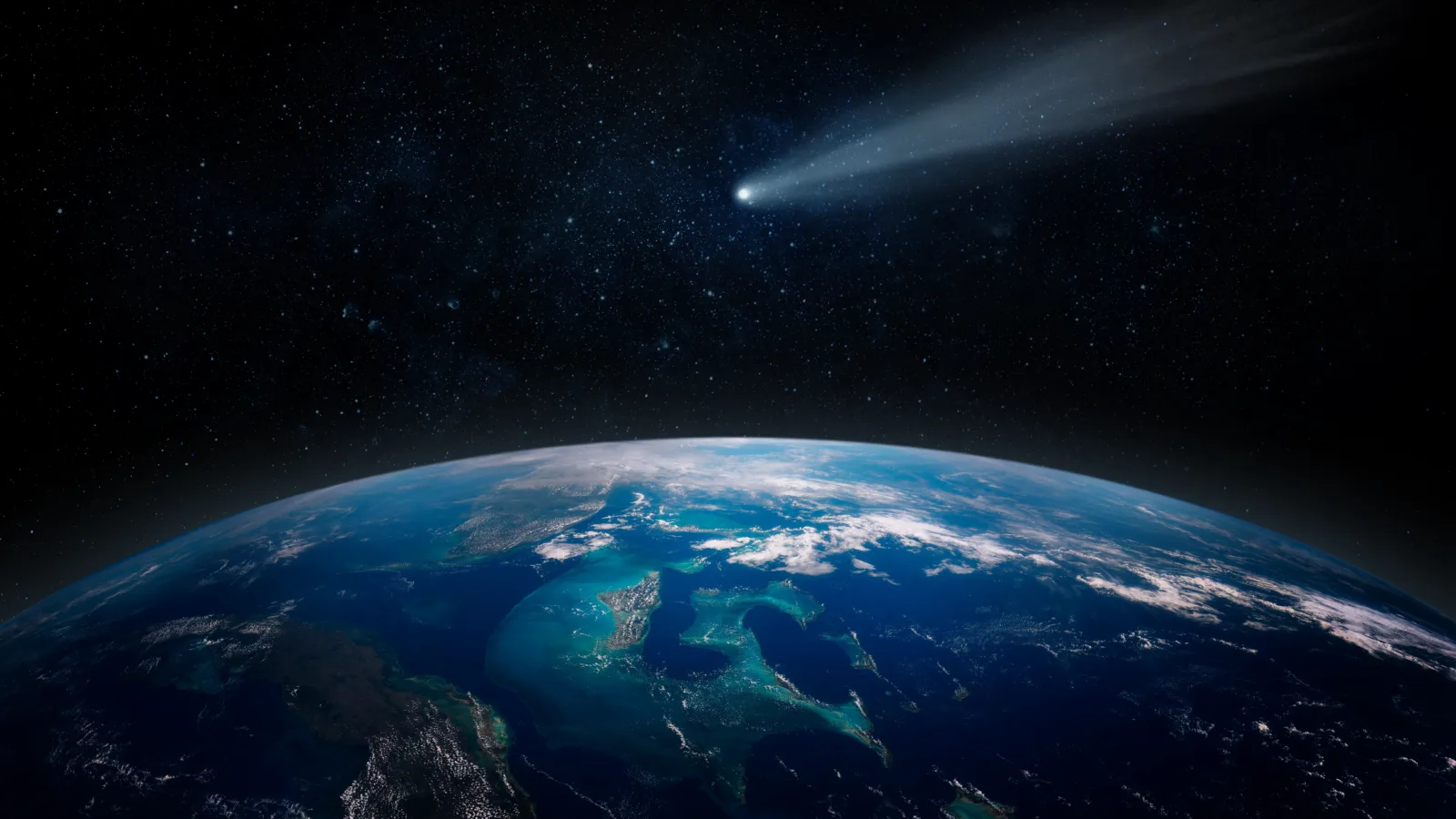
Every Orionid is a grain of dust shed by comet 1P/Halley on one of its past trips around the Sun. Halley itself was last here in 1986 and will not return until 2061, but its debris is spread along the whole orbit, and Earth crosses that stream twice a year: in early May, producing the Eta Aquariids, and in late October, producing the Orionids. Until 2061, these two showers are the closest most of us will get to the famous comet.
The Orionids are usually a medium-strength shower, but not always. From 2006 to 2009 they produced two to three times the normal rates for several nights in a row, the result of dust trapped in a resonance with Jupiter. Nothing unusual is predicted for 2026, so plan for the normal 20 an hour and treat anything more as a bonus.
How to watch
- Set the alarm for 3 AM on the 21st rather than staying up. The evening is moonlit and the radiant is low; the hours before dawn are when the shower performs.
- Give it at least an hour. Meteors come in bursts with gaps between them, and your eyes need 20 minutes to adapt to the dark.
- Lie back. A reclining chair or a blanket on the ground lets you take in a wide patch of sky without a stiff neck. Dress for a cold late-October morning.
- No telescope or binoculars. Meteors need the widest view you have, which is your own eyes.
- Keep the phone away, or dim it to its lowest red setting. One glance at a bright screen costs you several minutes of night vision.
- Photographing them? Our guide to photographing a meteor shower has the camera settings.
The sky around the shower
The pre-dawn sky gives you plenty to look at between meteors. Jupiter is brilliant in the east in Leo, with fainter orange Mars above it. Orion itself, Sirius below it, and the Pleiades high in the west fill the rest of the view. Four days after the peak comes the Hunter’s Moon, and after it the Moon is out of the evening sky again for the Taurids in early November. Dates and moon conditions for every shower of the year are on the meteor shower calendar.