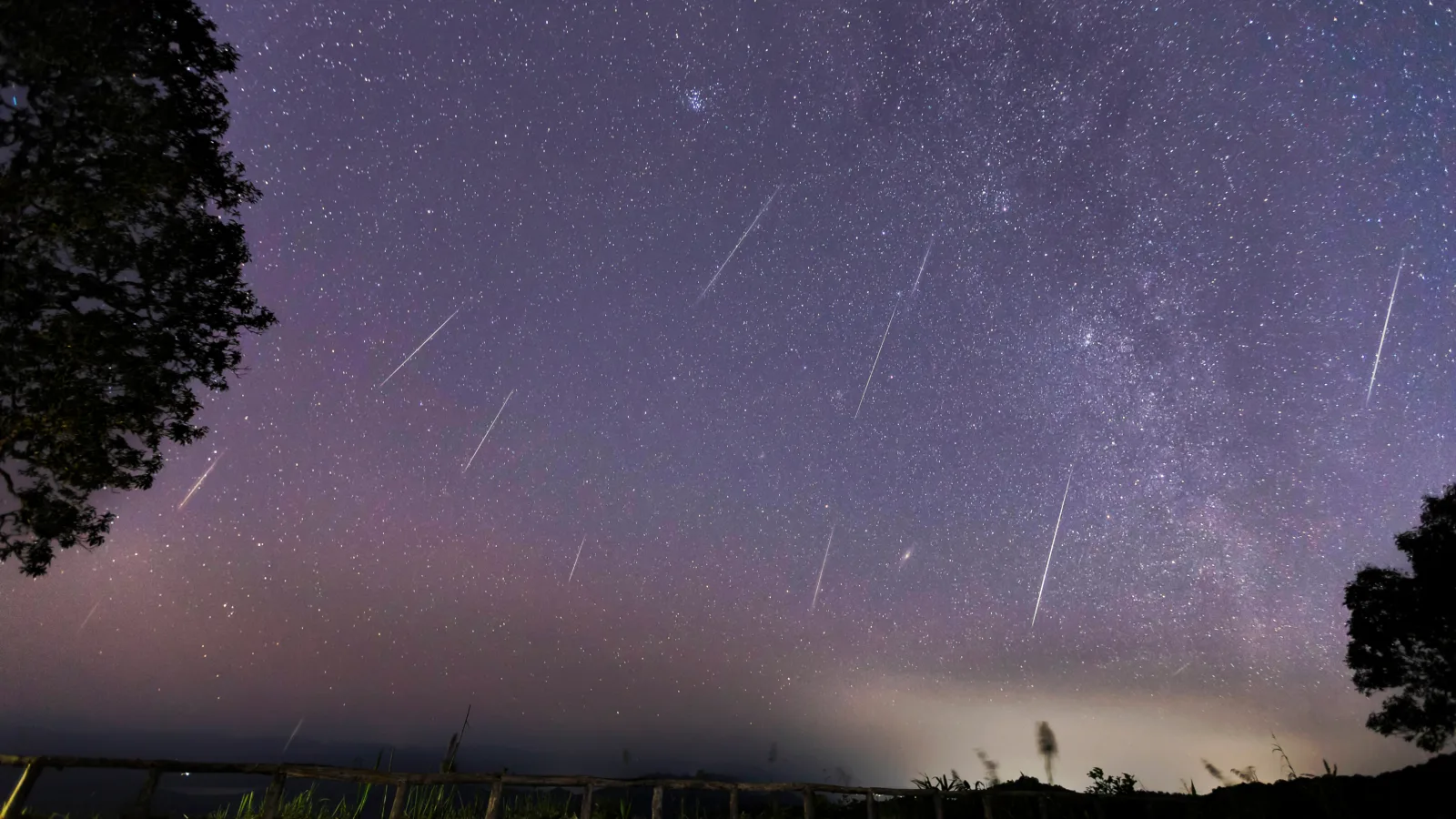
The Draconid meteor shower peaks on Thursday, October 8, 2026, and this year it comes with the one thing a faint shower needs most: no Moon. The Moon is a 4% crescent that rises only just before dawn, so the evening sky is fully dark. Expect a modest display, up to about 10 meteors an hour under a good sky and often fewer, but the Draconids have two quirks that make them worth an evening: they are best right after nightfall rather than in the small hours, and they are famous for sudden, unpredictable outbursts. None is forecast for 2026, which makes this a relaxed watch rather than a must-see, but relaxed evenings are exactly what October is for. Times below are for Dallas; the Draconids 2026 page adjusts them to your city.
When to watch
Our calculation puts the peak at 16:12 UTC on October 8, which is 11:12 AM Central Time, in daylight for the United States. Other forecasters place it a few hours later, into the early hours of October 9 UTC. Either way, the practical advice is the same: watch on the evening of Thursday, October 8, from the end of twilight, about 8 PM in Dallas, until around midnight, and give the evening of Wednesday, October 7, and Friday, October 9, a look as well. The shower is active from October 6 to 10, and rates fall off quickly away from the peak night.
Why the Draconids are an evening shower
Most meteor showers are best after midnight, when your side of the Earth faces forward into the stream of debris. The Draconids are the exception because their radiant, the point in the sky the meteors appear to stream from, lies in the head of Draco near the bright stars Eltanin and Rastaban. From mid-northern latitudes that part of the sky is highest in the north-west as darkness falls and sinks through the night. So the Draconids are a shower for people who go to bed at a sensible hour. Face north or north-west, but do not stare at the radiant itself; meteors near it have short trails, and the longer streaks appear 40 degrees or more away.
What you will see
Draconids are among the slowest meteors of the year, entering the atmosphere at roughly 20 kilometres per second, a third of the speed of the Perseids. That shows: they drift across the sky rather than flash, often yellowish, and easy to follow with the eye. With a 4% Moon out of the way, even faint members register from a dark site. Under suburban lights the count may drop to a handful in an hour, so if you can drive 30 minutes away from town, this is a good night to do it.
The comet behind the shower and the outburst question
The Draconids come from comet 21P/Giacobini-Zinner, which circles the Sun every six and a half years and was last at perihelion in March 2025. When Earth crosses a fresh, dense strand of the comet’s debris, the shower explodes: in 1933 and 1946 observers counted thousands of meteors an hour, and smaller outbursts came in 2011 and 2018. Because the comet passed close only last year, some hoped 2026 might bring a repeat. The models say no: Earth misses the dense trails this time, and forecasters expect a normal year. The lesson from history is that the Draconids do not always follow the models, so if you are outside anyway, keep looking up.
How to watch well
- Start about an hour after sunset and plan on at least 45 minutes; the first 20 are for your eyes to adapt.
- Bring a reclining chair or a blanket, and dress for a cold night. October evenings drop fast once the Sun is gone.
- No telescope, no binoculars. Meteors need the widest view you have, which is your own eyes.
- Keep your phone screen off or on its dimmest red setting.
- Saturn is at its brightest for the year this week, high in the south-east; it makes a good target while you wait between meteors. See our Saturn at opposition guide.
If the Draconids are quiet
October has a second, stronger shower. The Orionids peak in the early hours of October 21 with up to 20 meteors an hour, though a 75% Moon interferes until it sets. And the moonless window that makes this week so good, from October 7 to 13 around the new Moon of October 10, is also the best of the month for the Milky Way, which arches overhead in the early evening. Dates and moon conditions for every shower of the year are on the meteor shower calendar.