
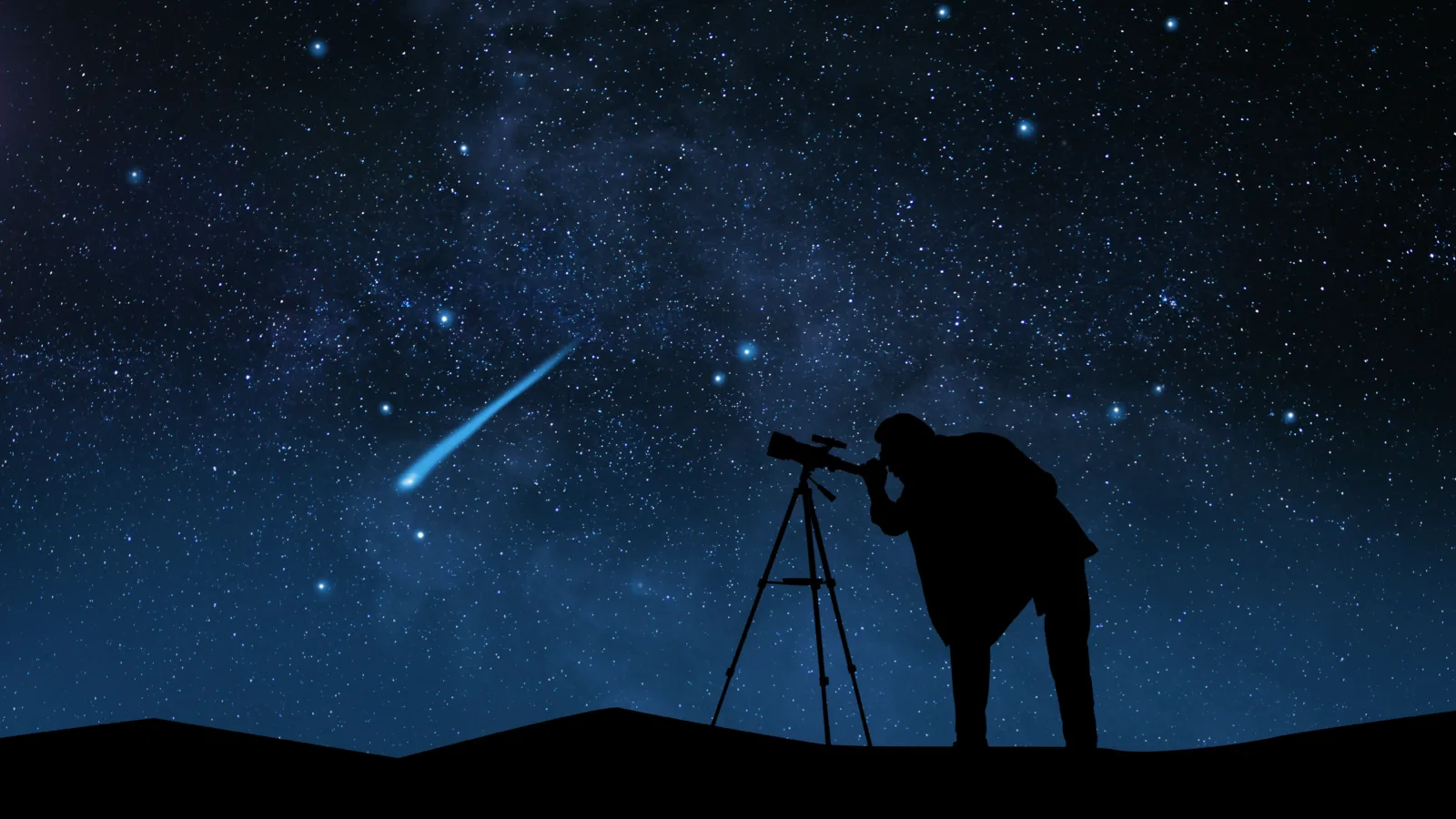
A photograph of a meteor shower is mostly a photograph of patience: hours of identical frames, a handful of which catch a streak. The reward is an image the eye can never see, dozens of meteors stacked into one sky, or a single bright fireball cutting through star trails. This guide covers the gear, the settings, the planning, and the four showers still to come in 2026 that are worth the lost sleep.
Pick the right shower and the right night
Two things decide whether a night is worth shooting: the shower’s rate and the Moon. Using this site’s calendar for the rest of 2026:
- Draconids, peak October 8 at 16:12 UTC. Usually modest, around 10 meteors an hour, but the Moon is only 4 percent lit, and this shower is unusual in being best in the evening rather than after midnight. A good low-effort first attempt.
- Orionids, peak October 21 at 09:24 UTC. Fast meteors from Halley’s Comet, up to 20 an hour, but a 75 percent Moon will wash out the fainter ones. Shoot after moonset or frame away from the Moon.
- Leonids, peak November 17 at 14:53 UTC. The fastest meteors of the year and often bright, with a half-lit Moon that sets around midnight, leaving dark hours before dawn.
- Geminids, peak December 14 at 04:51 UTC. The year’s best, up to 150 an hour under a dark sky, and the Moon is only 22 percent lit and rises late. If you shoot one shower in 2026, shoot this one.
The Ursids on December 22 face a 96 percent Moon and are not worth the cold. For all of these, the night of the peak and the night before are both productive, and the hours after midnight are best because your side of Earth is then facing into the stream.
Gear that works
Any camera with manual exposure will do, including recent phones in a night or pro mode, but a mirrorless or DSLR with a fast wide lens is the tool for the job. Something between 14 and 24 millimetres at f/2.8 or faster captures a large patch of sky and gathers enough light in a short exposure to record faint meteors. A sturdy tripod is essential, and an intervalometer, built into most cameras now, lets you shoot continuously without touching the body. Bring spare batteries; cold nights drain them fast, and a shower session can run four hours. A small red torch preserves your night vision.
Settings
Start with manual mode, ISO 3200, the lens wide open, and an exposure of 15 to 25 seconds, adjusting so the stars are just about to trail. Focus manually on a bright star using live view at maximum magnification, then tape the focus ring. Turn off long-exposure noise reduction, which doubles the gap between frames, and turn off image stabilisation on a tripod. Shoot raw. Set the intervalometer to fire continuously with the shortest possible gap; a meteor that arrives during a one-second gap is simply lost.
Where to aim
Do not point at the radiant, the spot the meteors appear to come from. Meteors near the radiant are short and foreshortened; the long, dramatic streaks appear 40 to 60 degrees away from it. Frame a wide view with the radiant just outside or at the edge of the picture, include some landscape at the bottom for scale, and keep the Moon out of the frame if it is up. The site’s shower pages report how high the radiant climbs from your city, which tells you which direction and how high to aim.
Processing: the stacked shower image
Those famous pictures showing dozens of meteors in one sky are composites, and there is nothing dishonest about them if you say so. The method: pick one base frame for the sky and landscape, then in each frame that caught a meteor, mask just the streak and layer it onto the base, aligned to the stars. Free tools and most editors handle it. The alternative is to let the stars trail deliberately, stacking every frame so the stars draw arcs around the pole while the meteors slash through them, the style behind the striking Perseid images from Egypt’s Western Desert this August, where circular star trails and straight meteor streaks make an unmistakable contrast.
Plan the location
Dark sky first: light pollution costs you more meteors than any camera setting. Check the Moon’s rise and set for your city on the moon calendar for the night you choose, aim to shoot when it is below the horizon, and confirm the radiant’s altitude on the shower’s page under meteor showers. Then dress warmer than seems reasonable, set the camera running, lie back, and watch with your own eyes while it works. The camera catches the streaks; you catch the ones it misses.