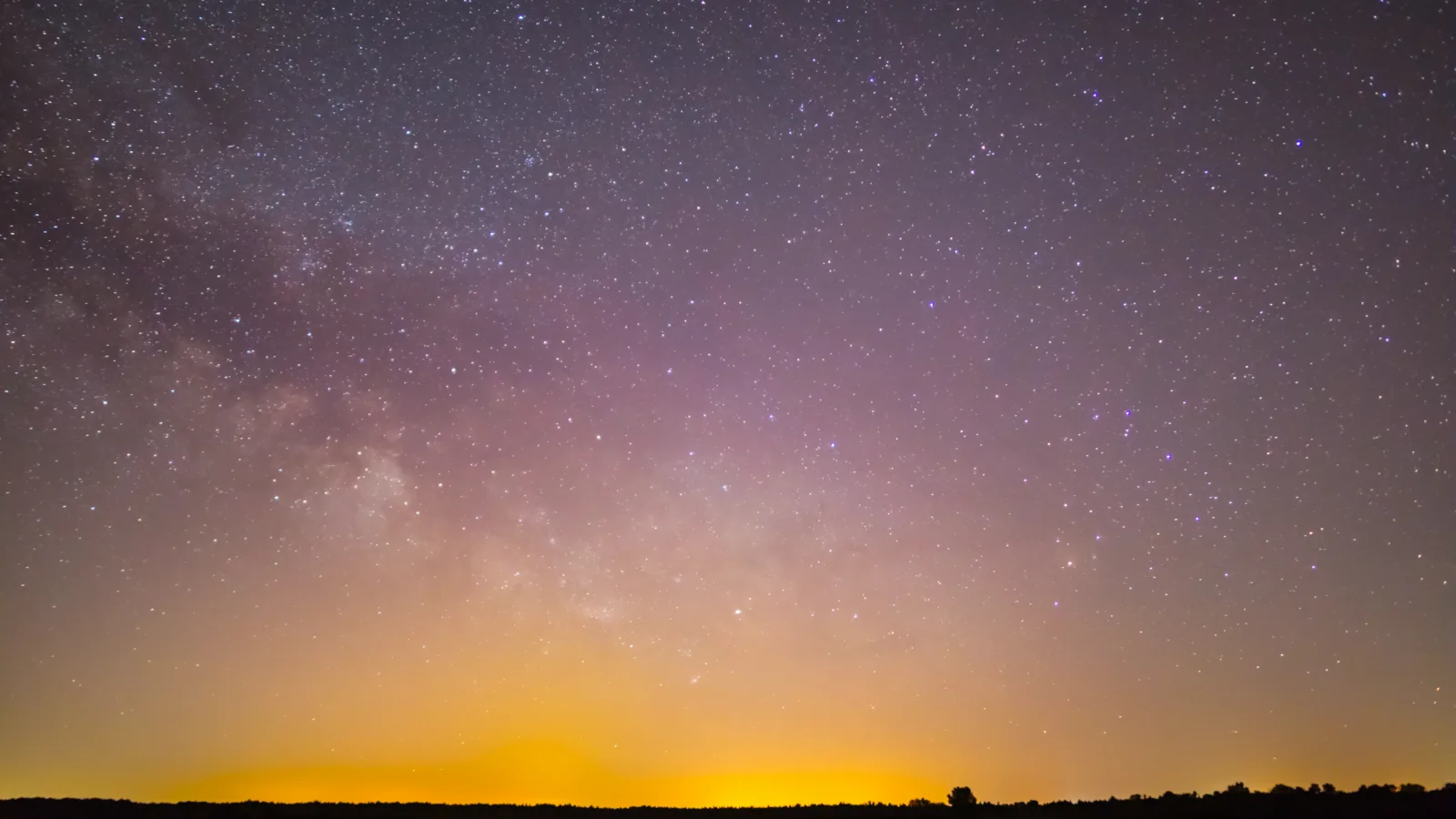
Every September, in the hour before dawn, a faint cone of light leans up from the eastern horizon. It is not the first hint of sunrise, though sailors and desert travellers named it the false dawn for that reason. It is sunlight scattered by countless dust grains orbiting the Sun in the plane of the planets, and September 2026 offers two clean windows to see it: roughly September 12 to 21 and October 11 to 20, when the Moon is out of the pre-dawn sky.
What you are actually looking at
The zodiacal light is the glow of the inner solar system’s dust cloud, shed over millions of years by comets and by collisions between asteroids. The grains are tiny, most of them under a tenth of a millimetre, but there are so many of them, spread through the plane of the ecliptic, that together they reflect enough sunlight to be seen from a dark site. The light is brightest near the Sun and fades along the zodiac, which is why it appears as a tilted wedge with its base at the horizon and its tip pointing along the line the planets follow.
Because the dust lies in the plane of the planets, the glow follows the ecliptic. Whether you can see it depends on how steeply that line stands above your horizon. From mid-northern latitudes the ecliptic is steep in the pre-dawn eastern sky in autumn, which lifts the cone clear of the horizon murk. That is why September and October mornings are the classic season for northern observers. In the southern hemisphere the same geometry applies to the evening sky in autumn, so look west after twilight ends in March and April, or right now in September low in the west after dusk.
When to look in 2026
The one thing that ruins the zodiacal light is moonlight. Even a fat crescent washes it out. Using this site’s phase data, the new moon fell on September 11 at 03:26 UTC, and the Moon reaches first quarter on September 18. Through that week the Moon sets in the evening and the pre-dawn sky is dark, and the waxing gibbous only starts to intrude on the morning sky around September 22. So the first window runs from about September 12 to 21.
The full Harvest Moon on September 26 fills the sky all night, and the waning moon then hangs in the morning sky until last quarter on October 3. After that it thins quickly, and the next new moon on October 10 at 15:50 UTC opens the second window, October 11 to 20. By late October the ecliptic angle is still favourable in the north, so the October window can be even better than September’s if your weather cooperates.
Timing within the morning matters as much as the date. Start looking about 90 minutes before sunrise, when the sky is fully dark, and keep watching until astronomical twilight begins. For Dallas on September 15 our twilight calculator puts astronomical dawn at 5:47 AM and sunrise at 7:10 AM local time, so the best interval is roughly 5:00 to 5:45 AM. Shift those by your own location; the pattern holds anywhere at mid-northern latitudes.
Where to look and what to expect
Face east, or slightly south of east, and look for a soft, broad pyramid of light rising from the horizon and tilting to the right, along the path the Sun will take after it rises. At its base it can be as bright as the brighter parts of the Milky Way, which is also in the sky at that hour, so the two can be confused. The Milky Way arches across the sky as a band; the zodiacal light is a wedge anchored to the horizon and leaning along the ecliptic.
You need a genuinely dark site. Light pollution kills the zodiacal light long before it kills the stars, so a suburban backyard will not do. Drive to a spot with a low, open eastern horizon, give your eyes at least twenty minutes without any white light, and use averted vision, glancing to the side of where you expect the glow. Once you see it, it is surprisingly obvious; the trick is the first time.
Photographing it
The zodiacal light photographs more easily than it is seen, because a camera accumulates the faint glow in a way the eye cannot. A wide lens between 14 and 24 millimetres, an aperture of f/2.8 or faster, ISO 1600 to 3200 and exposures of 15 to 25 seconds will record the cone clearly. Longer than that and the stars begin to trail; a simple star tracker allows a minute or more and shows the wedge extending far up the sky. Compose with something on the horizon, a ridge, a tree line or a distant town’s glow at the very bottom, to anchor the scale. Shoot a sequence over half an hour to catch the cone brightening as dawn approaches, and stop when the sky turns blue.
Three things worth knowing
- The glow you see stretches all the way around the sky along the ecliptic, but only the part nearest the Sun is bright enough to notice. On very dark nights a faint oval called the gegenschein can be seen at the opposite point from the Sun.
- Space probes have measured the dust directly. The cloud is constantly replenished; without new comets and collisions it would spiral into the Sun within a few tens of thousands of years.
- Astronomers using the Juno spacecraft’s star trackers found evidence that a large share of the dust comes from Mars’s region of the solar system, a surprise that is still being studied.
Check tonight’s moon phase and moonrise for your own city on our moon calendar, and use the events pages to see what else the sky is doing during those dark mornings.