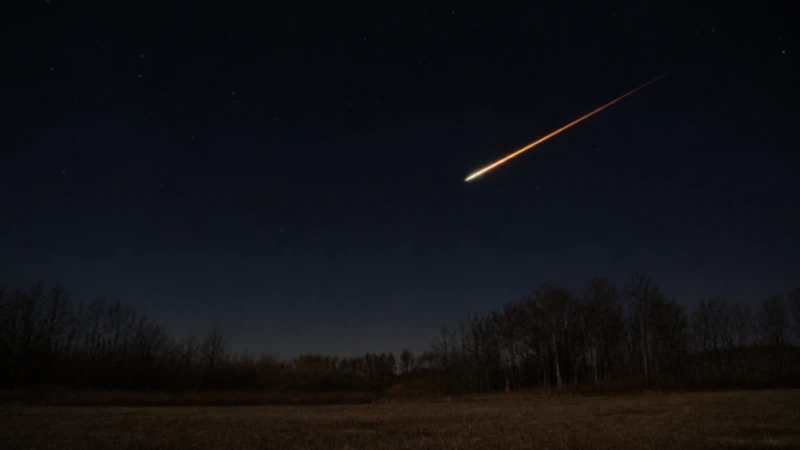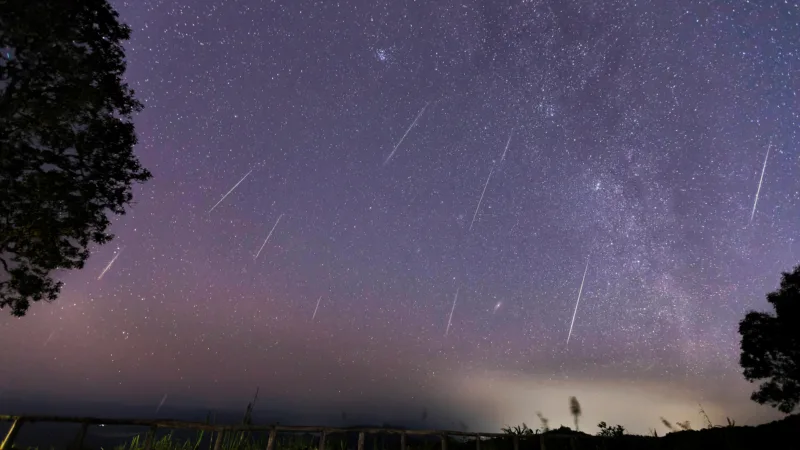
The Leonid meteor shower peaks on the night of Tuesday, November 17 to Wednesday, November 18, 2026, with 10 to 15 meteors an hour under a dark sky and a first-quarter Moon that sets around midnight, leaving the best hours, from 1 AM to dawn, moonless. No storm is forecast this year, but the Leonids are the fastest meteors of any annual shower and leave lingering trains, and their radiant this November sits beside the brightest planets in the sky. Times below are for Dallas in Central Standard Time; the Leonids page converts them to your city.
When to watch
The shower is active from November 6 to 30 with a sharp peak. Our calendar puts the maximum at 14:53 UTC on the 17th (8:53 AM Central); other forecasters put it at 0:00 UTC on the 18th (6 PM Central on the 17th). Both fall in daylight or evening for the Americas, so the two pre-dawn sessions either side are what count:
- Tuesday morning, November 17, 1 AM to 6:30 AM: the Moon set at 11:41 PM on Monday, so the sky is dark all session. Rates rising toward the peak.
- Wednesday morning, November 18, 1 AM to 6:30 AM: the Moon sets at 12:39 AM. Rates near or just past the peak; this is the better bet for the Americas if the 0:00 UTC forecast is right.
Europe and Africa get the evening of the 17th with the Moon up until about 11 PM local, then a dark morning on the 18th. For Asia and Australia the morning of the 18th local time is closest to both forecast peaks. In every case the hours after the radiant rises, about 11 PM to midnight local, and before dawn are the productive ones.
Where to look
The radiant is in the Sickle of Leo, the backwards question mark of stars with Regulus at its base, which rises in the east-north-east around 11 PM and stands high in the south by dawn. This year it has company: Jupiter and Mars, just past their November 16 conjunction, blaze about 8 degrees from the radiant at magnitudes -2.1 and 0.7. That makes the radiant the easiest to find it has ever been, and it means any meteor streaking away from the two bright planets is a Leonid. Do not stare at the radiant itself. Meteors near it are short; the long ones appear 40 to 60 degrees away. Lie back facing south-east or straight up and take in as much sky as you can. The pre-dawn sky also holds Venus, 25 degrees up in the south-east at its brightest, and Mercury below it.
What to expect
The zenithal hourly rate of 10 to 15 is a dark-sky, radiant-overhead figure. From a suburb with the radiant halfway up expect 3 to 6 an hour; from a city centre one or two. What you lose in numbers you gain in quality. Leonids hit the atmosphere at 71 kilometres per second, the fastest of any shower, so they are brief, often white or blue-white, and the brighter ones leave glowing trains that can last several seconds and drift in the high-altitude wind. One good Leonid with a train is worth an hour of cold.
Dress for a long sit, give your eyes 20 minutes to adapt, and keep your phone screen off. Our guide to photographing a meteor shower covers settings; for Leonids a wide lens, high ISO and continuous 15-second exposures catch the trains well.
The shower behind the storms
The Leonids are the shower that gave us the word “meteor storm”. On the night of November 12 to 13, 1833, observers across eastern North America saw tens of thousands of meteors an hour, a display that terrified people and launched the modern study of meteors. It happened again in 1866 and 1966, when rates over Arizona briefly reached thousands a minute, and a series of strong outbursts from 1998 to 2002 produced thousands an hour for observers in the right place.
The reason is the parent body, Comet 55P/Tempel-Tuttle, which returns every 33 years and lays down a fresh, dense ribbon of dust each time. When Earth crosses one of those young ribbons the rate soars; in ordinary years we cross only the thin, old, spread-out background. The comet last passed the Sun in 1998, the storms followed, and it returns in 2031. Forecasters do not expect a repeat of 1966, but the years around that return are the ones to watch, and modelling of the older dust trails goes on every year. For 2026 the prediction is a normal background year with no outburst.
The rest of the week
The Leonid mornings are the busiest of the month before dawn: Mars and Jupiter still within 1.3 degrees of each other on the 17th and 1.4 on the 18th, Venus at its brightest a week later, Mercury near greatest elongation on the 20th. In the evenings, the Lunar X is visible on the 16th from Europe, the Moon passes Saturn on the 20th, and Uranus reaches opposition on the 25th. The November guide has the whole month, and the moon calendar the moonset time for any night from your city.