The Moon always shows us the same face, but not quite the same face. Over a month it nods up and down by nearly 7 degrees and rocks east and west by up to 8, so that over time we can see about 59 percent of its surface rather than exactly half. The wobble is called libration, and it is the reason a crater or sea on the Moon’s edge can be an easy target one week and gone the next. This guide explains the three causes, how to judge the libration on any night with nothing but your eyes, which limb features it brings into view, and the best dates coming up.
Why the Moon wobbles
The Moon turns on its axis exactly once per orbit, which is why one hemisphere always faces us, as our article on why we always see the same side explains. But that rotation is perfectly steady, while the orbit is not, and three things let us peek around the edges.
- Libration in longitude (east-west): the orbit is an ellipse. Near perigee the Moon moves faster along its orbit than it spins, so its face runs slightly ahead and we see a little past the western limb; near apogee it lags and we see past the eastern limb. The swing is up to about 8 degrees either way.
- Libration in latitude (north-south): the Moon’s axis is tilted about 6.7 degrees to its orbit around the Earth, so for half of each month we look slightly over its north pole and for the other half over its south pole. Up to about 6.9 degrees either way.
- Diurnal libration: you are not at the centre of the Earth. At moonrise you look at the Moon from one side of the planet and at moonset from the other, about a degree of extra tilt each way, and an observer in the far north sees a touch more of the northern limb than one in the far south.
Add a small genuine wobble of the Moon’s body itself, the physical libration, which is only a few hundredths of a degree, and the apparent centre of the disc can wander anywhere within about 12 degrees of the Moon’s true centre.
Judging the libration by eye
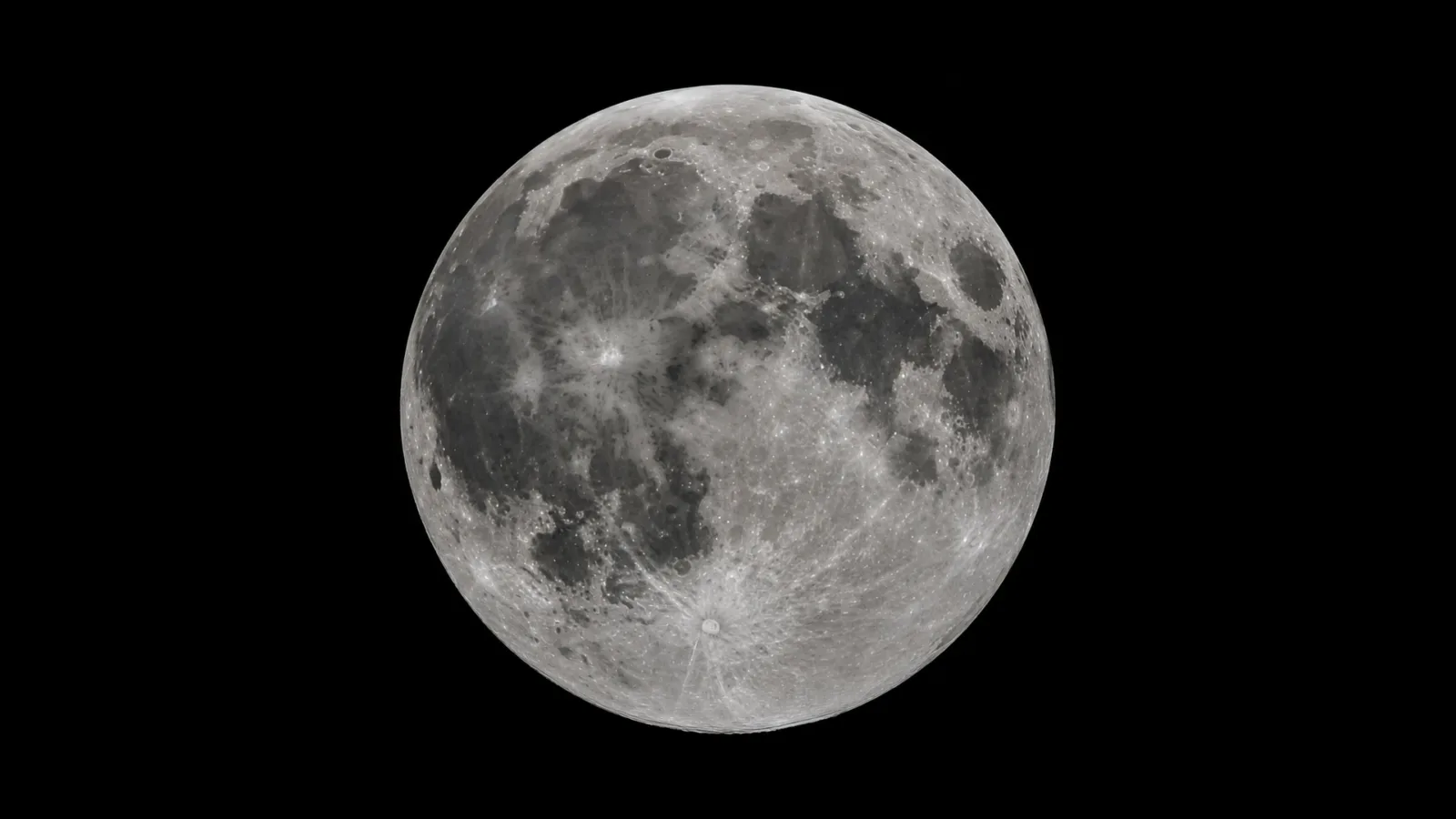
You do not need tables. Mare Crisium, the oval dark sea near the Moon’s eastern edge (the right-hand edge for northern observers), is a built-in gauge. When Crisium sits well in from the limb with a clear band of bright highland beyond it, the eastern limb is tipped toward you and the features beyond Crisium are on show. When Crisium is squashed against the edge, the Moon has rolled the other way and it is the western limb’s turn. Mare Frigoris, the long thin sea along the north, does the same job for latitude: a wide Frigoris with plenty of Moon above it means the north pole is tipped toward you.
For exact numbers, NASA’s Scientific Visualization Studio publishes the libration for every hour of the year, and the figures in this article come from that ephemeris. The two values are given as the longitude and latitude of the point on the Moon that faces the Earth: positive longitude brings the eastern (Crisium) limb into view, negative the western limb; positive latitude the north pole, negative the south.
What the limbs hide
- East limb (needs positive longitude): Mare Marginis and Mare Smythii, two seas that lie on the very edge and are only properly seen when the Moon leans our way. Mare Humboldtianum, a 270-kilometre ringed sea in the north-east, needs both an eastward and a northward libration and is one of the classic targets.
- West limb (negative longitude): Mare Orientale, the 900-kilometre bullseye impact basin that is one of the Moon’s most spectacular features from orbit and one of the hardest from Earth. Even at the best librations it is heavily foreshortened; what you can see are the concentric mountain rings, the Cordillera and Rook mountains, as bright bands along the limb, and with a large westward libration the dark lava floor itself. Grimaldi and Riccioli, two dark-floored craters nearby, are the signposts.
- South limb (negative latitude): the rugged south polar highlands, the huge crater Bailly, and Mare Australe, a patchy sea in the south-east that is best when the south and east are tipped together.
- North limb (positive latitude): the craters beyond Mare Frigoris, the pole itself, and on the north-east, Humboldtianum again.
The catch is that a favourable libration is only useful when that limb is lit. The waxing Moon is lit on its eastern side, so eastern-limb features are for the days after new moon; the western limb is lit after full moon; and anything near a pole is easiest when the Moon is nearly full, because the whole limb is lit then while the Sun still skims the poles at a low angle, so their shadows stay long.
The best dates coming up
Taking the ephemeris and the phases together, these are the windows worth marking:
- October 27 to 31, 2026: the south pole is tipped toward us by about 6.5 degrees, the maximum, while the Moon is a bright 97 to 63 percent waning gibbous rising in mid-evening. From the 29th the longitude also turns slightly east, so the south-eastern limb and Mare Australe are well placed. With the Moon rising between 7:38 and 11:57 PM in Dallas, this is a late-evening project.
- November 5 to 9: the north-east limb leans our way by over 5 degrees in both longitude and latitude, the kind of libration that exposes Mare Humboldtianum. Unfortunately the Moon is a thin waning crescent in the dawn sky with its eastern limb in darkness, so this one is for the record only.
- November 18 to 21: the largest westward libration of the season, more than 7 degrees, but on a waxing gibbous Moon whose western limb is still unlit. Skip it, and note the pattern: the best librations and the right phase line up only a few times a year.
- November 23 to 26, the Beaver Moon: the south pole is tipped toward us by 6.5 degrees again, this time on a full and nearly full Moon that is also a little closer than October’s and so slightly larger. The southern limb from Bailly to Mare Australe will be as well presented as it gets, in a telescope or good binoculars, on the nights of November 23 to 25. Our November full moon page has the moonrise time for your city.
Mare Orientale’s turn comes when a large westward libration coincides with a waning gibbous or last-quarter Moon. That is not in the next few weeks; we will flag the next good chance in the weekly guides.
Observing tips
- Binoculars are enough for Crisium’s position, the north-south nodding and the big seas. Mounted 10x50s show Humboldtianum and the Orientale mountain rings on a good night.
- Use a telescope at 60x to 120x for the polar regions and Orientale, and go for the moments of steadiest air, usually after midnight or in the hour before dawn.
- Compare nights. Sketch or photograph the position of Crisium relative to the limb on three or four nights; the shift is obvious and is the simplest demonstration of libration there is.
- Remember the photo on this site is fixed. The Moon graphic in our calendar uses a single NASA Lunar Reconnaissance Orbiter mosaic turned to the correct phase; it does not rock with libration, so the real Moon will always be tilted slightly compared with it.
Libration is also why the Moon’s 59 percent is not the same 59 percent for everyone: observers in Chile and in Norway each see a sliver the other never will. The far side, the remaining 41 percent, has only ever been seen by spacecraft and by the astronauts who flew around it.