Look at the Moon tonight, then look again next month, next year or in fifty years: the same dark patches, the same bright rays, the same face. The Moon never shows us its other side. No one on Earth saw the far side until a Soviet probe photographed it in 1959, and no human eye saw it directly until Apollo 8 flew around the Moon in 1968. The reason is not that the Moon does not spin. It spins exactly once per orbit, and that is no coincidence.
The Moon does rotate
A common belief is that the Moon keeps one face toward us because it does not turn. In fact it turns once on its axis every 27.3 days, the same time it takes to go around the Earth once. Picture walking in a circle around a chair while always facing it: by the time you are back where you started you have turned your body through a full circle too, even though you never took your eyes off the chair. The Moon does the same. Seen from the stars it rotates; seen from the Earth, which it is circling, it appears fixed. Astronomers call this synchronous rotation, or tidal locking.
Why the two periods match: tides
The Moon was not born this way. Early in its history it spun much faster, and the Earth’s gravity slowed it down. Gravity pulls harder on the near side of the Moon than on the far side, which stretches the Moon slightly into an egg shape with its long axis pointing at Earth. As long as the Moon spun faster than it orbited, that bulge was constantly being dragged around and pulled back, and the friction of flexing rock bled energy out of the spin. Over hundreds of millions of years the rotation slowed until the bulge pointed permanently at Earth and there was nothing left to drag. The Moon has been locked ever since.
This is not special to our Moon. Almost every large moon in the solar system is tidally locked to its planet, and Pluto and its moon Charon are locked to each other, each keeping one face toward the other for ever. It is simply what gravity does to two bodies given enough time.
We actually see a bit more than half
The lock is not perfect, and the Moon wobbles slightly as seen from here. Its orbit is an ellipse, so it speeds up and slows down while its spin stays steady, letting us peek a little around the eastern and western edges at different times of the month. Its axis is also tilted a touch, letting us see over the north and south poles alternately. These wobbles are called libration, and together they bring 59% of the Moon’s surface into view over time, though the extra 9% is always seen edge-on, near the limb. With binoculars you can watch it: the large grey oval of Mare Crisium, near the right-hand edge, sits noticeably closer to or farther from the limb from one week to the next.
There is no “dark side”
The far side is not dark. It gets exactly as much sunlight as the near side, over the same 29.5-day cycle of day and night. When we see a new moon, the far side is fully lit. “Dark” in the old phrase meant unknown, not unlit. The correct term is the far side.
What the far side looks like
When Luna 3 sent back its first grainy pictures on October 7, 1959, the surprise was how different the far side was. The near side is a third dark lava plains, the maria that form the “man in the Moon”. The far side has almost none; it is pale, rugged highland covered in craters, with one notable exception, the vast South Pole-Aitken basin near its southern edge. The leading explanation is that the crust is thicker on the far side, so the lava that flooded the near side’s basins could not reach the surface there. In January 2019 China’s Chang’e 4 became the first spacecraft to land on the far side, and its rover Yutu-2 the first to drive there; in 2024 Chang’e 6 brought the first far-side samples back to Earth.
The lock is still tightening
The same tides work on the Earth, which is why the Moon is slowly spiralling away from us, by about 3.8 cm a year, and why Earth’s day is lengthening by a couple of milliseconds a century. Given unlimited time, Earth would end up locked to the Moon as well, with one hemisphere never seeing it rise at all. That would take tens of billions of years, far longer than the Sun has left, so the near side we see tonight is the one we get.
See it for yourself
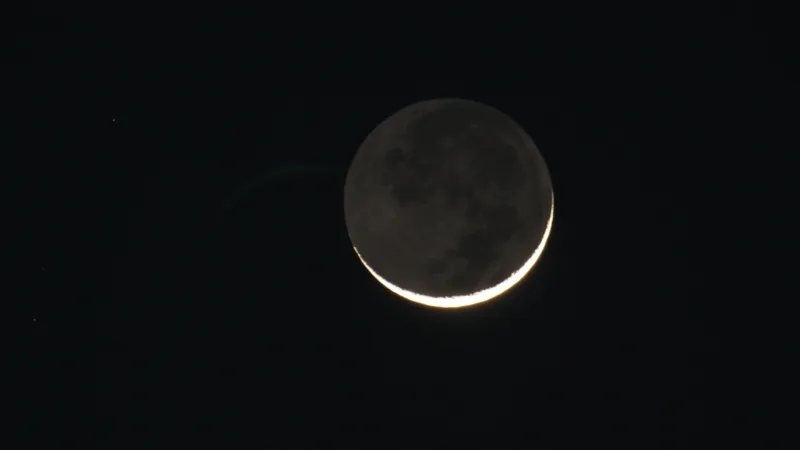
Any clear night the Moon is up, pick out the dark patches with the naked eye, then compare with the moon calendar a week later: the same features, lit from a different angle. If you want to watch the Moon’s phase change night by night while its face stays put, our explainer on why the Moon has phases shows the geometry, and the earthshine guide explains the faint glow that lets you see the whole near side even when only a crescent is sunlit.