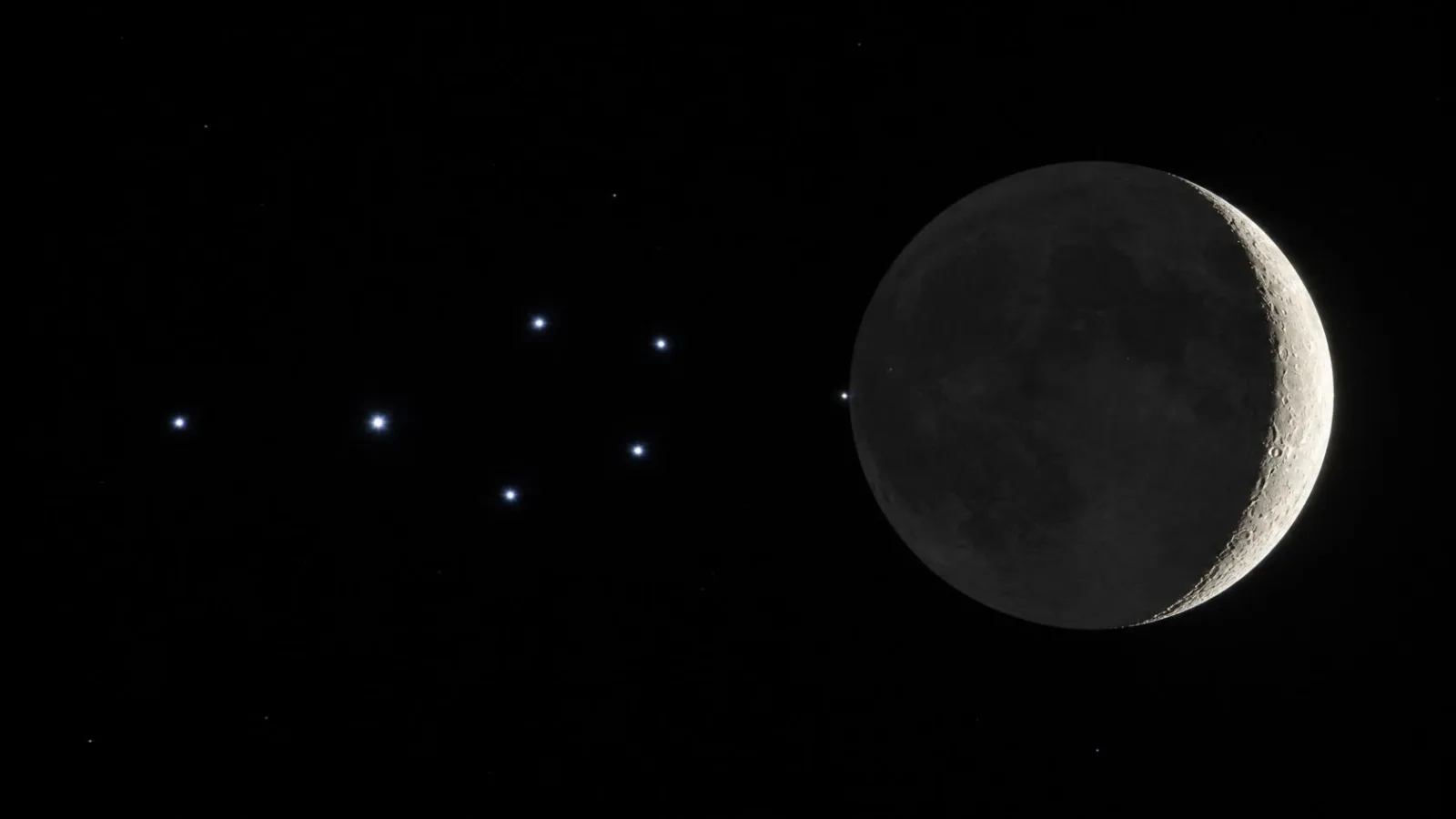
On the evening of Tuesday, October 27, 2026, the Moon passes in front of the Pleiades, the Seven Sisters star cluster, and from much of North America you can watch the cluster’s stars vanish behind the Moon’s edge one at a time and reappear on the other side. It is a lunar occultation, the same kind of event that hid Jupiter on October 6, but with a dozen stars instead of one planet. The Moon is two days past full, which makes it bright and the stars harder to see, so this is one for binoculars or a small telescope. Times below are for Dallas in Central Time.
When to watch
The Moon, 96% lit, rises in the east-north-east at 7:38 PM with the Pleiades right beside it. The first stars at the cluster’s western edge are covered before moonrise in Texas, so the show is already under way as the Moon clears the horizon. It is 15 degrees up by 9 PM, when the Moon is closest to the heart of the cluster, and 27 degrees up by 10 PM; the last stars reappear by about 10:30 PM. Give the Moon a little height before you start: at 8 PM it is only 4 degrees up and in the thickest, murkiest air.
Farther east the Moon is higher throughout. From the eastern United States the occultation runs from roughly 6 PM to midnight Eastern Time, with the closest approach around 9:30 PM. From the Pacific coast the Moon rises late in the event and passes just north of the brightest stars, so fewer are covered. Which stars disappear, and at exactly what minute, depends on where you stand, because the Moon’s edge sweeps a track across the ground like an eclipse path. A planetarium app set to your town gives the times for each star, and the International Occultation Timing Association publishes precise predictions.
What you will see
A star does not fade as the Moon approaches. It is there, and then it is gone, in a fraction of a second, because the Moon has no atmosphere to dim it gradually and a star is a point of light. That instant disappearance is the whole fascination of an occultation. The Moon is waning, so its leading edge, the one that covers the stars, is the bright limb: watch a star sitting just off that edge and wait. Reappearances happen on the trailing, dark edge, which is only a thin dark sliver this close to full, and a star popping out of apparent nothing is the more striking of the two if you can catch it.
The glare is the difficulty. To the naked eye the Pleiades will be washed out beside a nearly full Moon. In 10×50 binoculars the brighter members show; in a telescope at 30 to 60 times the cluster and the Moon’s edge fit in the same view and the events are easy to follow.
How to watch well
- Use the Moon as the signpost. There is nothing to find: the Pleiades are the little knot of stars touching the Moon.
- Keep the Moon’s bright disc out of the field as much as you can, to protect your eyes’ dark adaptation. In a telescope, position the limb at the edge of the view.
- Pick one star and wait. Occultations reward patience; stare at the right spot and you will see the moment.
- Note the times if you like: amateur timings of occultations are still used to refine the Moon’s orbit and the shapes of its mountains.
- Photograph it with a phone held to the eyepiece on a short video, which catches the vanishing better than a still.
Why the Moon keeps meeting the Pleiades
The Pleiades lie close to the ecliptic, the path the Moon follows, and the Moon’s orbit slowly wobbles so that for a few years at a time it crosses the cluster every month. We are in one of those stretches now: the Moon passed the Pleiades at the start of October, covers it on the 27th, and will do so again at intervals until 2029, with different parts of the world favoured each time. These runs come around roughly every 18.6 years, and the current one, which began in 2023, is the first since the series of 2005 to 2010, so a clear evening on the 27th is worth taking.
While you are out
Saturn is high in the south-east, bright and steady, and the Hunter’s Moon has only just passed, so the evening is bright but the planets hold up. If you want to get to know the Pleiades properly on a dark night, our guide to finding the Seven Sisters covers the star-hop and what binoculars show, and the moon calendar has moonrise for your city on the 27th.