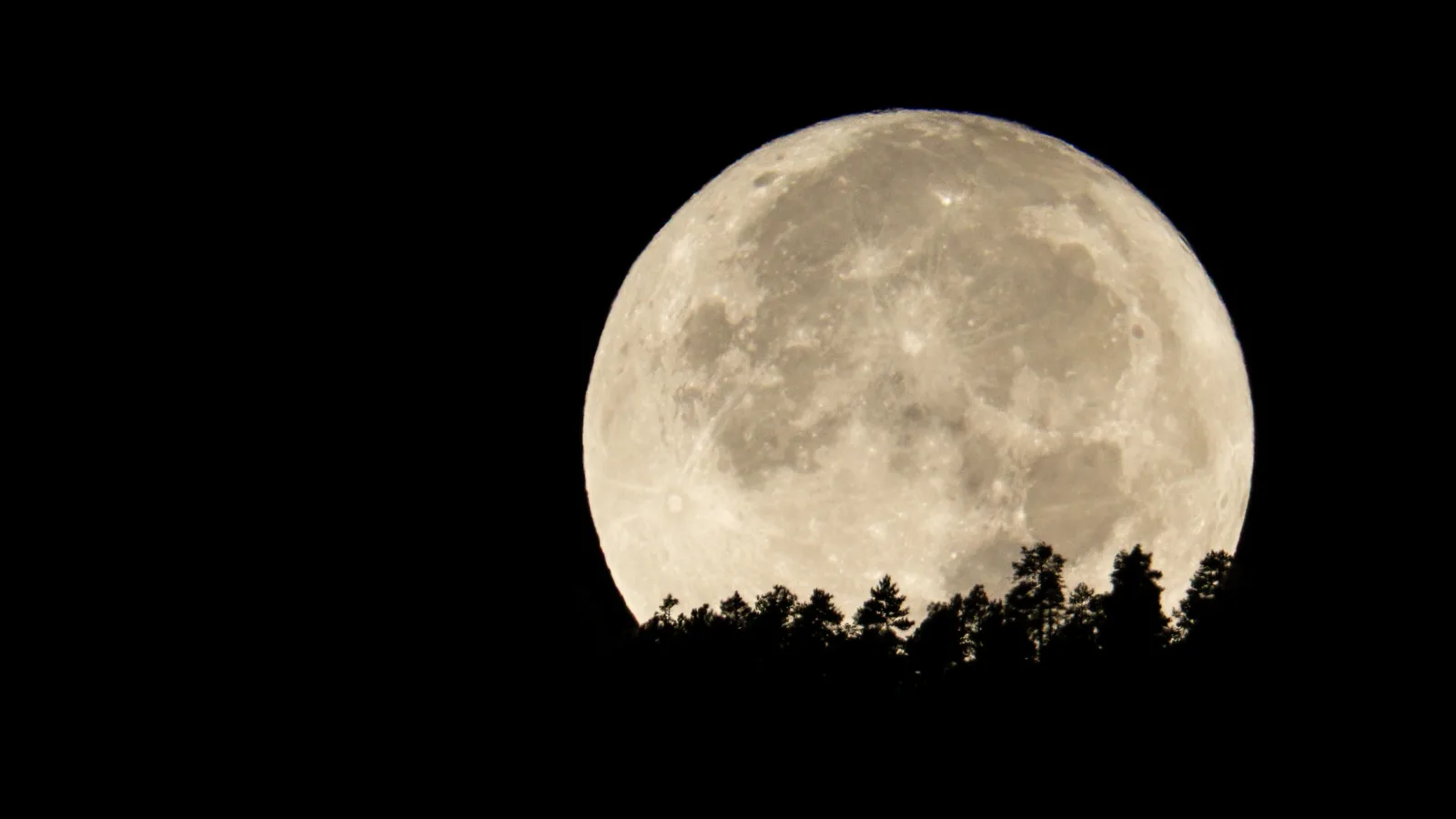
A supermoon is a full moon that happens when the Moon is near the closest point of its orbit to Earth, so it looks a little larger and brighter than an average full moon. The word gets a lot of attention, which is partly deserved and partly not: the difference is real but too small for most eyes to notice, and because there is no official definition, different sources count different moons. This guide explains the orbit behind it, how much bigger a supermoon really is, which definitions are in use, and when the next ones are.
The orbit behind it
The Moon’s orbit is not a circle but a slightly stretched oval. Its distance from Earth varies by about 50,000 km over each month, from a closest point called perigee, around 356,000 to 370,000 km, to a farthest point called apogee, around 404,000 to 407,000 km. Perigee and apogee drift around the orbit, so they line up with full moon only now and then. When a full moon happens close to perigee it is a supermoon; when it happens close to apogee it is sometimes called a micromoon.
How much bigger and brighter
Compared with a micromoon, a supermoon can appear up to about 14% wider and 30% brighter. Compared with an average full moon the gap is smaller, roughly 7% in width and 15% in brightness. Those numbers are accurate but they are not what people expect from the name. Side by side in photographs the difference is obvious; in the sky, with nothing to compare against, almost nobody can tell. The famous “giant Moon” people remember from a supermoon night is usually the Moon illusion, which enlarges any Moon near the horizon and has nothing to do with distance.
The extra brightness is more noticeable than the extra size, especially under a dark sky, and the Moon’s pull on the oceans is slightly stronger, so the spring tides around a supermoon run a little higher than usual.
Why the count varies from site to site
The term was coined in 1979 by an astrologer, Richard Nolle, who defined it as a new or full moon within 90% of its closest possible approach to Earth. Astronomers never adopted an official definition, so publications set their own thresholds, and a full moon near the edge is a supermoon on one site and not on another.
- Nolle’s 90% rule, used by NASA and most news coverage, works out to a distance of roughly 361,000 km or less. It also counts new moons, which nobody can see.
- A fixed cut-off of 360,000 km is used by several astronomy sites and by this one, because it is simple and close to the same line.
- Stricter definitions count only the single closest full moon of the year.
This is why you will read that 2026 has three supermoons while our full moon calendar flags two. The Beaver Moon of November 24 is 360,768 km away, a few hundred kilometres outside our line and just inside the 90% rule. Call it a supermoon if you like; the Moon will not look any different either way.
The next supermoons
- December 24, 2026, the Cold Moon, full at 01:28 UTC (the evening of December 23 in the Americas), at 356,740 km. The closest full moon of 2026 and a supermoon by every definition, with perigee only hours away.
- January 22, 2027, the Wolf Moon, at 357,644 km. Another clear supermoon.
- November 24, 2026, the Beaver Moon, at 360,768 km: a supermoon under the 90% rule, just not under ours.
At the other extreme, the full moons of July 18 and August 17, 2027, fall near apogee at about 405,000 km, the micromoons of that year. Photograph the December full moon and the July one with the same lens and you will have your own before-and-after of the Moon’s changing distance.
How to make the most of one
- Watch moonrise. The size difference is invisible overhead, but a supermoon rising behind a skyline gets the Moon illusion on top of its real extra size and is as big as the Moon ever looks.
- Check the exact time. The Moon looks full for a night either side, so if the official instant falls in daytime for you, the nearer evening is just as good. The next full moon page gives the time, distance and moonrise for your city.
- Do not expect miracles, and be suspicious of pictures showing a Moon filling half the sky. Those are long lenses and distant foregrounds, not supermoons.
Every full moon of the year, with its distance and whether it qualifies, is on the 2026 and 2027 calendars, and the new moon page flags the supermoon new moons that bring the strongest tides of the month.