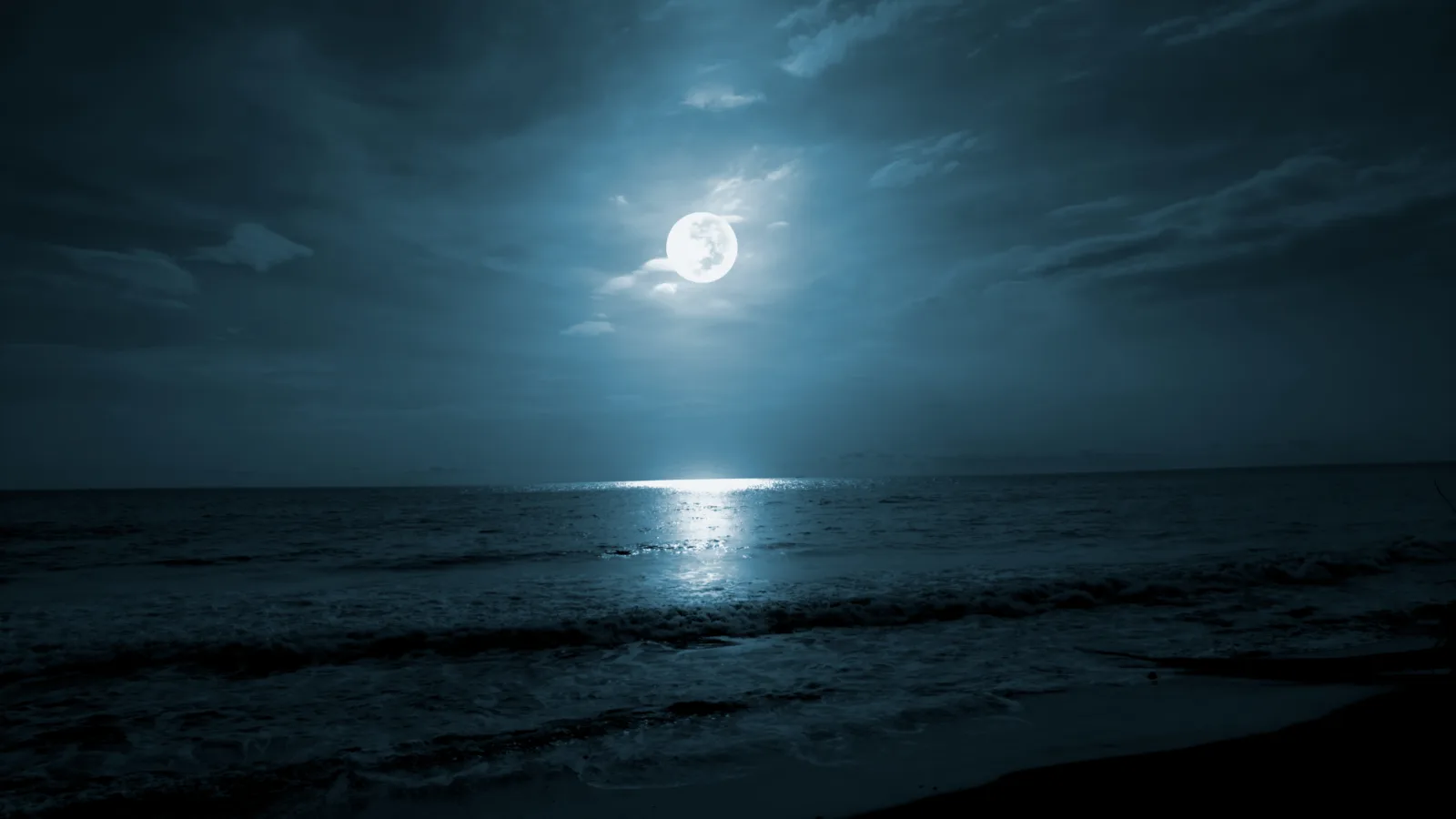
Everyone has seen it. A full Moon climbing over the rooftops looks enormous, far bigger than the same Moon high in the sky a few hours later. Then you photograph it and the picture shows an ordinary small disc. Nothing about the Moon changed. The giant horizon Moon is made entirely in your head, and it is one of the oldest unsolved puzzles in perception. Here is what is known, what is not, and how to prove to yourself that the Moon stays the same size.
First, the Moon really is the same size
The Moon’s disc covers about half a degree of sky, roughly the width of your little fingernail at arm’s length, and that barely changes through the night. If anything the rising Moon is slightly smaller: when it is on the horizon you are looking at it across the full radius of the Earth, about 6,400 km farther than when it is overhead, which shrinks it by about 1.5%. The atmosphere does not magnify it either. Near the horizon, air bends the Moon’s light so that the bottom edge appears lifted more than the top, which squashes the disc a little vertically and makes it orange, but never larger.
The test is easy. Hold a small coin or an aspirin at arm’s length and compare it with the rising Moon. Do the same a few hours later when the Moon is high. It covers the same amount of the coin both times. A camera with a fixed zoom shows the same thing: the two Moons come out identical. The enormous horizon Moon exists only while you are looking at it with your own eyes.
Why your brain enlarges it
Nobody has a complete answer, and researchers still argue about it, but the explanations that hold up best all come down to the same thing: your brain is judging distance, and it judges the horizon Moon to be farther away.
The favourite account is the one the Ponzo illusion demonstrates. Draw two identical bars across a pair of railway tracks converging into the distance, and the bar farther along the tracks looks longer, because the brain reasons that something far away which still covers the same patch of your vision must be bigger. On the horizon the Moon sits at the end of a landscape full of distance cues: trees, buildings, hills, roads shrinking toward it. The brain reads it as far off, and scales it up. Overhead there are no such cues, so the Moon is simply a disc in empty sky. A 1962 experiment by Lloyd Kaufman and Irvin Rock showed that removing the terrain cues shrinks the illusion, and later work found people judged a Moon seen over natural terrain to be about a third bigger than the same Moon with no landscape.
A related idea is that we picture the sky as a flattened dome rather than a hemisphere, with the horizon farther from us than the zenith. A Moon placed on that distant horizon gets enlarged for the same reason. Pilots sometimes report a huge low Moon over a featureless ocean, which suggests the horizon itself is enough of a cue even without scenery.
Other researchers argue that the effect starts in the eye’s own focusing and convergence rather than in judgements about landscape, and that several mechanisms stack up. The honest summary is that the illusion is real, it is perceptual, and the full explanation is still open after two thousand years of people noticing it. Ptolemy wrote about it in the second century.
How to break the illusion
- Look at it upside down. Bend over and view the rising Moon between your legs, or turn your head sideways. The illusion weakens or vanishes, because the landscape cues no longer make sense.
- Look through a tube. A rolled sheet of paper that hides the horizon takes the Moon back to its normal size.
- Half-close one eye and squint, which blurs the scenery and lets the Moon stand alone.
- Measure it. The coin test above settles the argument every time.
Why the horizon Moon is orange
This part is real physics rather than perception. Low in the sky the Moon’s light passes through far more air than when it is overhead. Air scatters blue light out of the beam and lets the reds and oranges through, the same effect that colours a sunset. Dust, smoke and humidity near the horizon make it stronger. As the Moon climbs the colour fades to yellow and then white.
Enjoy it anyway
Knowing that the giant Moon is an illusion does not make it any less beautiful, and moonrise is still the best time to look. The Moon is at its most dramatic when it comes up behind a skyline, and if you want a photograph that matches the feeling, use the longest lens you have from a long way back, so that a building or a tree stands in front of the Moon at the same apparent size. That is how the famous “huge Moon” photos are made.
The next good chance is the Hunter’s Moon, rising around sunset on the evenings of October 25 and 26. The moon calendar has the exact moonrise time for your city on any night, and the full moon page shows which full moons are genuinely a little larger than average, the ones called supermoons.