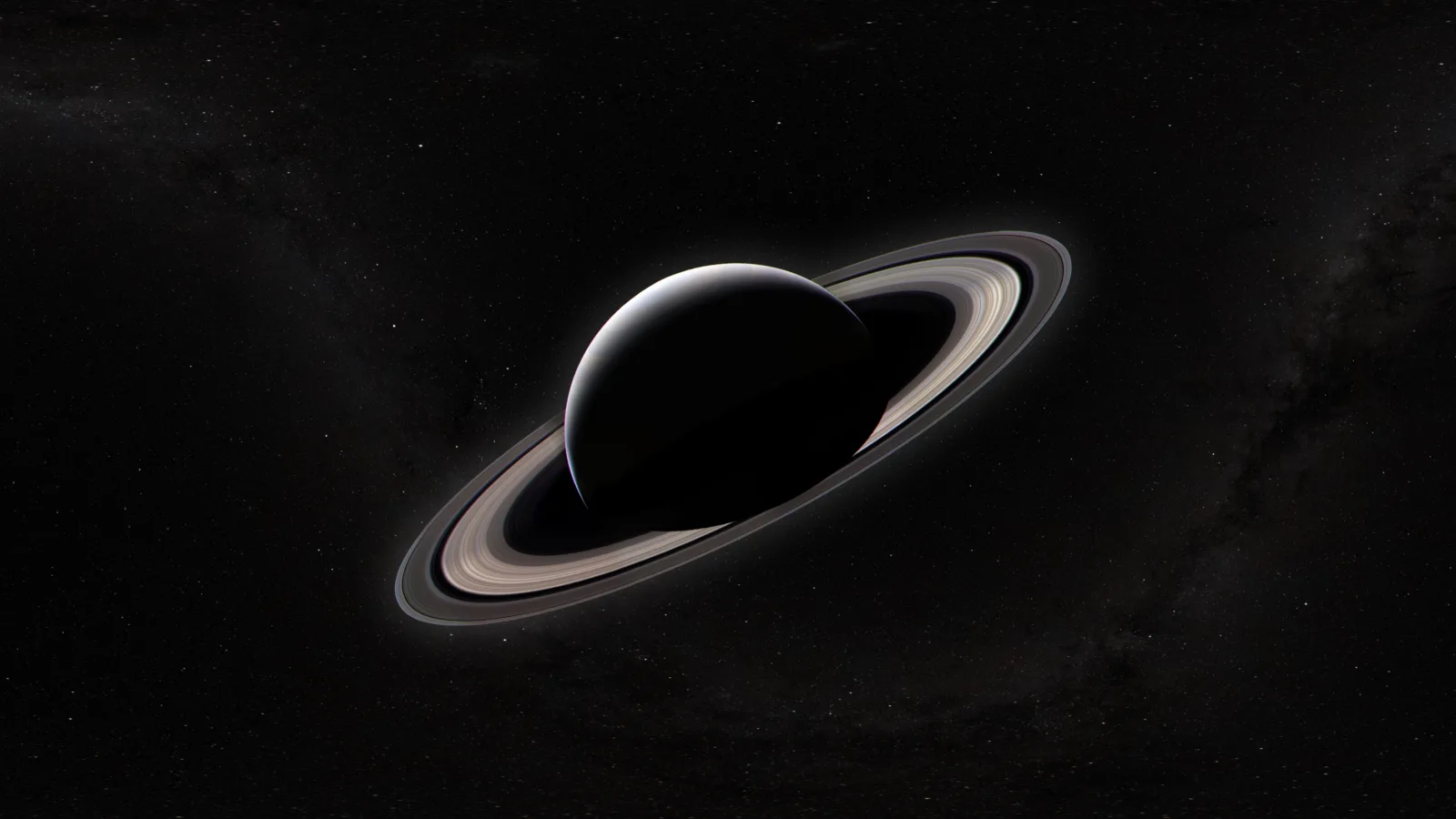
Watch Saturn against the stars over the next few weeks and it will appear to be moving the wrong way, drifting westward night by night instead of east. It is not; Earth is overtaking it. This backward drift, called retrograde motion, puzzled astronomers for two thousand years and turns out to be one of the simplest things in the sky once you see what causes it. Saturn and Neptune are both in the middle of it right now, and the timing is no accident.
What you would see
Planets normally creep eastward against the background stars, the same direction the Moon travels, because that is the direction everything orbits the Sun. But for a stretch of weeks around the time a planet is opposite the Sun in our sky, it slows, stops, reverses to the west, stops again, and then resumes its eastward path. Plotted night after night, the planet traces a loop or a flattened S. Mars does it most dramatically, wandering backward for two months or more; the slower outer planets do it for longer but over a smaller patch of sky.
Why it happens
Earth orbits the Sun faster than any planet farther out. When we catch up with and pass an outer planet, it appears to slide backward against the distant stars, exactly as a slower car appears to move backward when you overtake it on a motorway, even though both of you are heading the same way. The overtaking moment is opposition, when the planet is opposite the Sun and closest to Earth, and the retrograde stretch is centred on it. Mercury and Venus, inside Earth’s orbit, do the same thing for the opposite reason: they overtake us, and their backward loops are centred on inferior conjunction, when they pass between Earth and the Sun.
Retrograde right now, with dates
This site computes oppositions directly, and each one marks the midpoint of a retrograde loop:
- Neptune reaches opposition on September 26, 2026 at 01:08 UTC. It has been moving backward since early summer and continues until late November.
- Saturn reaches opposition on October 4, 2026 at 14:04 UTC. Its retrograde run lasts roughly two months either side, so it is drifting west through September and October and turns east again around the end of November. This is easy to check: note where Saturn sits relative to nearby stars in Aquarius this week, then look again in three weeks.
- Uranus follows on November 25, 2026 at 22:23 UTC.
- Jupiter had its opposition on January 10, 2026 and will not be retrograde again until the run-up to its next one on February 10, 2027.
- Mars is the one to wait for. Its next opposition is February 19, 2027, and its retrograde loop, starting in early January, is the biggest and fastest of any planet.
- Venus reaches inferior conjunction on October 24, 2026, so it is retrograde for about six weeks around that date, which is why it slides so quickly out of the evening sky in October.
Does the Moon go backward too?
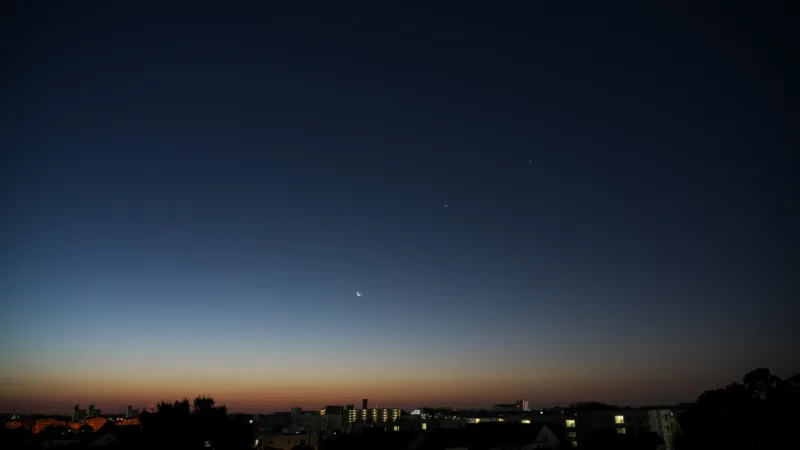
Not in the sky, though it can look that way in a time-lapse. The Moon always moves eastward against the stars, about 13 degrees a day. What confuses people is its daily motion across the sky, which is westward, like everything else, because Earth rotates. Watch the Moon over a single evening and it sets in the west; watch it at the same clock time on successive nights and it has shifted east. Retrograde motion is about the second kind of movement, the slow drift against the stars, and the Moon never reverses that one. A related illusion appears in photographs of the Moon near a planet on consecutive nights, when the Moon’s fast eastward motion makes the planet look as if it has jumped backward.
Why it mattered
Ancient astronomers who placed Earth at the centre of everything had to explain retrograde loops with circles riding on circles, the epicycles of Ptolemy. It was Copernicus in the sixteenth century who pointed out that if Earth itself orbits the Sun, the loops appear automatically with no extra machinery, one of the strongest early arguments for a Sun-centred solar system. Every time you notice Saturn drifting the wrong way this autumn, you are seeing the evidence he used.
Track the outer planets’ positions and brightness from your city on the planets page, and see the full list of oppositions and conjunctions on the events calendar.