Mars passes 1.2 degrees from Jupiter on November 16, 2026, close enough that the two planets fit in the same binocular field and almost in the same low-power telescope view. The closest moment is at 04:05 UTC on the 16th, which is 10:05 PM Central on Sunday, November 15, when the pair is below the horizon for the Americas, so the mornings of Sunday the 15th and Monday the 16th are equally good, with the planets high in the south at dawn. Times below are for Dallas; the event page converts them to your city.
Where and when to look
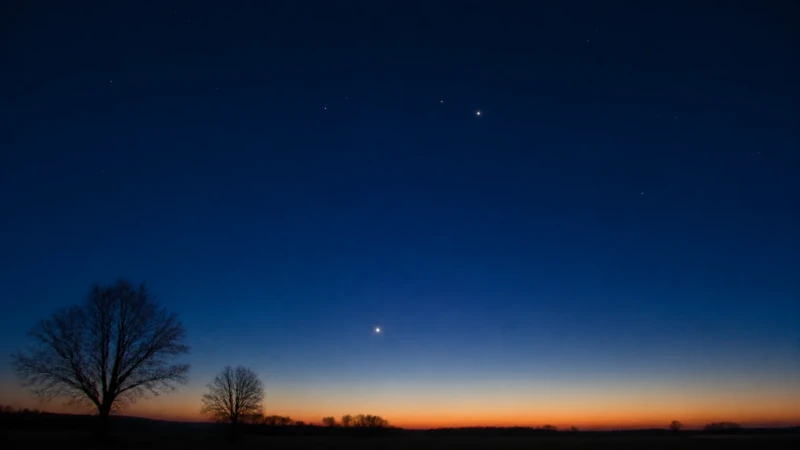
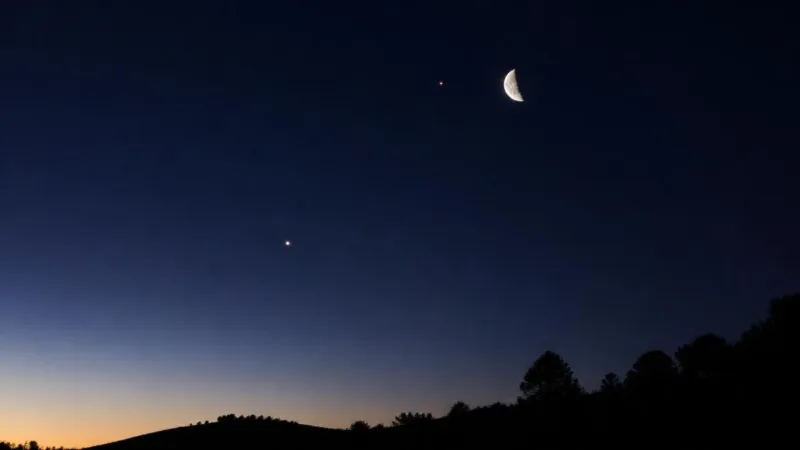
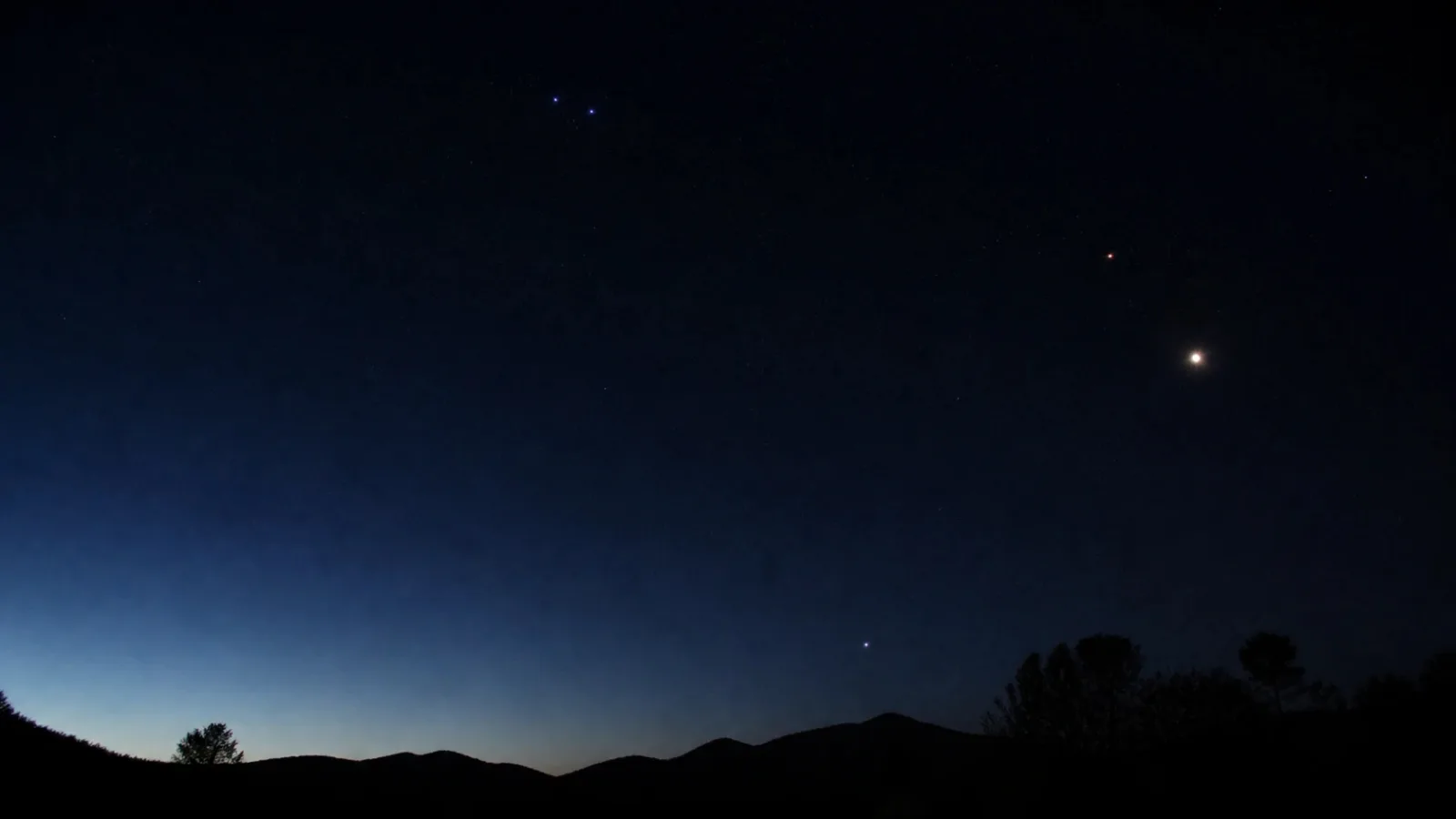
Both planets are in Leo, with Regulus 4 degrees to their lower left. They rise in the east around midnight and are highest at dawn: from Dallas about 71 degrees up in the south at 6:30 AM on November 16, the brightest things in the sky apart from the Moon. Jupiter is the brilliant white point at magnitude -2.1; Mars, at magnitude 0.7, is the orange point just above and slightly left of it, 1.2 degrees away, a little more than two Moon-widths.
- Sunday, November 15, 6:30 AM: 1.3 degrees apart, Mars to the upper left.
- Monday, November 16, 6:30 AM: 1.2 degrees, the minimum as seen from North America.
- Tuesday, November 17, 6:30 AM: 1.3 degrees, Mars now pulling ahead to the left.
If you are new to planet-spotting, finding them is easy: face south in the hour before dawn and look for the brightest star-like point high up, far brighter than anything around it. That is Jupiter, and the orange spark hugging it is Mars. Regulus, the next brightest point, is a short way to the lower left. On a clear night the Sickle of Leo, a backwards question mark of stars with Regulus at its base, frames the whole scene; no app or chart is needed.
The sky is dark until about 6:30 AM and the planets stay obvious to the naked eye until sunrise just before 7. For observers in Europe the conjunction evening of the 15th UTC is also below the horizon, and the mornings of the 15th and 16th give the same 1.2 to 1.3 degree view; in Asia and Australia the minimum falls in daylight on the 16th, with both mornings equally close.
How the gap closes and opens
From our planetary positions, the separation at 0h UTC each day:
- November 1: 5.8 degrees
- November 5: 4.3 degrees
- November 9: 2.9 degrees
- November 12: 1.9 degrees
- November 14: 1.4 degrees
- November 16: 1.2 degrees
- November 18: 1.4 degrees
- November 20: 1.8 degrees
- November 24: 3.0 degrees
Mars moves eastward against the stars by about two thirds of a degree a day, Jupiter by only a tenth, so Mars overtakes from the right and moves off to the left. Watching the gap change night by night over the week is the real pleasure of a conjunction, and the pair stay within 2 degrees from November 12 to 20. Mars goes on to pass Regulus in early December. The Mars and Jupiter pages give each planet’s altitude by the hour for your location.
In binoculars and a telescope
Any binoculars show both planets together with Jupiter’s four big moons as tiny points in a line beside the planet. A telescope at 40x to 60x puts both planets in one field: Jupiter is 37 arcseconds across with its cloud belts, and Mars is a small 7-arcsecond gibbous disc, 89 percent lit, whose colour contrast with Jupiter’s cream is striking. Mars is brightening on its way to opposition in February 2027, when it will be close to magnitude -1.2 and nearly twice its present size; Jupiter is also heading toward opposition early next year, so both are near their best for the Northern Hemisphere.
A closer conjunction than usual
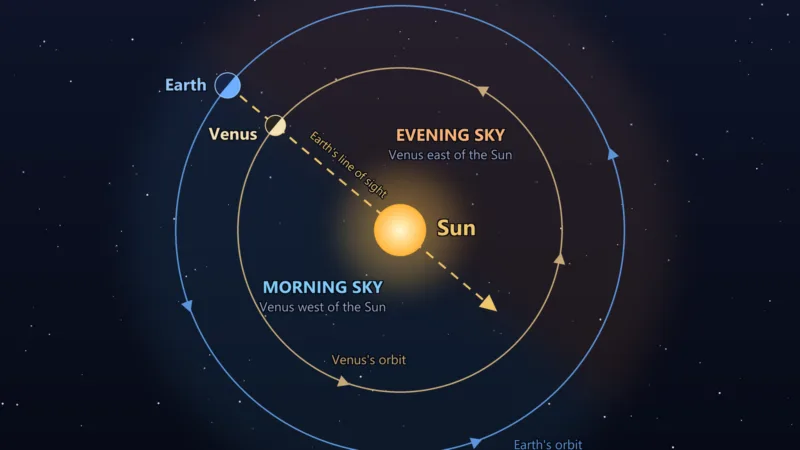
Mars and Jupiter meet about every two years and three months, as Mars laps Jupiter. The last conjunction, in August 2024, was a very tight 0.3 degrees; this one is wider but stays high in a dark sky for longer before dawn. Conjunctions are a line-of-sight effect, nothing more: on November 16 Mars is 1.30 astronomical units from Earth, about 195 million kilometres, while Jupiter is four times further away at 5.26 AU.
The Leonids the next morning
The Leonid meteor shower peaks on November 17 at 14:53 UTC, with the radiant in the Sickle of Leo, about 8 degrees from the two planets. The Moon, a day short of first quarter, sets at 11:41 PM on the 16th in Dallas, leaving the hours from midnight to dawn on the 17th dark. Rates are a modest 10 an hour or so, but the meteors are fast and often leave trains, and the radiant beside the brightest planets in the sky makes a memorable scene. The Leonids page has the details.
The rest of the dawn sky
Venus is low in the south-east, 24 degrees up at dawn by mid-November and blazing at magnitude -4.6, with Spica beside it; Mercury is 13 degrees up and just naked-eye at magnitude -0.2, approaching its November 20 greatest elongation. Two weeks after the conjunction, on the morning of November 30, the 58 percent Moon returns to the pair, 2 degrees from Jupiter and 4 from Mars. For the Moon’s phase and the dawn times on any of these mornings, see the moon calendar, and for the planets’ positions through the month, the planet events calendar.