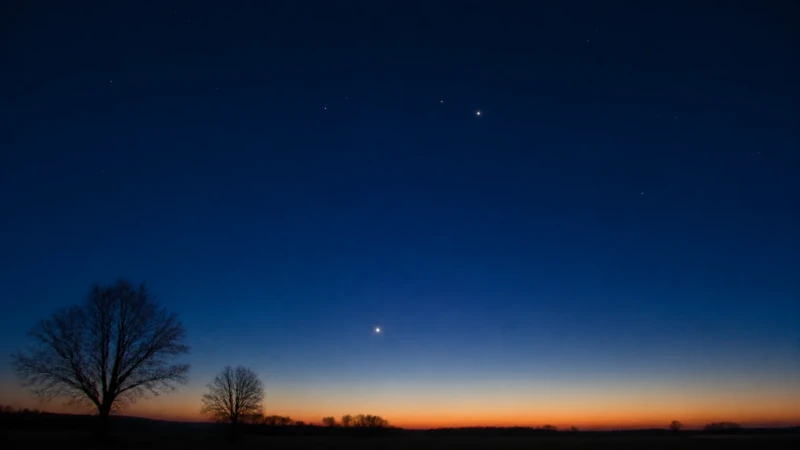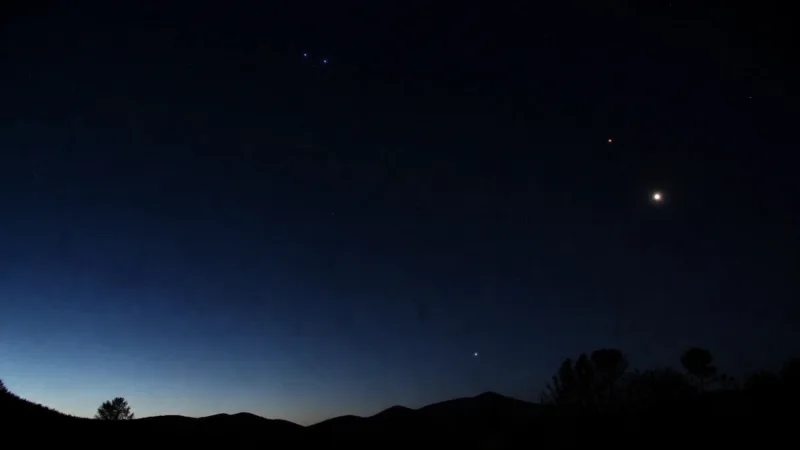
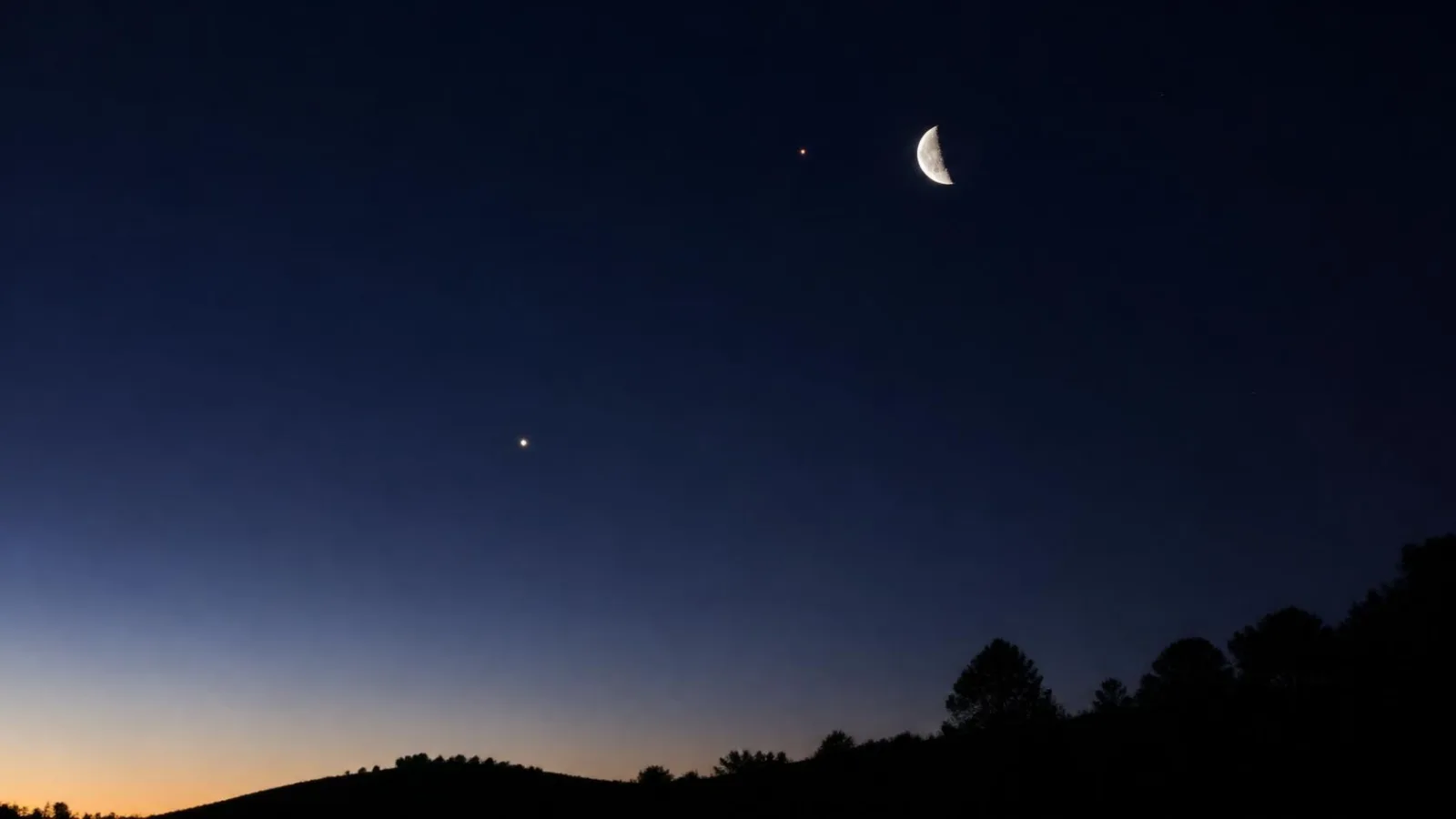
Before dawn on Monday, November 2, 2026, the waning crescent Moon sits about one degree from Mars, with Jupiter six degrees further along the same line and the star Regulus beyond that, all high in the south-east. It is the best Moon-and-planets grouping of the autumn, it needs no equipment, and from Dallas it is on show from about 1 AM until the sky brightens around 6:20 AM Central. Times below are for Dallas; every page linked here converts them to your city.
What you will see
The Moon rises at 12:06 AM on Monday, 40 percent lit and shrinking toward last quarter. Mars is the orange point just to its lower left, about 1.3 degrees away at 6 AM, close enough that the two fit comfortably inside a binocular field with room to spare. Follow the line down and left and you reach Jupiter, brilliant at magnitude -2.0 and 6 degrees from the Moon, and then Regulus, the brightest star of Leo, 6 degrees beyond Jupiter. Off to the upper right of the Moon, about 11 degrees away, the faint smudge of the Beehive cluster marks where Mars was a month ago.
At dawn the whole group stands 60 to 70 degrees high in the south-east, well clear of trees and haze. The closest approach to Mars, about one degree, comes at 7:40 AM Central, after sunrise, so the pre-dawn view is as good as it gets for North America. Mars is magnitude 0.9, a little brighter than Regulus, but it will not stand out next to the Moon until you look for the colour.
Hour by hour from Dallas
- 12:06 AM: moonrise in the east-north-east. Mars rises a few minutes behind it, Jupiter about half an hour later.
- 3 AM: the group is 35 degrees up in the east. Good for photographs with a skyline.
- 5 AM: 60 degrees up in the south-east, the sky still fully dark. Best for binoculars and telescopes.
- 6:20 AM: civil dawn. The Moon, Jupiter and Mars stay visible to the naked eye until about 6:40 AM, with sunrise at 6:45.
Remember that clocks went back an hour on Sunday, November 1, so dawn now comes at about 6:20 rather than 7:20. If you set an alarm by last week’s times you will be an hour early.
Twenty-four hours later the Moon has moved on by 13 degrees. On Tuesday, November 3 at 6 AM it is a 32 percent crescent sitting two degrees from Regulus, with Jupiter 7 degrees to its upper right and Mars 12 degrees beyond that. The closest approach to Jupiter, half a degree, happens at 4:50 PM Central on Monday afternoon, in daylight for the Americas.
From Asia and Australia: the Moon covers Jupiter
That daylight moment for America is the pre-dawn of Tuesday, November 3 for Asia. From Manila the Moon rises at 12:26 AM on the 3rd with Jupiter about 3 degrees to its lower left, and the gap closes to about one degree by dawn. Further south the Moon passes directly in front of Jupiter. According to the University of Southern Queensland’s guide to the southern sky, from Sydney the Moon’s bright edge covers Jupiter at 10:40 AM on November 3 and the planet reappears at the dark edge at 11:39 AM, in broad daylight but visible in binoculars. Parts of Indonesia, Malaysia, southern Thailand and southern India also see the occultation during their morning. Times vary by hundreds of kilometres, so check a local source before you set up; the event page above shows the geocentric moment for your zone.
From Europe the pairing is looser: on the morning of the 2nd the Moon is about 4 degrees to the right of Mars, and on the 3rd it sits 4 to 5 degrees to the lower left of Jupiter.
Through binoculars and a telescope
Binoculars show the earthshine on the Moon’s dark side, Mars as a tiny orange disc and Jupiter with its four big moons strung out beside it. A telescope at 50x or more adds cloud belts on Jupiter, 36 arcseconds across, and a small gibbous Mars just 6.6 arcseconds wide; Mars is still four months from its February 2027 opposition and will double in apparent size by then. The crescent Moon’s terminator, with the Sun setting over the Apennine mountains and the crater Copernicus, is worth the look on its own.
Why the planets are here
Mars and Jupiter are both in Leo this autumn and Mars, the faster of the two, is catching Jupiter up. On November 2 they are 5.2 degrees apart; two weeks later, on November 16, they pass just 1.2 degrees from each other in the dawn sky. The Moon’s visit on the 2nd is a preview, and a chance to learn the pair’s position before the conjunction. The Jupiter and Mars pages show their altitude hour by hour for your city.
Also at dawn: Venus is back
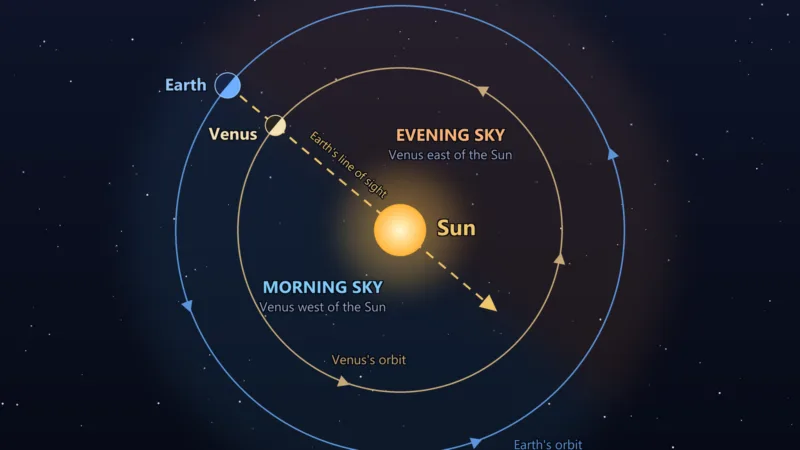
Venus passed between us and the Sun on October 23 and from about November 2 it reappears very low in the east at dawn, 8 degrees up at civil twilight from Dallas and blazing at magnitude -4.3. Look below and left of the Moon-Mars-Jupiter line, almost at the horizon. On Saturday, November 7 the thin 3 percent crescent Moon rises at 5:18 AM and stands a degree from Venus, with the star Spica a degree and a half further on, a tight triangle 15 degrees above the horizon at dawn. Our Venus guide covers the switch from evening to morning sky. Mercury, meanwhile, is at inferior conjunction on November 4 and out of sight.
For moonrise and dawn times in your own city, and the Moon’s phase on any of these mornings, see the moon calendar.