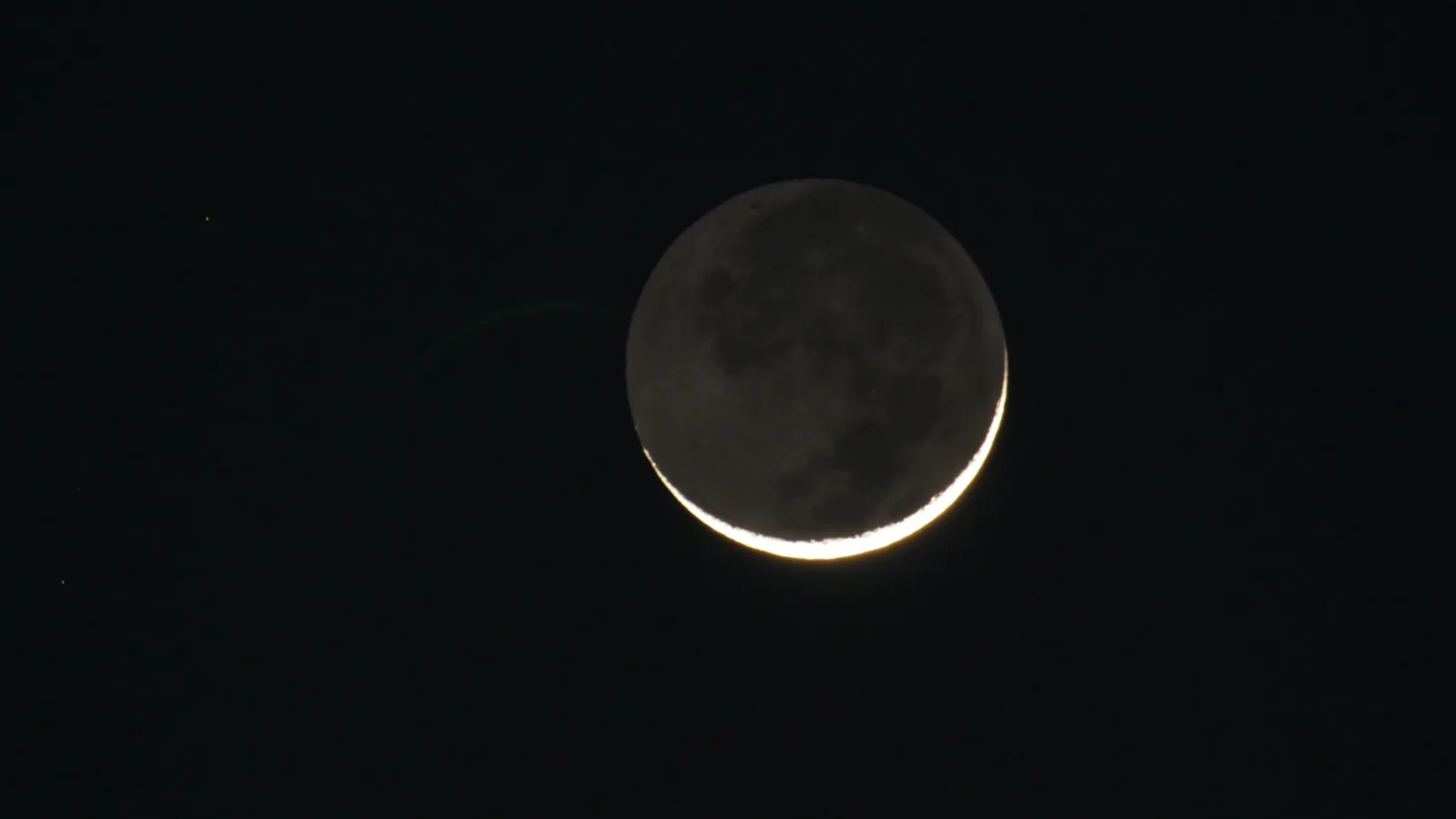
Look at a thin crescent Moon this week and you may notice something odd: you can see the rest of the disc too, glowing faintly inside the bright curve. That ghostly light is earthshine, sunlight that has bounced off the Earth, travelled to the Moon and come back to your eye. It is easy to see without any equipment, it is at its best in the few days either side of new moon, and this month gives you two good runs: the waning crescent before dawn on October 6, 7 and 8, and the waxing crescent after sunset from October 12 to 15. Times below are for Dallas in Central Time; the moon calendar gives moonrise and moonset for your city.
What you are seeing
The bright crescent is lit directly by the Sun. The rest of the Moon’s near side is in lunar night, but it is not in total darkness, because the Earth is hanging in its sky. When we see a thin crescent Moon, someone standing on the Moon would see an almost full Earth, and a full Earth is a powerful lamp. It is nearly four times as wide as the Moon looks from here, and it reflects about 30% of the sunlight that hits it, compared with about 12% for the dark, dusty Moon. Put together, the Earth lights the lunar night roughly 50 times more brightly than a full Moon lights ours. That light falls on the dark part of the Moon and a little of it reflects back to us. Light that has made the trip Sun to Earth to Moon to Earth: that is earthshine.
Why it is best when the crescent is thin
The phases of the Earth seen from the Moon are the reverse of the Moon’s phases seen from here. At new moon the Earth is full in the lunar sky; at full moon it is new. So earthshine is strongest right around new moon and fades as the Moon waxes: by first quarter the Earth is only half lit from the Moon, the bright part of the Moon is producing far more glare, and the glow is lost. The practical window is from about a day after new moon to about five days after, and the same again before new moon in the morning sky. Our phases explainer shows the geometry.
When to look this month
- Tuesday, October 6, before dawn: a 17% crescent rises at 3:13 AM. Earthshine is obvious by 5 AM, with Jupiter right beside the Moon.
- Wednesday, October 7, before dawn: a 10% crescent rises at 4:20 AM. The best morning of the run: a thin crescent, a dark sky and a strong glow.
- Thursday, October 8, before dawn: a 4% sliver rises at 5:23 AM, low in the east as dawn begins.
- Monday, October 12, after sunset: a 5% crescent very low in the west-south-west, setting at 7:54 PM. A challenge, with Mercury nearby.
- Tuesday, October 13, after sunset: a 10% crescent setting at 8:33 PM. The best evening: high enough to see in a darkening sky.
- Wednesday and Thursday, October 14 and 15: 16% and 24% crescents setting at 9:17 PM and 10:06 PM. Still visible, fading as the crescent thickens.
The new moon is on October 10, so there is nothing to see on the 9th, 10th or 11th.
How to see it well
- Your eyes are enough. Look at the Moon for a few seconds and let the dark part appear. Blocking the bright crescent with a rooftop or a finger makes the glow stand out.
- Binoculars show detail. The dark maria, the “seas”, are visible in earthshine, along with a few bright craters such as Aristarchus, the most reflective spot on the near side.
- Twilight helps. In a fully dark sky the crescent’s glare is harsh. The half hour when the sky is deep blue gives the most natural-looking view.
- Photograph it with a phone on a steady support. A one or two second exposure overexposes the crescent and brings out the earthlit disc. Use night mode or a manual app.
Leonardo worked it out first
The correct explanation is five hundred years old. Around 1510, in the notebook now known as the Codex Leicester, Leonardo da Vinci sketched the crescent Moon with its ghostly disc and reasoned that the glow was sunlight reflected from the Earth, which is why earthshine is sometimes called the Da Vinci glow. He thought the oceans did the reflecting; we now know clouds do most of the work. The older folk name is “the old Moon in the new Moon’s arms”, and astronomers call it the ashen light.
Why scientists still measure it
Earthshine is a mirror held up to our own planet. Its brightness depends on how much sunlight the Earth reflects, which changes with cloud cover, ice and snow. Observatories have measured earthshine for decades as a way of tracking the Earth’s reflectivity, a quantity that matters for climate because sunlight that is reflected back to space is sunlight that does not warm the planet. So the faint glow on a crescent Moon is also a reading of how bright the Earth is today.
Next time you see a thin crescent, look for the rest of the Moon. The waning crescent and waxing crescent pages have the dates of the coming months’ crescents, and our weekly sky guide has everything else that is up this week.