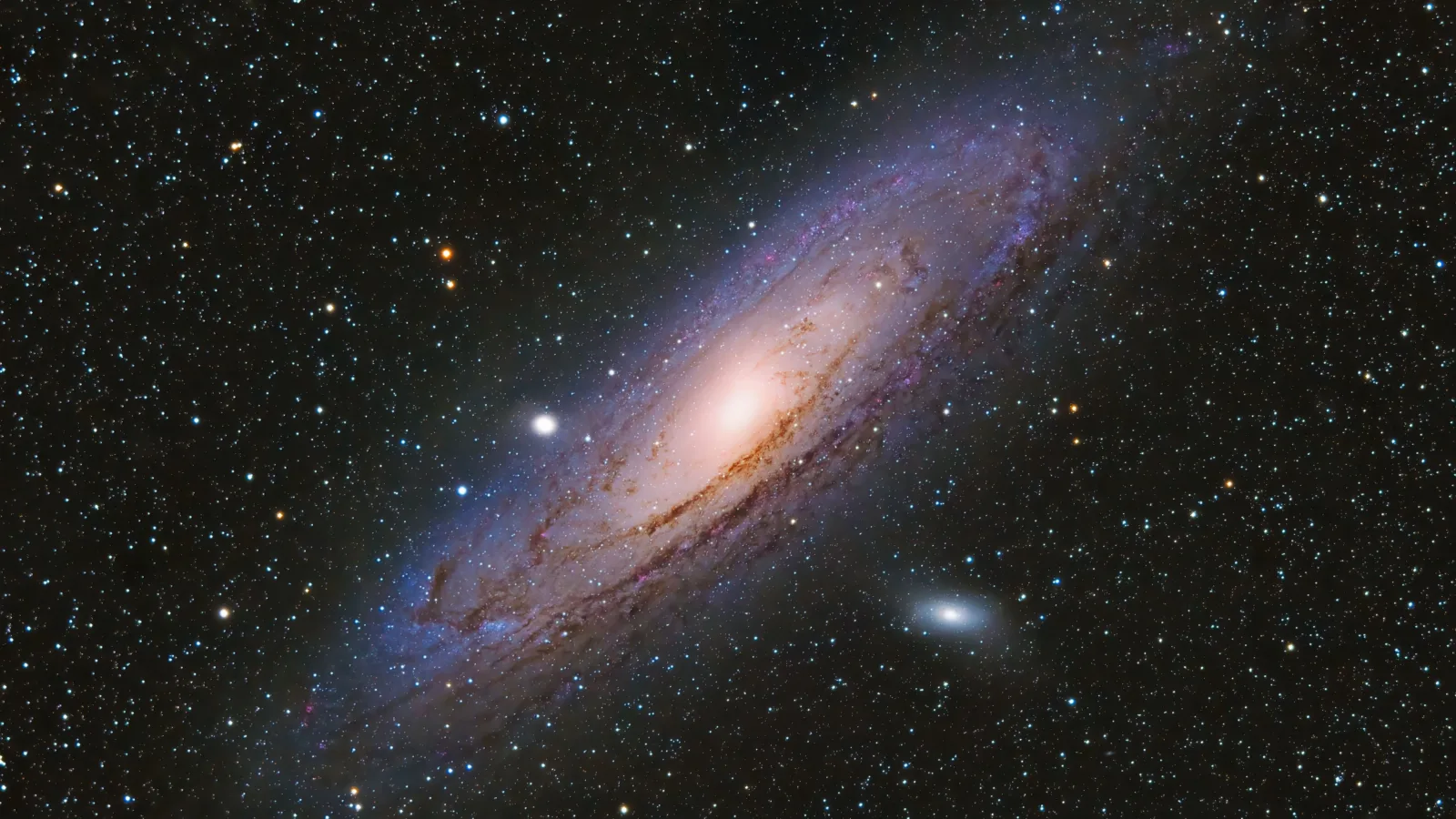
The Andromeda Galaxy is the farthest object most people will ever see with their own eyes: a galaxy of a trillion stars, 2.5 million light years away, whose light left it before humans existed. In October it rides high in the evening sky, and with the new moon on October 10 keeping the nights dark, the week either side is the best chance of the year to find it. You do not need a telescope. You need a reasonably dark sky, ten minutes for your eyes to adapt, and a star-hop of three steps. Times here are for Dallas; the pattern is the same anywhere in the northern hemisphere.
When and where to look
Andromeda is low in the north-east at dusk in early October. By 10 PM it is high in the east, and it passes almost straight overhead around 1 AM. The earlier in the evening you look, the lower it is and the more air you look through, so 10 PM to midnight is the sweet spot. By late October it is already high by 9 PM. Pick a night with no Moon: from October 5 to about October 13 the Moon is out of the evening sky entirely.
The star-hop
- Find the Great Square of Pegasus. Look high in the east for a large, almost empty square of four medium-bright stars, standing on one corner like a diamond in the evening. It is the most obvious large pattern in the autumn sky.
- Follow the chain of Andromeda. From the Square’s upper-left star, Alpheratz, a line of stars runs off to the left, curving gently. Count two stars along it: Mirach is the second, and it is noticeably orange.
- Step up from Mirach. From Mirach, go up at a right angle to the chain, past one fainter star, to a second fainter star about the same distance again. Just beyond that second star is a soft, oval glow the size of a fingertip at arm’s length. That is the core of the Andromeda Galaxy.
Under a dark rural sky the glow is plain once you know where to look, and averted vision, looking slightly to one side, makes it brighter. From the suburbs the naked eye may only catch it as a hint, but any binoculars show it clearly as an elongated smudge with a brighter centre. A 10×50 pair also picks up its small companion galaxy, M32, as a fuzzy star just below the core.
What you are actually seeing
The glow is the galaxy’s central bulge, the densest few thousand light years of a disc that is really about six times the width of the full Moon across the sky. The outer disc is too faint for the eye, which is why photographs look so much bigger than the view. The light entering your eye left Andromeda 2.5 million years ago. It is the nearest large galaxy to our own, and it is approaching us at about 110 kilometres a second; in roughly four billion years the two will merge. Nothing to worry about tonight.
Tips that make the difference
- Dark adaptation is everything. Ten minutes with no phone screen, and Andromeda goes from invisible to obvious. Twenty is better.
- Use binoculars first if you have them. Once you have seen it in binoculars, you will know exactly where to look with your eyes alone.
- Get away from streetlights. Thirty minutes’ drive from a city makes more difference than any equipment.
- Avoid the Moon. Even a half Moon will hide it. Check the moon calendar for your city and pick a night when the Moon sets early or rises late.
- Do not expect colour or spiral arms. To the eye and to binoculars it is a pale grey oval. The colour in photographs comes from long exposures.
While you are there
The same part of the sky has two more easy targets. The Double Cluster in Perseus, a pair of rich star clusters visible as a fuzzy patch between Cassiopeia’s W and Perseus, is a fine binocular sight to the lower left of Andromeda. And below Cassiopeia, the Milky Way runs through the north-east, still bright in early October. If a bright “star” low in the east catches your eye, it is Saturn, just past opposition and up all night. For the rest of what October offers, see our October sky guide.