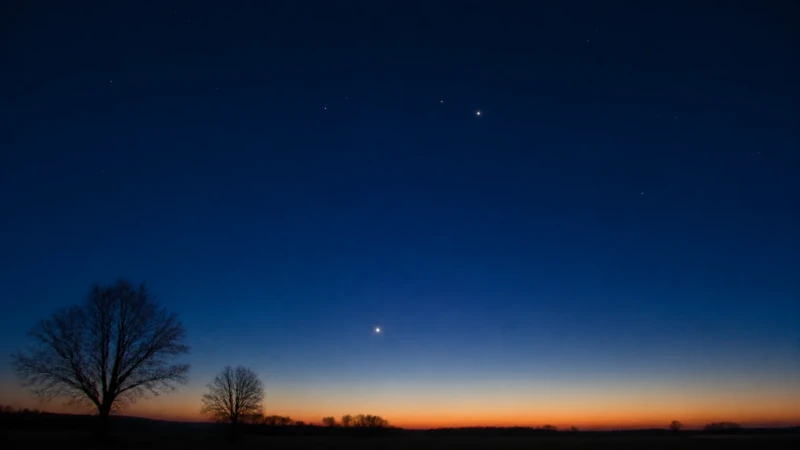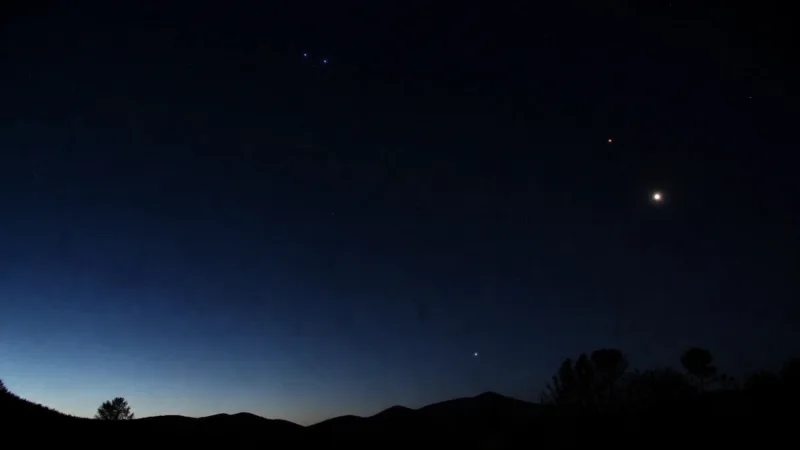
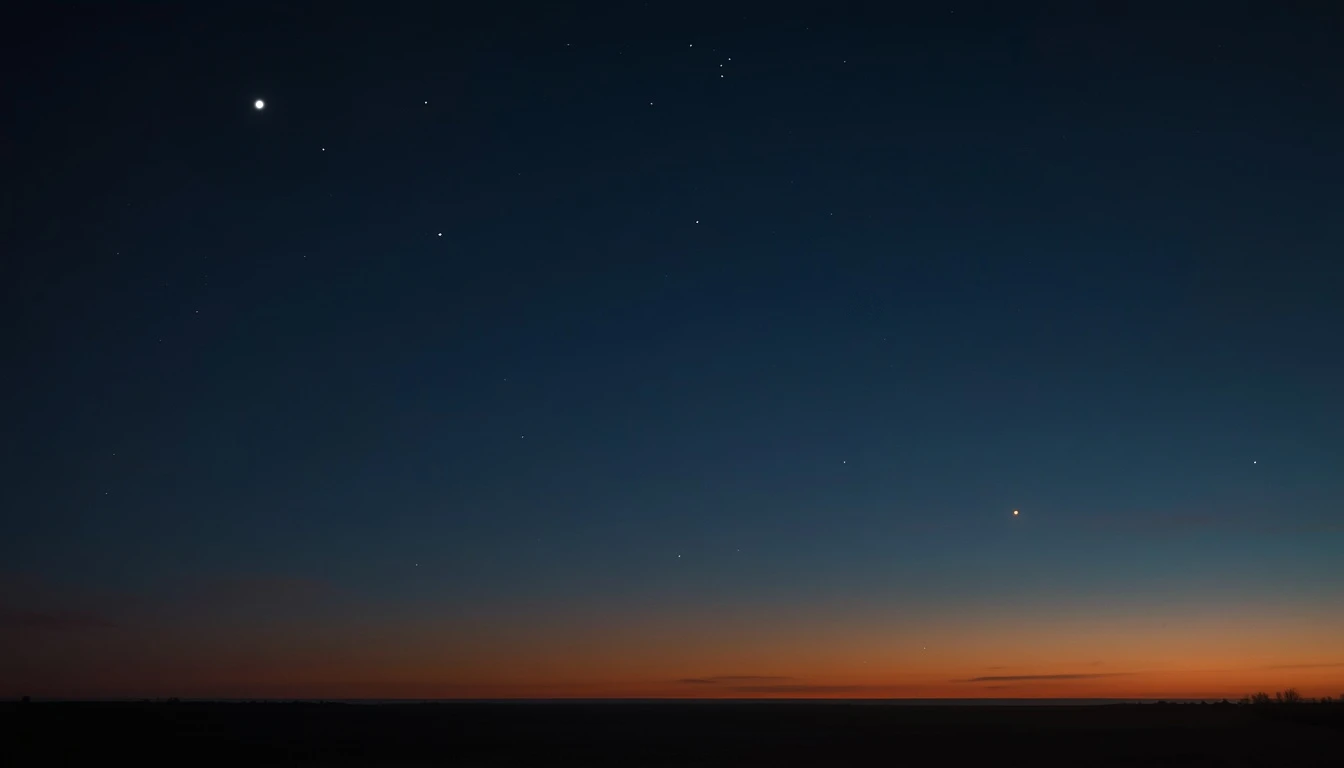
Mercury is having its best morning showing of the year for the northern hemisphere. It climbs out of the dawn twilight in the second week of November 2026, reaches greatest elongation west on Friday, November 20, 20 degrees from the Sun at magnitude -0.5, and stays easy until the end of the month before sinking back by mid-December. From Dallas it stands 12 to 13 degrees above the south-eastern horizon at dawn from November 14 to 25, below and to the left of brilliant Venus, which makes it the easiest Mercury to find in a long while. Times below are for Dallas in Central Standard Time; the event page converts them to your city.
When to look
The window is about 40 to 60 minutes before sunrise, which in Dallas means roughly 6:00 to 6:25 AM. Earlier, Mercury is still too low; later, the twilight swallows it. Day by day at civil dawn, about 25 minutes before sunrise:
- November 10: 8 degrees up, magnitude 1.3. Just emerging; binoculars needed.
- November 12: 10 degrees, magnitude 0.6.
- November 14: 12 degrees, magnitude 0.1. Naked-eye from here on.
- November 16 to 25: 12 to 13 degrees, magnitude -0.5 to -0.6. The peak; Mercury is highest around the 19th and brightest around the 25th.
- November 30: 10 degrees, magnitude -0.6.
- December 6: 7 degrees, fading into the dawn.
Greatest elongation itself is at 5:31 PM Central on the 20th (23:31 UTC; some sources give 0:00 UTC on the 21st), which is why the mornings of the 20th and 21st are equally good.
Where to look
Face south-east. Venus is the unmistakable beacon 24 to 30 degrees up, the brightest thing in the sky. Mercury is about 15 degrees below it and a little to the left, roughly a hand and a half at arm’s length, close to the horizon. It looks like a bright star that does not twinkle much, pale yellow-white, and at magnitude -0.5 it is brighter than any star in that part of the sky. A clear horizon matters: a rooftop, hill or open field facing south-east. Binoculars find it first; once you know the spot, your eye will.
From November 19 to 21 Venus sits only 2 degrees above the star Spica, so the morning line-up reads, from top to bottom, Venus, Spica and then Mercury. Jupiter and Mars are far above all of them, 70 degrees high in the south.
Why this one is good
Mercury never strays more than about 28 degrees from the Sun, and most of its showings are lost in twilight. What makes or breaks one is the angle of the ecliptic at dawn or dusk. In the northern autumn the morning ecliptic stands steeply, so a given elongation lifts Mercury almost straight up from the horizon rather than along it. That is why November morning elongations are the ones to watch in the north, and why this same event is poor from the southern hemisphere, where Mercury hugs the horizon in the glow.
Through a telescope the planet shows a phase. On November 12 it is a 22 percent crescent 8.5 arcseconds across; by the 20th it is 59 percent lit and 6.8 arcseconds; by the 27th a 78 percent gibbous 5.8 arcseconds wide. It is small and low, so expect a shimmering blob at high power, but the changing phase over two weeks is real and visible at 100x. The Mercury page gives its altitude from your city at any hour.
Mercury in brief
- The smallest planet, 4,880 kilometres across, only about 40 percent wider than our Moon, and the closest to the Sun at an average of 58 million kilometres.
- It orbits in 88 days, so it swings from one side of the Sun to the other every few weeks and gives six or seven elongations a year, three or four of them in the morning. Most are poor; one or two a year are as good as this one.
- A Mercury day, sunrise to sunrise, lasts 176 Earth days, two of its years, because its slow spin is locked to its orbit in a 3:2 pattern.
- Only two spacecraft have orbited it, NASA’s Messenger from 2011 to 2015 and the European-Japanese BepiColombo, which arrives in late 2026 after a seven-year cruise.
- Copernicus is said to have regretted never seeing it. From a flat horizon on a clear November morning you will do better than he did.
Dates to mark
- November 14 to 28: naked-eye Mercury at dawn, best around the 19th to 21st.
- November 19 to 21: Venus 2 degrees from Spica above it.
- November 29: Venus at greatest brilliancy, the brightest it will be this apparition.
- December 5: the waning crescent Moon about 7 degrees from Venus at dawn.
- December 7: the thin crescent Moon about 7 degrees from Mercury, low in the dawn, the last easy chance before Mercury is gone. New moon follows on December 8.
Mercury’s next showing is in the evening sky early in 2027. Until then the morning is the place to look, and this month it is at its best. Our November planets guide covers Venus, Jupiter and Mars in the same sky, and the planet events calendar lists every elongation and pairing with times for your zone.