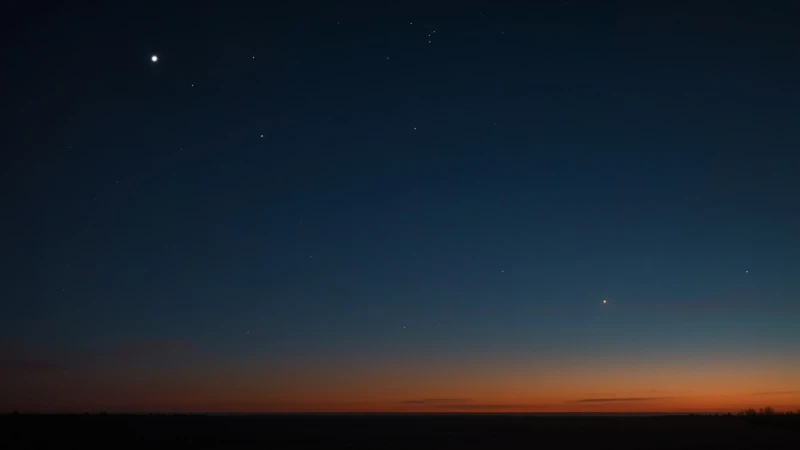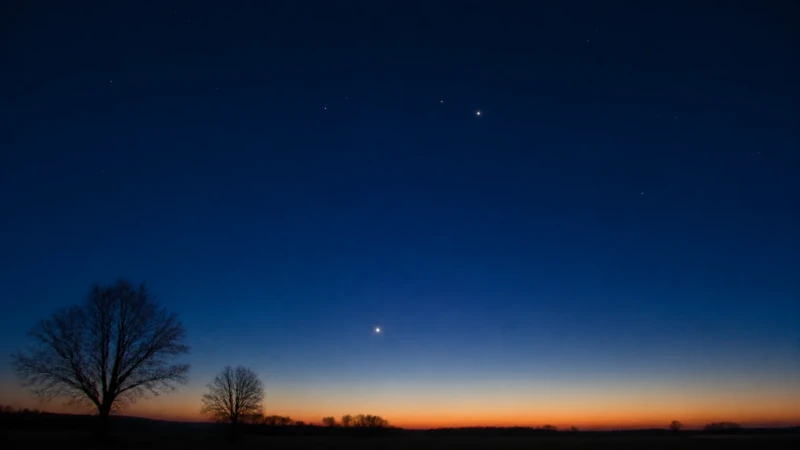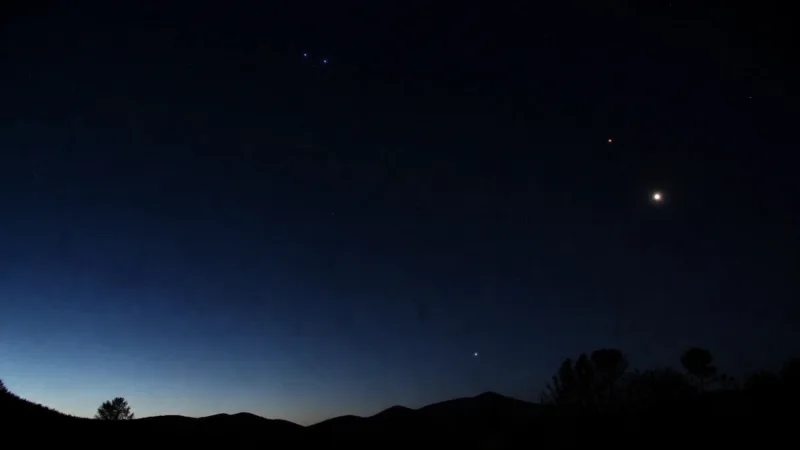
Venus reaches greatest brilliancy as the Morning Star around November 29, 2026, blazing at about magnitude -4.7 in the dawn sky, bright enough to cast faint shadows from a dark site and to be found in full daylight if you know where to look. It is a strange peak: Venus is brightest not when it is full but when it is a thick crescent, a quarter lit, because that is when the lit part covers the most sky. This guide explains the timing, what Venus looks like through binoculars and a telescope this month, where it sits relative to Spica and Mercury, and when the Moon joins it. Times below are for Dallas in Central Standard Time; the Venus page converts them to your city.
When Venus is brightest, and why it is flat
Greatest brilliancy, properly called greatest illuminated extent, is the moment the lit area of Venus’s disc as seen from Earth is largest. Since Venus passed between us and the Sun on October 23, it has been pulling away: the disc shrinks each week as the distance grows, while the sunlit fraction grows as the angle opens. The product of the two, the actual area of lit planet, rises to a maximum and then falls. From our planetary positions the peak is a plateau: the lit area is within a fraction of a percent of its maximum from November 27 to December 1, with the centre on the 29th. Published dates range from the 27th to the 29th for the same reason. The practical point is that Venus is as bright as it gets for a whole week, and only slightly less for a month either side.
By the numbers, at greatest brilliancy Venus is 0.40 astronomical units away, 41 arcseconds across, 26 percent lit, 40 degrees from the Sun, and at magnitude -4.7 by our model, with other catalogues giving -4.4 to -4.8 depending on how they treat the atmosphere. Whatever the figure, it is about 20 times brighter than Sirius.
Where and when to look
Venus rises about three hours before the Sun and is high in the south-east by dawn: 24 degrees up at civil dawn in mid-November, 30 degrees on the 25th and 33 degrees by December 6. You cannot miss it. The useful detail is what sits around it:
- November 19 to 21: Venus passes 2 degrees above Spica, the brightest star of Virgo, the closest the two come this season.
- November 14 to 28: Mercury is about 15 degrees below Venus and a little to the left, at magnitude -0.5, its best morning showing of the year. Our Mercury guide has the details.
- December 5: the 22 percent waning crescent Moon stands about 7 degrees from Venus at dawn, the month’s best photo pairing.
- Far above: Jupiter and Mars, 65 to 70 degrees high in the south, a few degrees apart after their November 16 conjunction.
Through binoculars and a telescope
Venus is one of the few planets that rewards binoculars. In steady 10x binoculars braced against a wall, the disc is visibly not round: a fat crescent, 41 arcseconds across, which is bigger than Jupiter appears. A telescope at 50x shows the crescent plainly, and at 150x it fills a good part of the field, brilliant white and featureless, its terminator slightly soft because Venus’s thick atmosphere scatters light around the edge of the night side. The phase changes week by week: 11 percent lit on November 12, 19 percent on the 20th, 26 percent on the 29th, 32 percent by December 6, the disc shrinking as the crescent fattens. Watching that progression over a month is watching the geometry of the inner solar system directly.
Observe at dawn rather than in the dark. Against a bright sky the glare is tamed and the crescent is far easier to see; the best views of Venus are often had after sunrise, with the planet found in binoculars first and then followed up in the telescope. Take care never to sweep near the Sun once it is up.
Venus in daylight
At magnitude -4.7 Venus is visible to the naked eye in a clear blue daytime sky, and greatest brilliancy is the easiest time of the apparition to try. The trick is knowing exactly where to look. On the morning of December 5 the crescent Moon is 7 degrees from Venus, so find the Moon in the daytime sky and look a hand-width to its right; without the Moon, note Venus’s position at dawn relative to a tree or rooftop and come back to the same spot an hour after sunrise. Once seen, it is unmistakable and oddly easy to find again.
What comes next
Venus reaches greatest elongation west on January 3, 2027, 47 degrees from the Sun, when it is half lit and a little less bright, and it remains the Morning Star through the winter and spring before swinging back behind the Sun next summer. For the apparition as a whole our Venus guide explains the switch from evening to morning. The planet events calendar lists the Moon’s visits and every elongation with times for your zone.