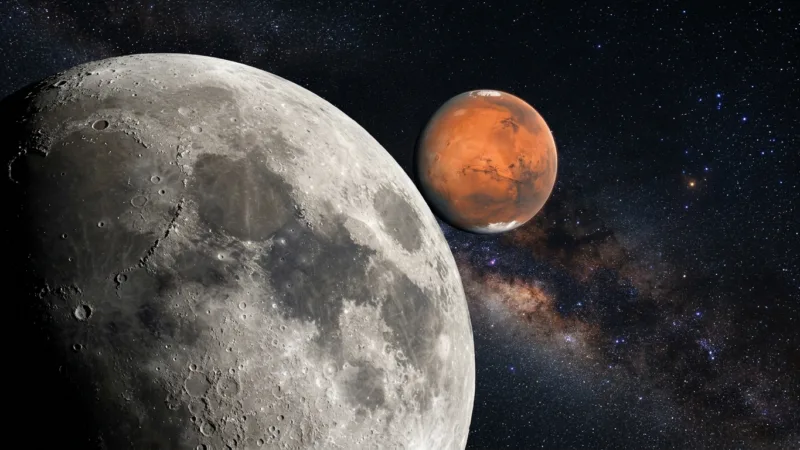
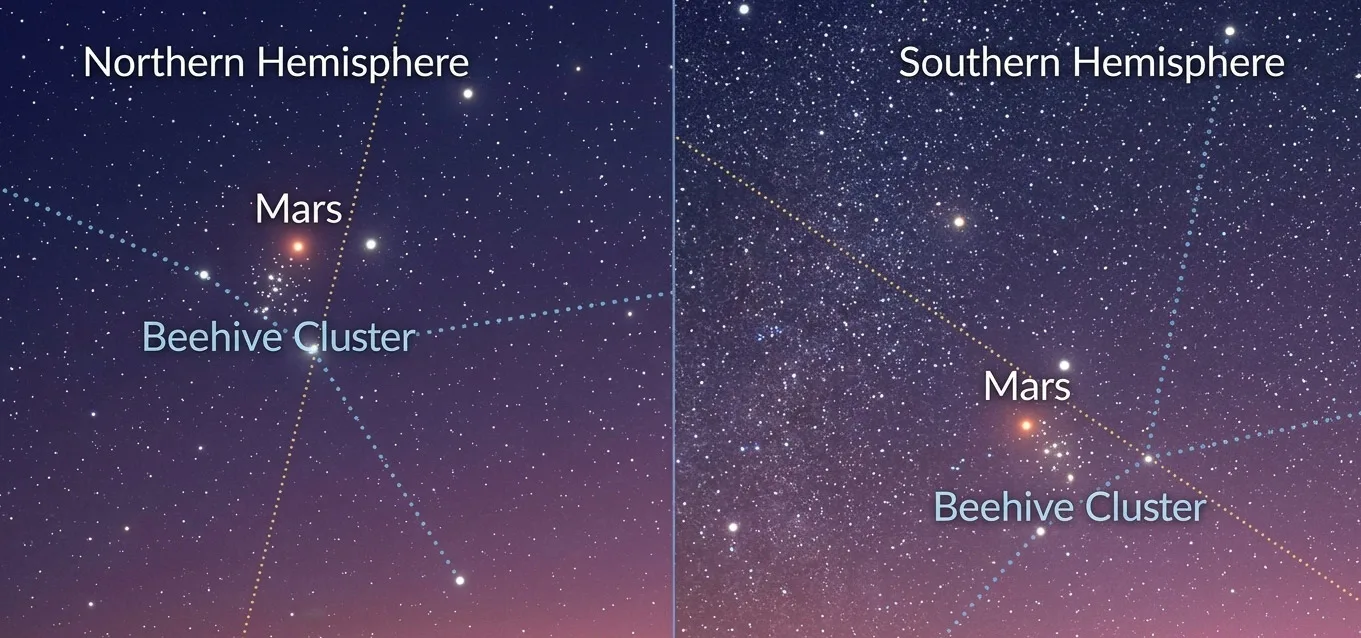
For three mornings this week Mars drifts straight through one of the best star clusters in the sky. On Saturday, October 10, the red planet sits at the western edge of the Beehive Cluster; on Sunday, October 11, it is near the middle; by Monday, October 12, it is leaving on the eastern side. An orange planet among a swarm of faint blue-white stars is one of the prettiest binocular sights of the year, and with the new moon on October 10 there is no moonlight to spoil it. Times below are for Dallas in Central Time; the Mars page gives its position for your city.
When and where to look
This is a morning event. The Beehive rises just before 2 AM, and Mars with it. By 5:30 AM the pair is 43 degrees high in the east, well above the murk near the horizon, and the sky stays fully dark until astronomical dawn begins at about 6:05 AM. The best window is 4:30 to 6 AM.
Finding it is easy because of a bright signpost. Look east for Jupiter, by far the brightest object in that part of the sky. Mars is the orange point above and to the right of Jupiter, modest at magnitude 1.0 but obvious from its colour. Point binoculars at Mars and the cluster is in the same field of view.
Morning by morning
- Thursday and Friday, October 8 and 9: Mars approaches from the west, one to two degrees from the cluster. Both fit comfortably in one binocular field.
- Saturday, October 10: Mars is at the western edge of the cluster, about two-thirds of a degree from its centre.
- Sunday, October 11: the closest morning. Mars is inside the cluster, less than half a degree south of its centre, with stars on every side.
- Monday, October 12: Mars is at the eastern edge, moving out.
- Tuesday and Wednesday, October 13 and 14: Mars pulls away to the east, one to two degrees beyond the cluster, still a fine pairing.
Mars moves a little over half a degree a day against the stars this month, about the width of the full Moon, so the view is noticeably different each morning. If you look on two or three mornings you can watch a planet move.
What you will see
To the naked eye from a dark site the Beehive is a small misty patch, and this week it has an orange star in it. From town you will see Mars but probably not the cluster. In binoculars, any pair, the mist turns into dozens of stars spread across an area about three full Moons wide, with Mars glowing among them like an ember. That contrast of colour is the whole appeal: the cluster stars are white and blue-white, Mars is plainly orange.
A telescope is too much. At anything above about 30 times magnification the cluster no longer fits in the view. Use the lowest power you have, or stay with binoculars. For a photograph, a camera on a tripod with a 100 to 200 mm lens and an exposure of a few seconds will catch the planet and the brighter cluster stars together.
The Beehive Cluster
The Beehive, catalogued as M44 and known since antiquity as Praesepe, the manger, is an open cluster of about a thousand stars some 600 light years away in the constellation Cancer. The stars formed together around 600 to 700 million years ago and still travel through space as a group. Ancient observers knew it as a little cloud and used it as a weather sign: if the manger could not be seen in an otherwise clear sky, rain was on the way. Galileo turned his telescope on it in 1609 and was the first to see that the cloud was made of stars, counting about forty.
The cluster lies almost on the ecliptic, the path the planets follow, which is why they visit it. Mars passes through or close to the Beehive roughly every two years; it was last here in spring 2025.
Where Mars is heading
Mars is slowly brightening as Earth catches up with it. It reaches opposition on February 19, 2027, when at magnitude -1.2 it will be brighter than every star except Sirius. Through the rest of October it climbs higher in the morning sky, from 64 degrees at dawn in mid-month to 70 degrees by the 31st, while Jupiter follows below it in Leo. Our October planets guide covers the rest of the month, and the planets page shows where each one is tonight from your city.