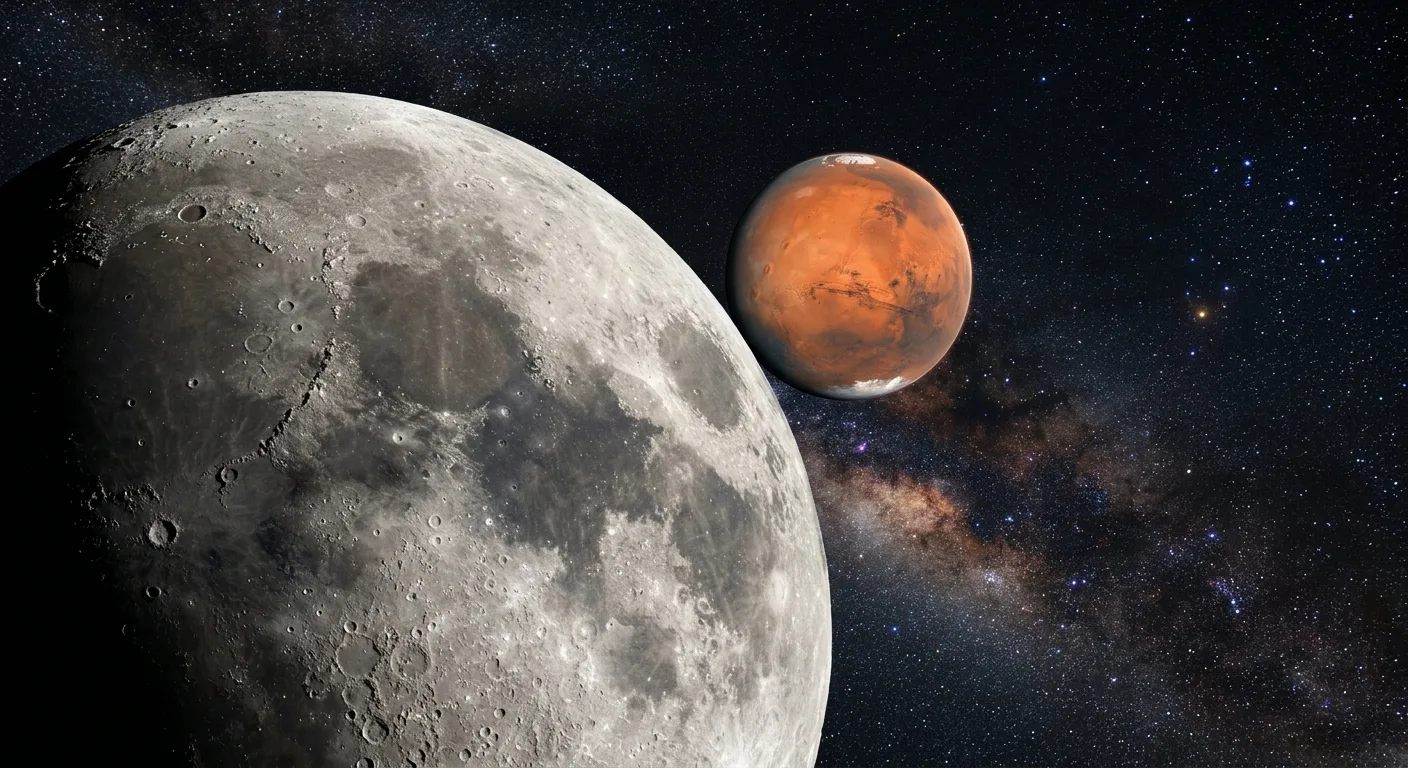
Two mornings in a row this week the waning crescent Moon visits the two brightest planets of the dawn sky. On Monday, October 5, it passes just over a degree from Mars. On Tuesday, October 6, it goes one better and passes in front of Jupiter, an occultation visible from most of North America. Both are naked-eye events that need nothing but an early alarm and a clear view to the east. Times below are for Dallas in Central Time; the event pages linked here convert them to your city.
Monday, October 5: the Moon beside Mars
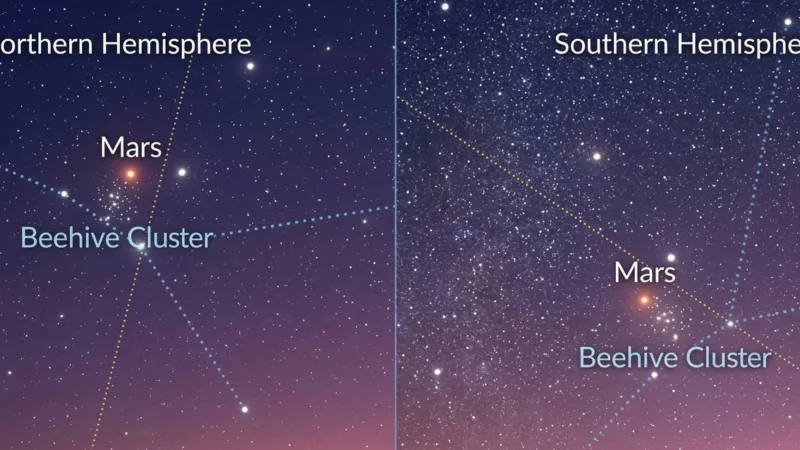
The Moon, a 27% crescent, rises at 2:05 AM with Mars close by; closest approach is at 1:10 AM, so by the time the pair clears the horizon they are already separating slightly, about 1.1 degrees apart, two Moon-widths. Mars is a modest orange point at magnitude 1.1, and the contrast with the bright crescent is the attraction. By 5 AM the two are 50 degrees high in the east, with Jupiter blazing below them and the sky still fully dark until about 6:15. Earthshine, the faint glow on the Moon’s unlit side, is easy to see at this phase and looks lovely in binoculars with Mars in the same field. Details for your location on the Moon near Mars page.
Tuesday, October 6: the Moon covers Jupiter
This is the one to set the alarm for. The Moon, now a 17% crescent, rises at 3:13 AM and comes within a fifth of a degree of Jupiter at 5:24 AM, so close that from a broad band of the Earth it passes directly in front of the planet. The occultation is visible from the United States except the Pacific coast states, south-central and south-eastern Canada, Mexico, the northern Caribbean and West Africa. From Dallas, Jupiter is about 14 degrees up at 4:30 AM and 36 degrees by 6:15, with the sky darkening into dawn after 6:15.
What you see: Jupiter, at magnitude -1.9 the brightest object in the sky after the Moon, creeps toward the Moon’s bright edge, then vanishes behind it over about a minute. Jupiter is a disc, not a point, so it does not blink out; it is swallowed gradually, moons first. Up to an hour later it reappears from behind the dark limb, which is the more dramatic half because the planet seems to emerge from nothing. In binoculars or a small telescope you can watch the four Galilean moons disappear one by one ahead of the planet.
The exact disappearance and reappearance times depend on where you are, and they can differ by tens of minutes across a single state, because the Moon’s edge projects a track across the ground like an eclipse path. The Moon near Jupiter page gives the moment of closest approach for your city; for the minute-by-minute contact times, a planetarium app such as Stellarium set to your location is the tool. If you are west of the Rockies the Moon misses Jupiter and the two rise together as a tight pair, still a fine sight.
How to watch
- Start early. Be outside 20 minutes before the disappearance time for your location. The Moon’s bright edge approaches Jupiter faster than you expect.
- Naked eye is enough for the pairing and the disappearance. Binoculars make the reappearance from the dark edge much easier to catch, because you can watch the spot where Jupiter will pop out.
- A telescope at 50 to 100 times shows the moons vanish in sequence and Jupiter’s disc slide behind the lunar mountains. Any small scope will do.
- Photograph it with a phone held to binoculars or an eyepiece; short video captures the moment of contact better than stills.
- Clear view to the east matters more than dark skies. These are bright objects; a balcony facing east works.
The rest of the week’s dawn sky
Mars and Jupiter stay high in the east before sunrise all month, Mars above and to the right. The Moon thins to a 4% sliver by Thursday, October 8, the morning of the Draconid meteor shower peak, and reaches new moon on October 10. Saturn, just past opposition, is low in the west at dawn. And on the evening of October 12 the Moon returns as a young crescent next to Mercury, low in the west after sunset, for a third planet pairing in eight days. All of them are on the planets page with altitudes for your city.