Mercury reaches greatest elongation east on Monday, October 12, 2026, when it stands 25 degrees from the Sun in the evening sky, as far as it gets on this visit. How good that is depends entirely on where you live. For the southern hemisphere this is the best evening view of Mercury all year. For the northern hemisphere it is a hard catch: the planet is only 6 to 8 degrees above the horizon in the minutes after sunset and gone within the hour. It can be done, with a flat horizon, a clear sky and binoculars, and this guide explains how. Times below are for Dallas in Central Time; the Mercury elongation page converts them to your city.
What greatest elongation means
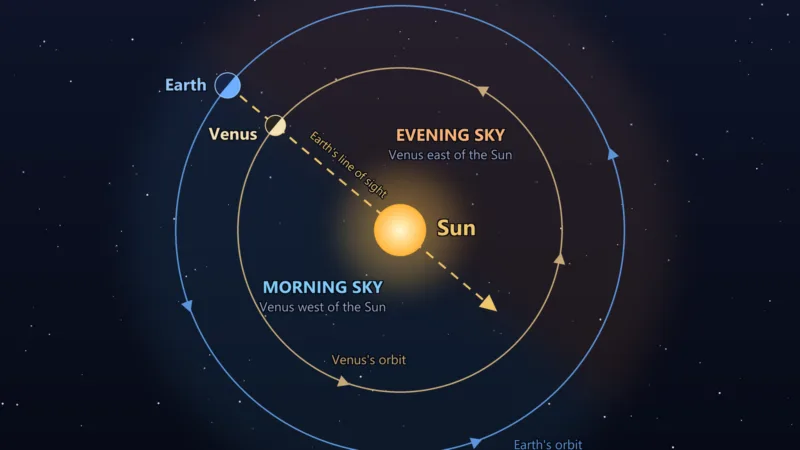
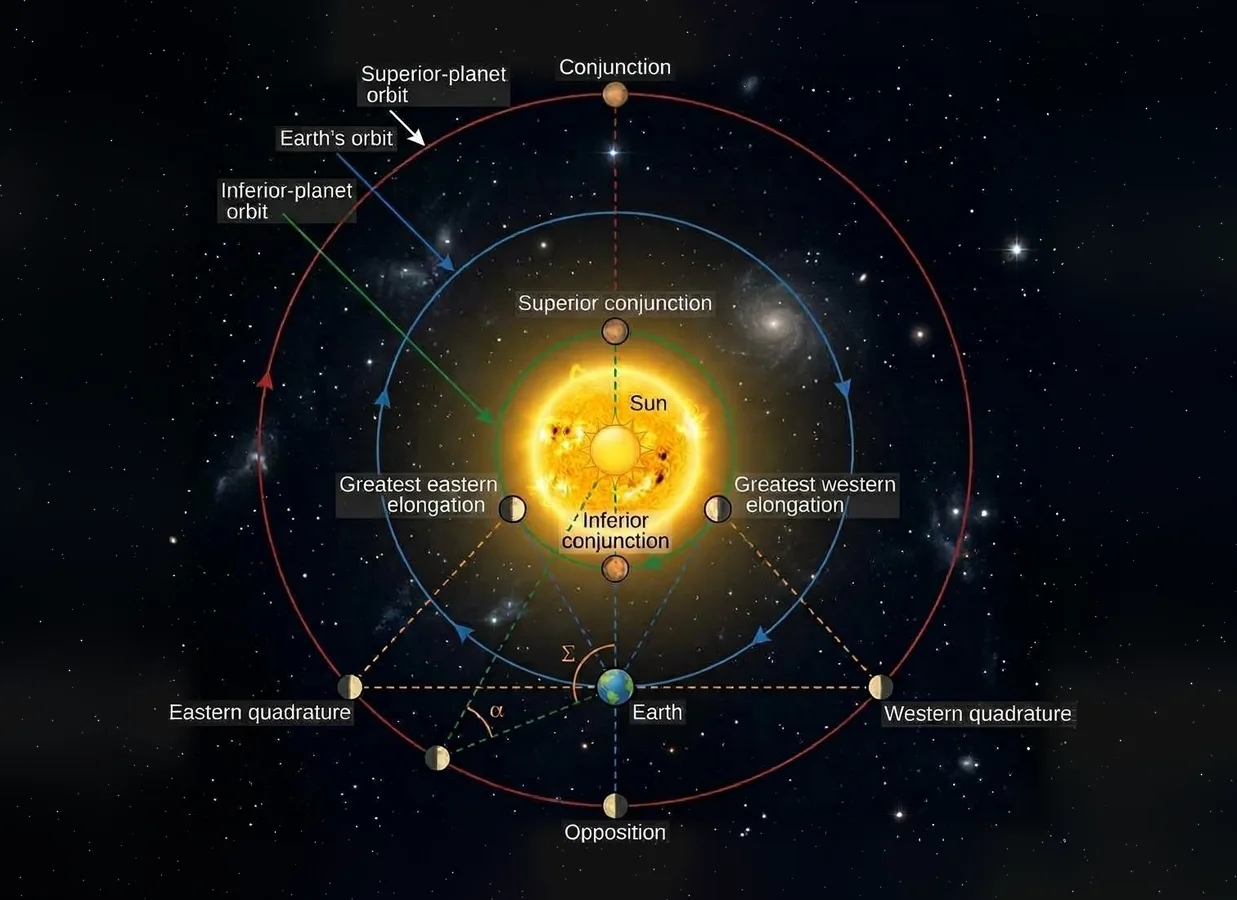
Mercury orbits closer to the Sun than we do, so from Earth it never strays far from the Sun in the sky. It swings out to one side, then back, then out to the other, every few weeks. Greatest elongation is the moment it is farthest out. East of the Sun means it follows the Sun down and appears after sunset; west means it rises before the Sun and appears at dawn. Twenty-five degrees is a generous elongation for Mercury, close to the most it ever manages.
Why the same event is good in the south and poor in the north
What matters is not just how far Mercury is from the Sun but in which direction. In northern autumn the ecliptic, the path the Sun and planets follow, meets the evening horizon at a shallow angle. Mercury’s 25 degrees are stretched mostly sideways along the horizon rather than upward, so it sets soon after the Sun. In the southern hemisphere it is spring, the ecliptic stands steeply at dusk, and the same 25 degrees lift Mercury high into a dark sky. For northern observers the best evening view of 2026 was back in February. The good news is that the pattern reverses for morning appearances, so the north’s next easy view of Mercury comes before dawn around its greatest elongation west on November 20.
How to see it from mid-northern latitudes
In Dallas on October 12 the Sun sets at 6:57 PM. Mercury then follows this schedule:
- 7:07 PM, 10 minutes after sunset: 9 degrees up in the west-south-west. The sky is still bright; binoculars are needed.
- 7:17 PM, 20 minutes after sunset: 7 degrees up. The best compromise between height and a darkening sky.
- 7:27 PM, 30 minutes after sunset: 5 degrees up and sinking into the haze.
- 7:57 PM: Mercury sets.
So the window is about 15 minutes long, from roughly 7:10 to 7:25 PM. The same pattern holds within a few minutes on every evening from about October 6 to 18, so you have nearly two weeks of chances, not one night.
- Find a truly flat horizon to the west-south-west: a lake, a field, a hilltop or an upper floor. Trees and buildings a few degrees high will hide it.
- Wait for a very clear evening. Haze near the horizon is the usual reason people miss Mercury.
- Start 10 minutes after sunset with binoculars. Sweep slowly just above the horizon, a little to the left of where the Sun went down. Never use binoculars while any part of the Sun is still above the horizon.
- Look for a steady, slightly pinkish point. At magnitude 0.0 Mercury is as bright as the brightest stars, but the twilight hides that. Once you have it in binoculars, try to see it without them.
The Moon as a guide on October 12
On the evening of the elongation itself a two-day-old crescent Moon, 5% lit, is in the same part of the sky. The two were closest, 2 degrees apart, in the afternoon; by dusk in the central United States the Moon is about 3 degrees to Mercury’s left, at about the same height, and sets at 7:54 PM. The crescent is thin and low, so it is a challenge too, but if you can find it, Mercury is the point of light just to its right. Details for your city are on the Moon near Mercury page. Venus is also nearby but too low to see: it sets within minutes of the Sun as it heads for inferior conjunction on October 24.
If you are in the southern hemisphere
From Australia, New Zealand, southern Africa and South America this is the Mercury appearance to catch. The planet stands high above the western horizon for well over an hour after sunset through mid-October, easy to the naked eye, with the crescent Moon and Venus lined up with it on the 12th. Look west as the sky darkens; you will not need binoculars.
What you can see in a telescope
Mercury shows phases like the Moon. At this elongation it is about 60% lit, a tiny gibbous disc about 7 arcseconds across, less than half the apparent size of Saturn’s globe. Low altitude and unsteady air make detail impossible; the reward is simply seeing the phase. Over the following week the disc grows and thins to a crescent as Mercury swings between us and the Sun.
After October 12
Mercury holds its height for about a week, then drops quickly. It fades as it goes, reaching magnitude 0.2 by October 18, and is lost in the Sun’s glare by the last week of the month. It passes between Earth and the Sun on November 4 and then moves to the morning sky. The Mercury page shows whether it is visible tonight from your city, and our October planets guide covers the other planets, all of which are easier.