October 2026 is a good month for planets, with one at its very best, two dominating the morning sky, one making a brief evening appearance and one leaving the stage. Saturn reaches opposition on October 4 and shines all night. Jupiter and Mars own the hours before dawn, and on October 6 the Moon passes in front of Jupiter for much of North America. Mercury reaches its greatest evening elongation on October 12 but stays very low for northern observers, while Venus slips into the Sun’s glare before switching to the morning sky in November. Altitudes and times below are for Dallas in Central Time; the planets page recalculates them for your city.
Saturn: at opposition, up all night
Saturn is the planet of the month. It reaches opposition on October 4 at 9:04 AM Central Time, when Earth passes directly between it and the Sun, so it rises at sunset, stands 53 degrees high in the south-east at midnight on the first of the month and sets at dawn. At magnitude 0.6 it is the brightest object in that part of the sky, a steady cream-coloured light in the faint constellation Pisces. The rings are tilted about 7 degrees toward us, enough to show the Cassini Division in a 4-inch telescope on a steady night. By the end of October Saturn is already 21 degrees up at dusk and highest around 11 PM, which makes late October the comfortable time for an early-evening look. Our Saturn at opposition guide has the details on what different telescopes show.
Jupiter: brilliant before dawn, and hidden by the Moon on October 6
Jupiter is the brightest thing in the morning sky at magnitude -1.9, rising after midnight and standing 43 degrees high in the east as dawn breaks on October 1, 65 degrees by the 31st. It sits in Leo, a little west of Regulus. The event of the month comes on the morning of October 6, when the waning crescent Moon passes in front of Jupiter. The occultation is visible from most of the United States and Canada, Mexico and the northern Caribbean, with the pair only a fifth of a degree apart at closest approach. From Dallas the Moon rises at 3:13 AM with Jupiter right beside it; the exact minute of disappearance and reappearance depends on where you are, so check a planetarium app for your town. West of the Rockies the Moon misses the planet and the two simply rise together in a tight pair.
Mars: high in the morning sky
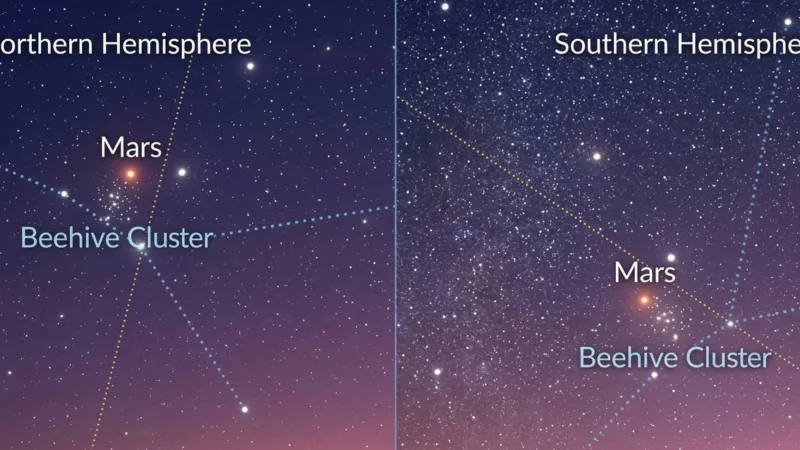
Mars is still four months from its next opposition, on February 19, 2027, so it is a modest orange point at magnitude 1.1, but it is well placed: 60 degrees high in the east before sunrise on October 1 and 70 degrees by month’s end, above and to the right of Jupiter in Cancer. The Moon passes it too, on the morning of October 5, a little over a degree away, the night before the Jupiter occultation. Watch the pair from about 5 AM, with Mars roughly 50 degrees up by the start of dawn.
Mercury: greatest elongation on October 12, a hard catch in the north
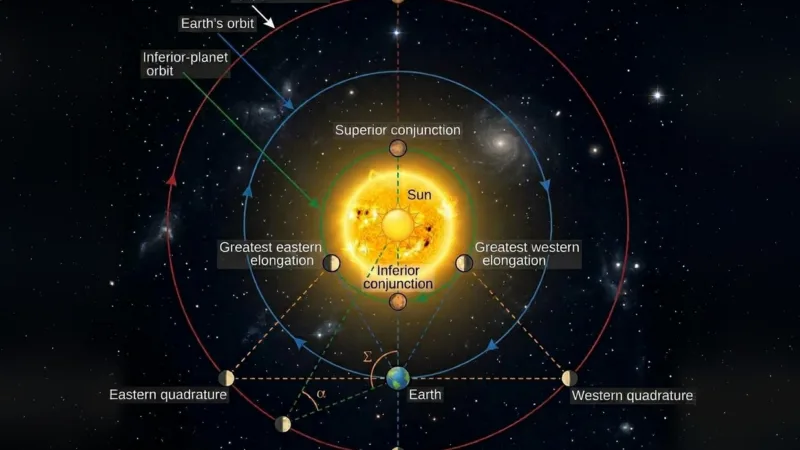
Mercury reaches greatest elongation east on October 12, 25 degrees from the Sun, which is as far from it as it gets this autumn. That makes it the southern hemisphere’s best evening view of Mercury this year; for northern observers the best was back in February, because in autumn Mercury’s path lies almost flat along the evening horizon. From mid-northern latitudes it is a low target: about 6 to 8 degrees above the west-south-west horizon 20 minutes after sunset, at magnitude 0.0. You need a flat horizon and binoculars to pick it out of the glow, then it shows to the naked eye. The evening of October 12 gives you a marker: a two-day-old crescent Moon sits about 3 degrees to Mercury’s left at dusk. After mid-month Mercury drops back toward the Sun and is gone by the last week of October.
Venus: leaving the evening sky
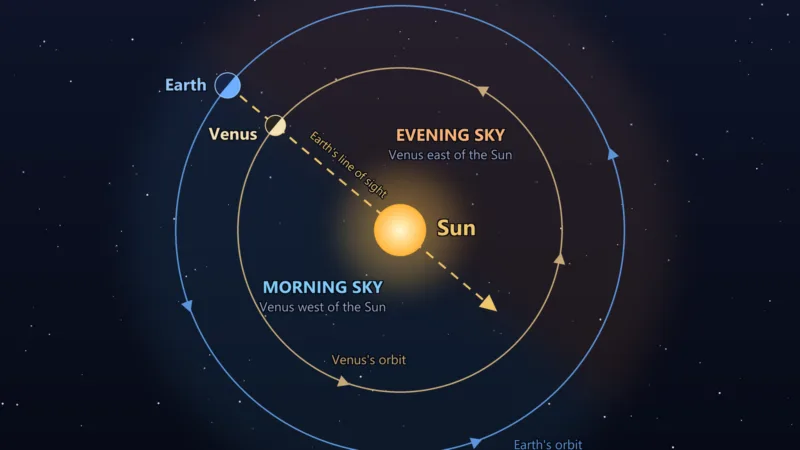
Venus is at its brightest, magnitude -4.5, but it is only about 5 degrees high at dusk on October 1 and sinks lower every evening. By mid-month it sets before the sky is dark. It passes between Earth and the Sun at inferior conjunction on October 24, then reappears in the east before sunrise in the first days of November, about 6 degrees up by the 31st, on its way to a long run as the Morning Star through the winter.
Uranus and Neptune: for binoculars
Uranus, at magnitude 5.6, rises in the evening in Taurus, a few degrees to the lower left of the Pleiades, and is 24 degrees high in the east by midnight on October 1, 49 degrees by the 31st. It is within reach of binoculars from a dark site and heads for its own opposition on November 25. Neptune, magnitude 7.8, is nine degrees west of Saturn and just past its September opposition; use Saturn as the signpost and a telescope to see its blue-grey disc. Our Neptune guide explains how to find it.
The month at a glance
- Evening: Saturn rising in the east, Mercury and Venus very low in the west-south-west at dusk (Venus gone by mid-month), Uranus and Neptune for optics.
- Midnight: Saturn and Neptune high in the south-east, Uranus climbing in the east.
- Before dawn: Jupiter and Mars high in the east, Saturn low in the west.
- Dates: October 4 Saturn opposition; October 5 Moon near Mars; October 6 Moon occults Jupiter; October 12 Mercury greatest elongation and Moon near Mercury; October 24 Venus inferior conjunction.
For any night this month, the planets page shows each planet’s altitude and direction at dusk, midnight and dawn for your city, and the October sky guide covers the Moon, meteor showers and everything else the month brings.