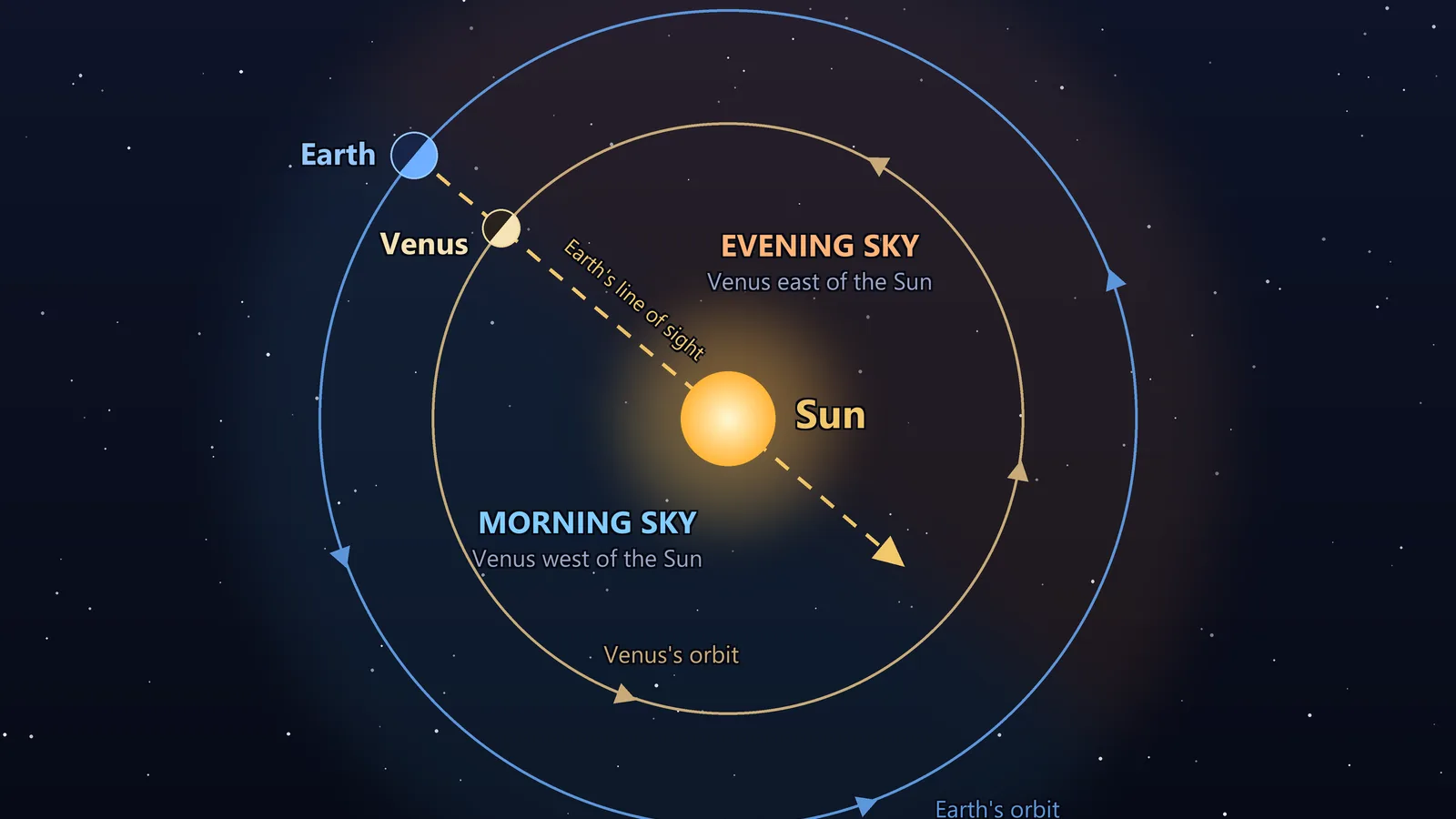
Venus is about to vanish. For months it has been the Evening Star low in the west after sunset, but it has been sinking lower every week, and on Saturday, October 24, 2026, at 03:35 UTC, which is 10:35 PM Central Time on Friday, October 23, it passes between the Earth and the Sun. That moment is called inferior conjunction. Venus is already lost in the Sun’s glare, and it stays hidden for about two weeks. Then it reappears on the other side of the Sun, in the east before dawn, and begins a long run as the Morning Star that lasts through the winter and spring. Times below are for Dallas; the Venus page adjusts them to your city.
What inferior conjunction is
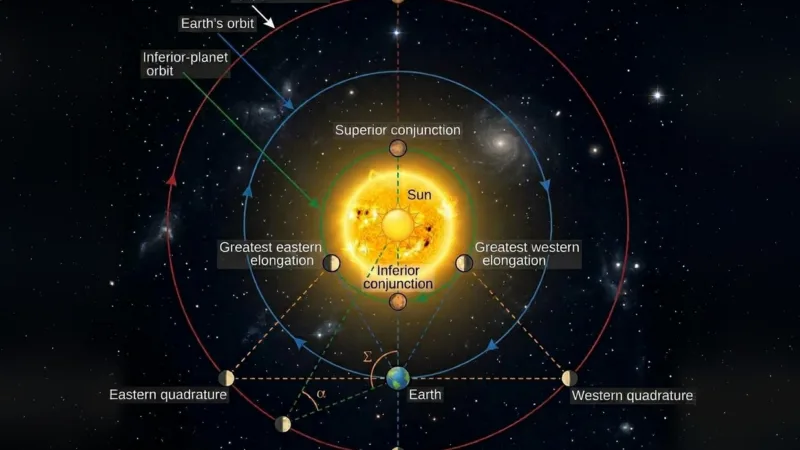
Venus orbits the Sun inside Earth’s orbit, so from our point of view it swings from one side of the Sun to the other every 19 months. When it is east of the Sun we see it after sunset; when it is west, before sunrise. Inferior conjunction is the moment it passes between us and the Sun, switching from evening to morning. At this one it does not cross the Sun’s face; it passes about six and a half degrees from it, so there is no transit. Transits of Venus are rare, and the next is not until 2117.
Venus at its closest, and nearly invisible
Inferior conjunction is also when Venus is closest to Earth. On October 24 it is 0.27 astronomical units away, about 41 million km, and its disc is 62 arcseconds across, the largest it ever appears, bigger than Jupiter. Yet only 1% of that disc is lit from our side, a hair-thin crescent, and it sits in daylight beside the Sun. That combination makes it one of the hardest and most dangerous targets in astronomy: experienced observers do photograph the crescent in daytime with careful shielding, but pointing binoculars or a telescope anywhere near the Sun can blind you in an instant. Do not try it. Wait two weeks and it will be safe and easy.
The last evening views
From mid-northern latitudes the evening apparition is already over. By mid-October Venus was setting within minutes of the Sun, too low to see even in binoculars. Observers in the southern hemisphere, where the evening ecliptic stands steeper, kept it a little longer, but by the week of the conjunction it is gone for everyone.
When and where it returns
Venus climbs into the morning sky quickly. These are its positions at dawn from Dallas, with the crescent filling out as it goes:
- November 1: 7 degrees above the eastern horizon before sunrise. Low, but at magnitude -4.3 it punches through the twilight. First chance for most people.
- November 7: 15 degrees up in the south-east, a 7% crescent in a small telescope. The waning crescent Moon is right beside it this morning, a fine pairing.
- November 14: 22 degrees up, an 11% crescent.
- November 21: 28 degrees up, the crescent now 19% lit.
- November 28: 31 degrees up and at about its brightest for this apparition, magnitude -4.7 by our calculation and -4.9 in some almanacs. In a dark rural sky it can cast a faint shadow.
Venus is brightest not when it is fullest but a few weeks after conjunction, when the crescent is still thin but the disc is still large; the lit area is at its greatest then. Through December the crescent thickens to a half, and Venus reaches its greatest distance from the Sun, 47 degrees, on January 3, 2027, after which it stays a morning object until summer.
A telescope target worth the early alarm
The weeks after conjunction are the best time all cycle to see Venus’s phases. Any telescope, and even steady 10x binoculars, shows the crescent in early November, and you can watch it fatten week by week like a miniature Moon. Galileo’s observation of exactly this, in 1610, was one of the proofs that Venus orbits the Sun. Look as early in dawn as possible, when Venus is highest and the sky is darkest, but the glare is also fierce, so a slightly brightened sky often gives a steadier view.
The rest of the planets while Venus is away
Saturn holds the evening, high in the south by 11 PM. Jupiter and Mars own the hours before dawn, high in the east, and Venus will rise below them in November to make a line of three morning planets. Mercury is also heading for the morning sky, with its own best dawn appearance around November 20. Our October planets guide has the details, and the Venus conjunction page gives the moment for your time zone.