On a cold, clear evening the brightest star low in the sky does not just twinkle. It flickers red, then blue, then green, fast enough that people report it as a drone or a distress flare. The star is usually Sirius, and nothing is wrong with it. Twinkling is something the air does, and once you know how it works you can use it: to tell a planet from a star, to judge whether tonight is worth setting up a telescope, and to explain the flashing light to whoever is standing next to you.
A point of light through moving air
Stars are so far away that even the largest shows no size at all to the eye. Sirius, the brightest in the night sky, is only 0.006 arcseconds wide, which is a coin seen from several hundred kilometres. Its light reaches the top of our atmosphere as a single, perfectly flat sheet.
The air it then crosses is not uniform. Pockets a little warmer or cooler than their surroundings bend light by slightly different amounts, and each pocket acts as a very weak lens. By the time the light reaches the ground it has been gathered into a moving pattern of brighter and dimmer patches a few centimetres to a hand’s width across, the same thing as the ripples of light on the floor of a swimming pool. The pupil of your eye is about 7 millimetres wide, so it sits inside one patch at a time, and the pattern is carried past by winds high in the atmosphere that often blow at tens of metres a second. The brightness you see therefore jumps many times each second. Astronomers call it scintillation.
Most of the twinkle is made high up, around 10 kilometres, where the jet streams run. That is why a perfectly calm night at ground level can still have furiously twinkling stars, and why stars seen from orbit do not twinkle at all.
Why planets hold steady
A planet is close enough to show a disc, even if the eye cannot make it out. This month Venus is 47 arcseconds wide, Jupiter 38, Saturn 19, Mars and Mercury about 7 and Uranus 3.8, against Sirius’s 0.006. That difference decides everything.
Follow the light back up to 10 kilometres. The rays from opposite edges of Jupiter’s disc pass through the turbulent layer about 1.8 metres apart, which is many pockets of air wide. While one part of the disc is being brightened, another is being dimmed, and the eye receives the average. The rays from opposite edges of Sirius are a third of a millimetre apart at the same height. They all go through the same pocket and brighten and dim together.
The rule “stars twinkle, planets do not” is therefore a matter of size, and it has exceptions worth knowing:
- Small planets twinkle. Mercury always does, being small and never far above the horizon. Mars does when it is on the far side of its orbit and only a few arcseconds wide.
- Any planet twinkles near the horizon, where its light crosses so much air that even a disc is not enough. Venus in its last minutes before setting can flash colours like a star.
- High stars can look steady on a night of calm upper air. Vega or Capella overhead sometimes barely flicker.
Above about 30 degrees, on an ordinary night, the test is reliable: the bright point that burns without a flicker is a planet. The planet pages will tell you which one it is from your city.
Why low stars flash colours
Two things change as a star sinks toward the horizon. The first is the amount of air. Light from overhead crosses one thickness of atmosphere; at 30 degrees up it crosses two, at 10 degrees more than five and at 5 degrees more than ten. More air means more pockets and a stronger twinkle.
The second is colour. The atmosphere bends blue light a little more than red, so it acts as a weak prism, and near the horizon a star’s colours arrive along slightly different paths. The patches of bright and dim on the ground are then in different places for each colour. One instant your eye is in a bright patch of red and a dim patch of blue, the next the reverse, and the star seems to change colour. It takes a bright star to show it, because the eye only sees colour when there is enough light, and a white one, because a white star has every colour to lose.
Sirius is both, and for most of the northern hemisphere it is never high. It reaches 47 degrees at its best from Miami, 40 from Dallas, 32 from New York, 31 from Chicago, 26 from Seattle, 22 from London and 14 from Stockholm, and it spends hours lower than that on either side. From Sydney it climbs to 73 degrees and is a much calmer star. The other regular flashers are Capella, low in the north-east on autumn evenings; Arcturus, low in the west in autumn and rising before dawn in winter; and Vega, sinking in the north-west in December.
Reading the night from the twinkle
For anyone with a telescope the twinkle is a free forecast. The same turbulence that makes stars flicker smears the view at high magnification, a quality observers call the seeing.
- Stars twinkling hard, even overhead: the upper air is rough. Planets will boil in the eyepiece and fine detail on the Moon will come and go. Stay at low power: clusters, the Milky Way and meteors are unaffected.
- Stars steady and a little soft: good seeing, often on still, slightly hazy nights. This is when Saturn’s rings and Jupiter’s belts snap into focus, even if the sky looks less sparkling.
- Brilliantly clear after a cold front: usually the worst seeing of all. Transparency and steadiness are different things, and the nights that look best to the eye are often the ones that disappoint at 200 times magnification.
Professional observatories are built on mountains to get above much of the turbulence, and the largest telescopes use adaptive optics, flexible mirrors that reshape themselves hundreds of times a second to undo it. Space telescopes avoid the problem altogether.
You can also photograph the colours. Put a camera or phone on a tripod, aim at Sirius when it is low, take an exposure of a second or two and tap the tripod as the shutter opens. The star draws a wobbling line across the frame, and the line comes out as a string of red, green, blue and white beads, one for each instant of the flicker.
Sirius and the flashing stars this season
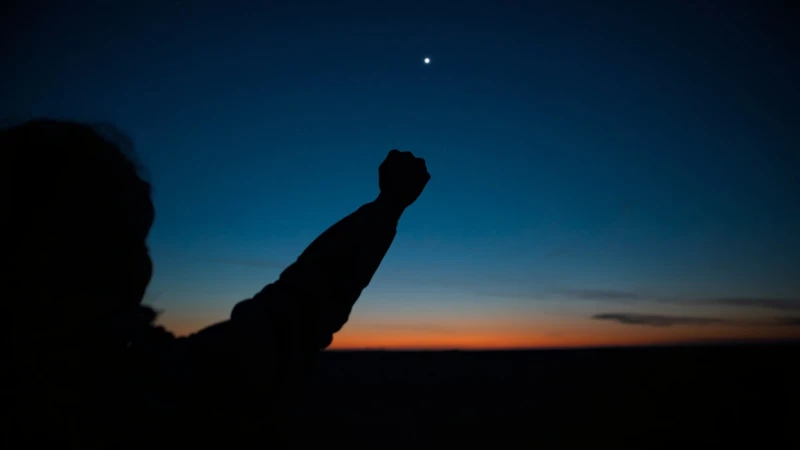
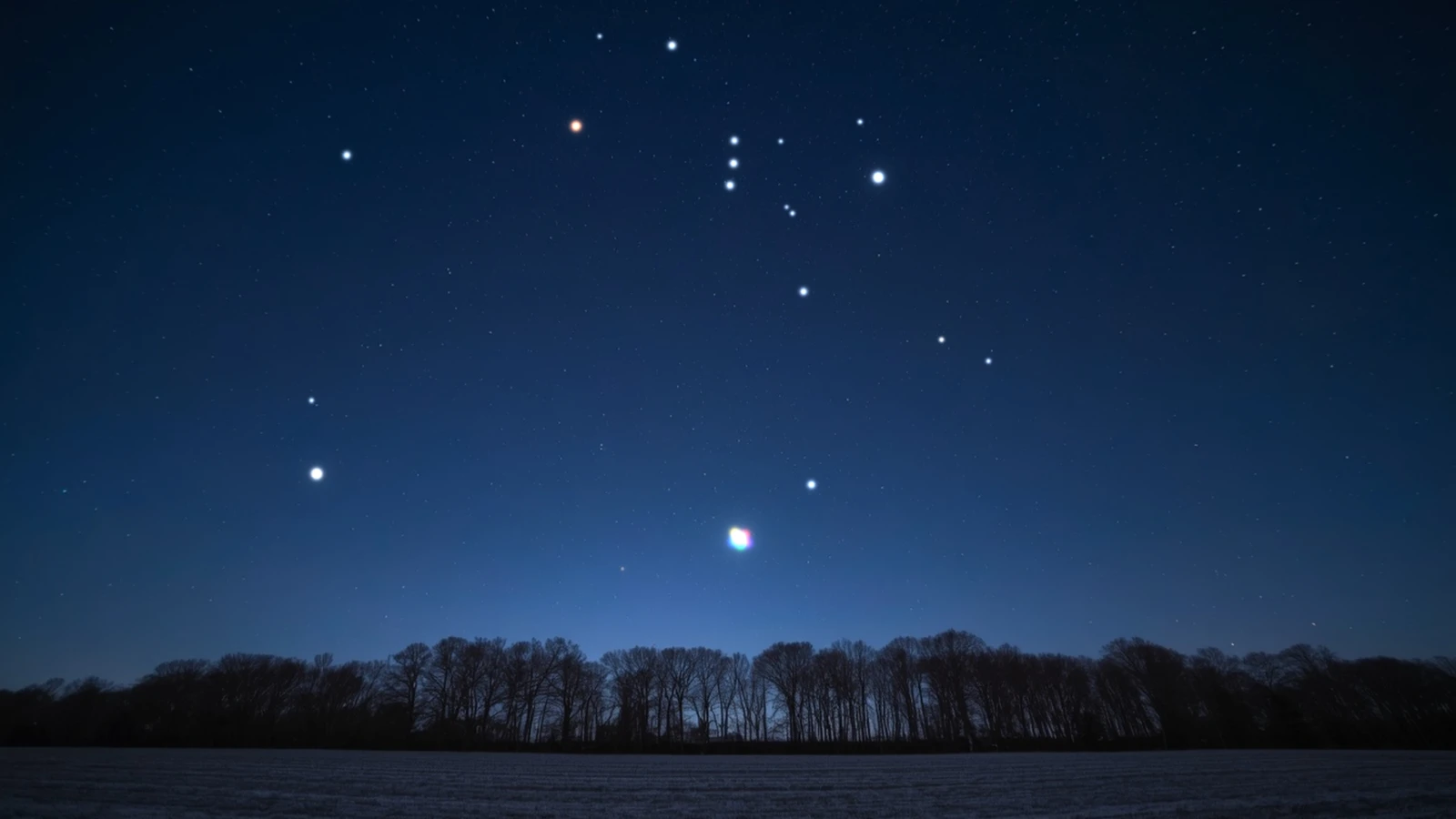
From Dallas in mid-November, Capella is the flasher of the early evening: 15 degrees up in the north-east at 7 PM and 35 degrees by 9 PM, steadying as it climbs. Betelgeuse and Rigel, the shoulder and foot of Orion, rise together at about 8 PM. Sirius follows at about 10 PM on November 19, is one fist up by 10:55 PM and does not reach 30 degrees until nearly 1 AM, so the hour before midnight is its most colourful. It rises four minutes earlier each night: by mid-December it is up at 8:15 PM and by mid-January at 6:15 PM, flashing low in the south-east as darkness falls. To find it, follow the three stars of Orion’s Belt down and to the left, as in our guide to the Orion Nebula.
For a steady contrast, look to Saturn, 55 degrees up in the south in mid-evening, or to Jupiter and Venus before dawn; the November planets guide has where each one is. Low in the dawn below Venus, Mercury is the exception that proves the rule: a planet, and twinkling.