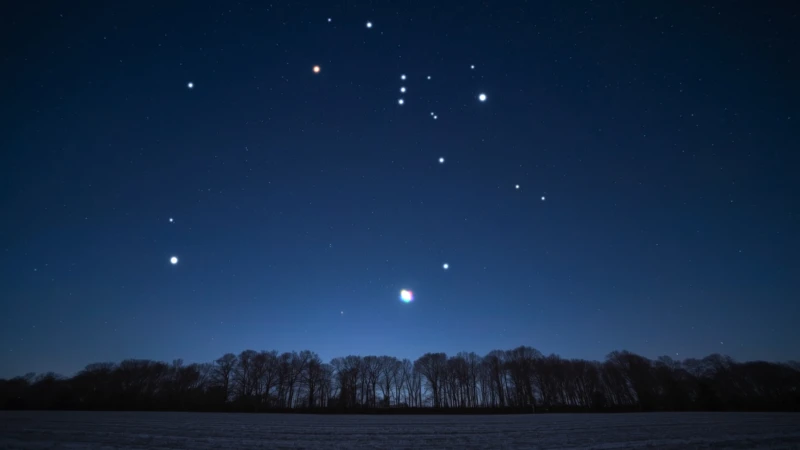
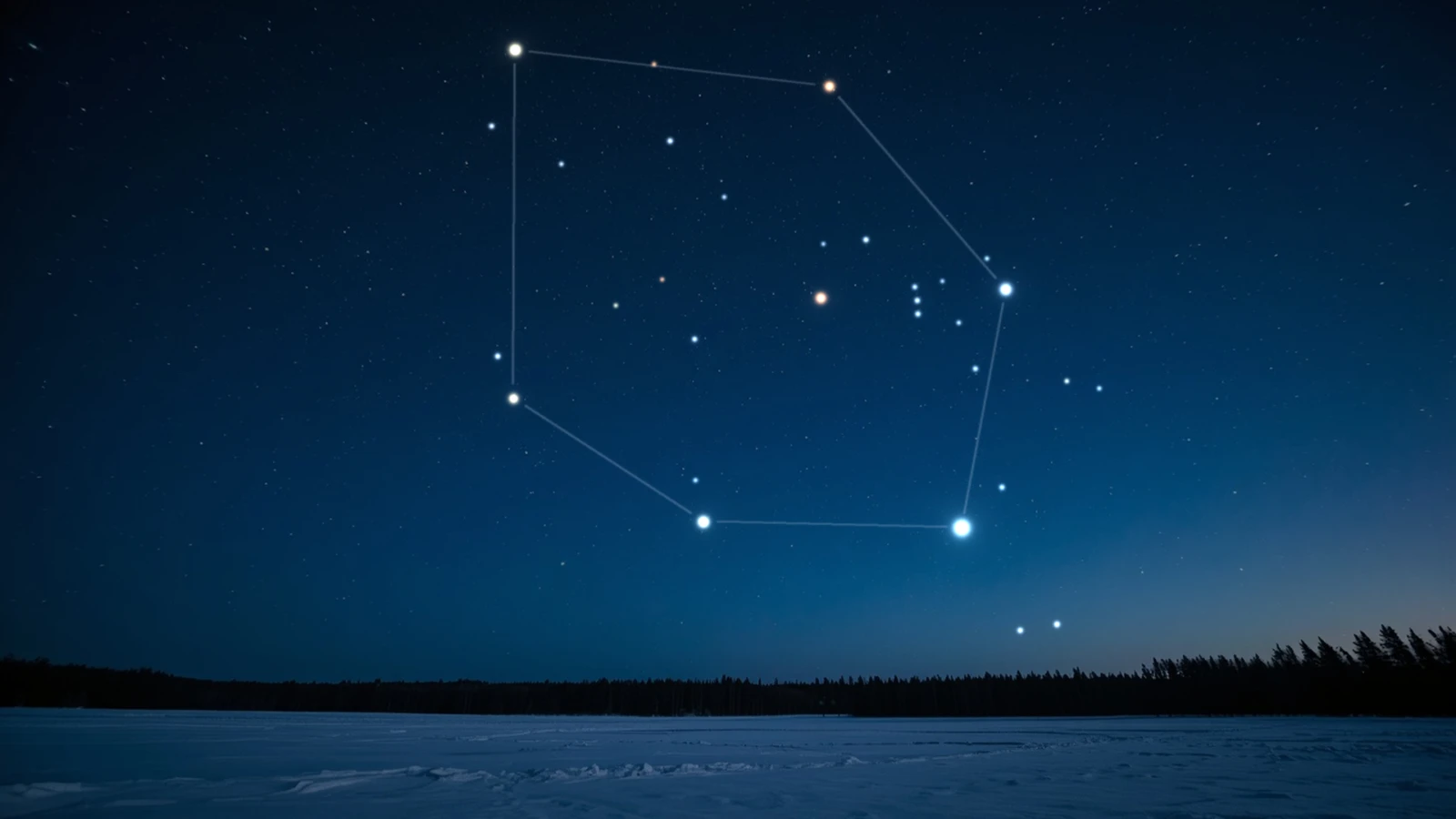
The Winter Hexagon is the largest star pattern most people will ever trace: six brilliant stars from six different constellations, forming a ring 66 degrees tall with a seventh, Betelgeuse, inside it. Of the 21 stars in the whole sky that rank as first magnitude, seven are on or in this one figure. It is not a constellation and it is too big for any chart on a phone screen to show well, which is exactly why it is worth learning by eye. From late November it is up before midnight; by January it fills the evening sky. Times below are for Dallas; the pattern is the same everywhere.
The six stars and how to trace them
Start with Orion, the one winter figure everyone knows, and its Belt of three stars in a short straight line. The Belt points both ways.
- Sirius. Follow the Belt one way, 23 degrees, a little more than two fists at arm’s length, to the brightest star in the night sky, white and usually flashing. That is the bottom of the hexagon.
- Procyon. From Sirius go 26 degrees toward the Twins to a lone yellow-white star, the only bright thing in Canis Minor.
- Pollux, with Castor. Another 23 degrees on is a pair of stars 4.5 degrees apart. Pollux, the nearer to Procyon and slightly orange, is the corner; Castor rides beside it.
- Capella. Swing 34 degrees across the top to a bright golden star that passes almost overhead from mid-northern latitudes. It is the top of the hexagon.
- Aldebaran. Drop 31 degrees to the orange eye of Taurus, sitting in a V of fainter stars. The other end of Orion’s Belt points to it, also 23 degrees away.
- Rigel. The last corner is Orion’s blue-white foot, 27 degrees from Aldebaran and 24 from Sirius, which closes the ring.
Betelgeuse, Orion’s orange shoulder, is the star in the middle, 19 degrees from Rigel. With Sirius and Procyon it makes the Winter Triangle, almost perfectly equal-sided at 26 to 27 degrees a side, which is the easier figure to pick out first on a hazy night.
How big it is
From Capella at the top to Sirius at the bottom is 66 degrees, more than six fists and nearly three-quarters of the way from the horizon to the zenith. Across the middle, Aldebaran to Procyon, it is 46 degrees, and the walk around all six stars is 164 degrees, close to half a circle. No binocular or camera lens short of a fisheye takes it in. If the scale is hard to believe, measure it; our guide to measuring the sky with your hand shows how.
When it is up
The hexagon rises in pieces over about five hours, Capella first and Sirius last, so the question is when the whole figure is clear of the horizon haze, which means Sirius at least a fist up.
- Late November: Capella is up at nightfall, Aldebaran by 7 PM, Orion by 9 PM, and Sirius rises at about 9:50 PM. The full hexagon stands clear by 10:45 PM and is highest around 2 AM.
- Mid-December: complete by about 9:10 PM.
- New Year: complete by about 8 PM.
- Mid-January: complete at 7:10 PM, just as the sky becomes fully dark, and highest at about 10:45 PM. This is the start of its best season.
- Mid-February: centred in the south at 8:30 PM, with Sirius nearly 40 degrees up and Capella 77 degrees up, not far from overhead.
- March: already tipping into the west at nightfall.
- Early April: Rigel sets before midnight and the figure breaks up for the year.
The whole sky comes round four minutes earlier each night, two hours a month, so any date in between is easy to work out. Latitude changes the tilt, not the timing: from New York or London Capella passes almost exactly overhead while Sirius stays low, 32 degrees up at best from New York and 22 from London. From the southern hemisphere the figure is upside down, a summer hexagon, with Sirius high and Capella skimming the northern horizon.
What the stars are
The hexagon is a line-of-sight accident. Its stars have nothing to do with one another and lie at distances that differ a hundredfold.
- Sirius, magnitude -1.5, is 8.6 light-years away, the nearest star visible to the naked eye from most of the United States and all of Europe. It is about twice the Sun’s mass and has a white dwarf companion.
- Procyon, magnitude 0.4, is 11.5 light-years away and also has a white dwarf.
- Pollux, magnitude 1.1, is an orange giant 34 light-years away. Castor, 51 light-years away, is six stars in three close pairs.
- Capella, magnitude 0.1 and 43 light-years away, is two yellow giants circling each other every 104 days.
- Aldebaran, magnitude 0.9, is an orange giant about 44 times the Sun’s diameter, 65 light-years away. The V of stars around it, the Hyades cluster, is more than twice as far.
- Rigel, magnitude 0.1, is a blue supergiant about 860 light-years away, roughly a hundred thousand times as luminous as the Sun.
- Betelgeuse, in the middle, is a red supergiant some 550 light-years away, wide enough to swallow the orbit of Mars, and variable: it wanders between about magnitude 0 and 1.5.
Their colours are worth a deliberate look, because colour is temperature. Rigel, at about 12,000 degrees, is blue-white; Sirius, near 10,000, white; Procyon, 6,500, faintly yellow; Capella, between 5,000 and 5,700, close to the colour of the Sun; Pollux and Aldebaran, 4,900 and 3,900, orange; Betelgeuse, 3,500, the reddest. Low in the sky Sirius adds colours of its own, as our guide to why stars twinkle explains.
What is inside it
The winter Milky Way runs through the hexagon from near Capella, between Orion and the Twins, down past Sirius, faint compared with the summer one but full of clusters for binoculars. The Orion Nebula hangs below the Belt. The cluster M35 sits at the foot of the Twins, three more, M36, M37 and M38, lie in a line across Auriga below Capella, and M41 is 4 degrees straight below Sirius. Just outside the Aldebaran corner, 14 degrees beyond it, are the Pleiades.
The Moon and planets this season
The ecliptic, the path of the Moon and planets, cuts through the top of the hexagon between Aldebaran and Pollux, so the Moon crosses it every month and a bright planet sometimes sits inside as an extra star. This winter the Moon is in the hexagon on November 24 to 27, full beside the Pleiades on the 24th and 3 degrees from Elnath, the tip of the Bull’s horn, on the 25th; on December 22 to 24, when the full Cold Moon of the 23rd shines from inside the figure; on January 18 to 20; on February 14 to 17; and on March 14 to 16, by then a half Moon.
No bright planet is inside the hexagon this season. Jupiter and Mars follow it up the sky instead, close to the star Regulus in Leo about 30 degrees east of Pollux and Procyon: Jupiter rises shortly after 10 PM in mid-December and is a quarter of the way up the eastern sky at that hour by mid-January, while Mars brightens from magnitude 0.2 to -1.2 between December and February. Uranus, for binoculars, is just outside the Aldebaran corner near the Pleiades; our Uranus guide has the star-hop, and the moon calendar shows which nights the Moon is out of the way.