Every sky guide speaks in degrees. Mars is 1.3 degrees from Jupiter, Saturn is 55 degrees up, Uranus is 5.5 degrees from the Pleiades. None of it helps unless you can turn a number into a patch of sky, and the tool for that is already at the end of your arm. This guide gives the hand measures, shows how to check them against stars whose spacing is known, and then goes further than most: how degrees turn into minutes of time, why the Moon is smaller than you think, and where the hand ruler stops working.
The hand ruler
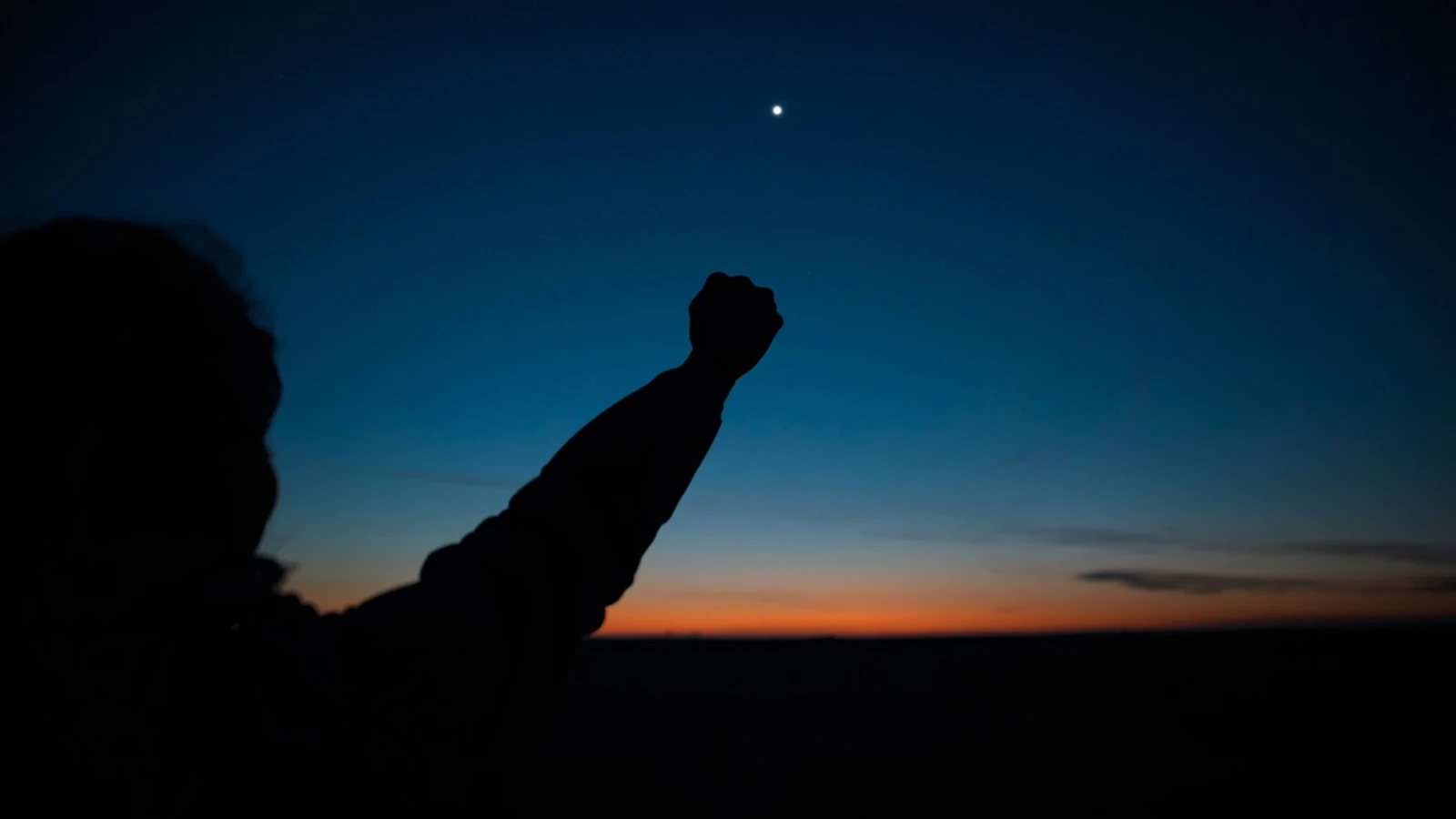
Hold your arm out straight, elbow locked, and close one eye. At that distance:
- The tip of your little finger covers about 1 degree.
- Three middle fingers together cover about 5 degrees.
- A clenched fist, across the knuckles, covers about 10 degrees.
- Index finger to little finger, spread wide, spans about 15 degrees.
- Thumb to little finger, spread wide, spans 20 to 25 degrees, depending on how far your hand opens.
It works for a child as well as an adult, because people with small hands have short arms and the ratio stays about the same. The whole sky gives a first check: from the horizon to the point straight overhead is 90 degrees, so nine fists stacked one on another should carry you from one to the other. If it takes you eight or ten, you know how much to correct by.
Calibrate it on the stars
Star patterns do not change, so they make a better test card than the horizon. These separations are computed from the star positions our site uses:
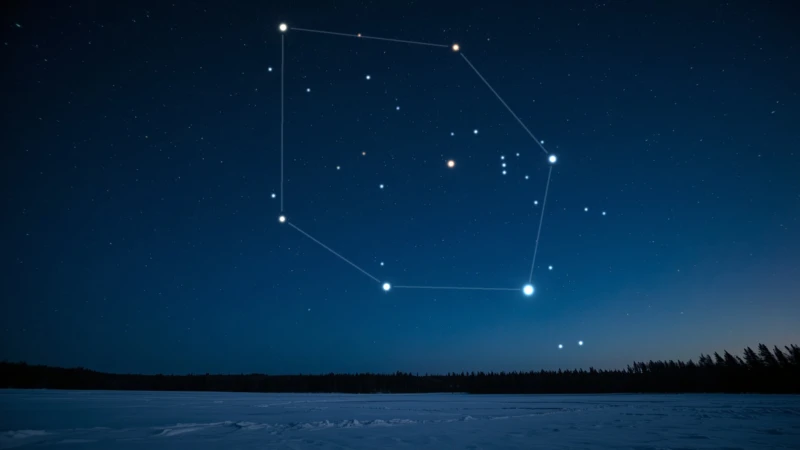
- The Big Dipper’s pointer stars, Dubhe and Merak: 5.4 degrees, a three-finger gap.
- The top of the Dipper’s bowl, Dubhe to Megrez: 10.2 degrees, one fist.
- The whole Dipper, Dubhe to Alkaid at the handle’s tip: 25.7 degrees, a full hand span.
- The pointers to the North Star, Dubhe to Polaris: 28.7 degrees. The old rule says five times the pointer gap, which comes to 27 degrees, so go a little farther than the rule suggests.
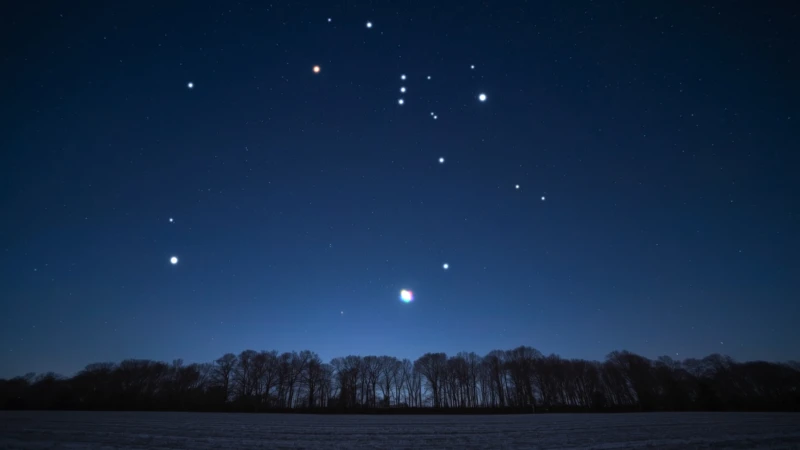
- Orion’s Belt, end to end: 2.7 degrees, about half of the three-finger measure.
- Betelgeuse to Rigel, Orion’s shoulder to his foot: 18.6 degrees, nearly two fists.
- Castor and Pollux, the Twins: 4.5 degrees.
- The Pleiades to Aldebaran: 13.7 degrees.
- The Summer Triangle: Vega to Deneb 23.9 degrees, Vega to Altair 34.2, Deneb to Altair 38.0.
Pick whichever is up. On autumn and winter evenings the Dipper scrapes the northern horizon from the southern United States and Orion is the better test, rising in the east by mid-evening; before dawn the Dipper stands high in the north-east and is easy.
The Moon is smaller than you think
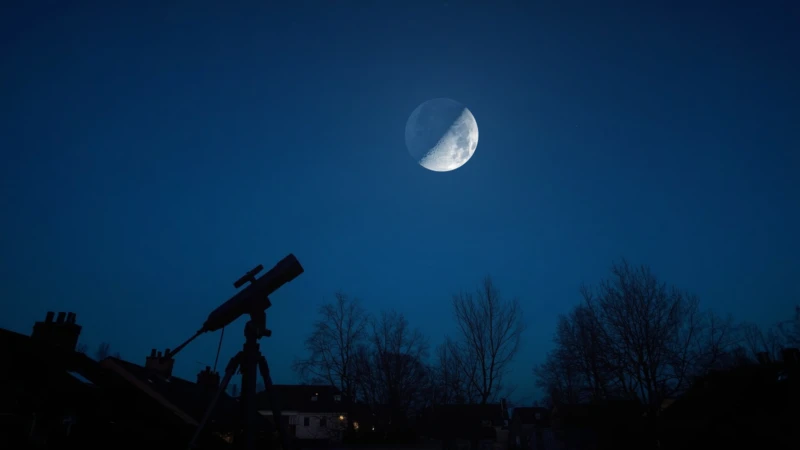
Ask people how big the Moon looks and most will say a coin held at arm’s length. It is far smaller. The Moon is half a degree across, between 0.49 degrees at its farthest and 0.56 at its closest, so the tip of your little finger covers it twice over. The Sun is the same size, which is why total solar eclipses work. Try it at moonrise, when the Moon seems enormous on the horizon, and again when it is high: the finger covers it equally both times. That is the simplest proof that the horizon Moon’s size is in your head, as our guide to the Moon illusion explains.
Below a degree the hand gives out and the units get smaller. A degree is 60 arcminutes and an arcminute is 60 arcseconds. Good eyes separate two points about 1 arcminute apart; the classic test is Mizar and Alcor, the double star at the bend of the Dipper’s handle, 11.8 arcminutes apart. Planets are measured in arcseconds: Jupiter’s disc is about 40 arcseconds wide, under your eye’s limit of 60, which is why it looks like a point until you magnify it. Binoculars sit in between. A typical 10×50 pair shows a circle of sky 5 to 6.5 degrees wide and a 7×50 about 7, so anything described as “one binocular field” away is roughly three fingers.
Degrees are also minutes
The sky turns once in 24 hours, which is 15 degrees an hour. A star near the celestial equator therefore moves one fist in 40 minutes, and a planet two fists above the western horizon will be gone in about two hours or less. That conversion is behind three useful tricks.
- Time until sunset. Hold your fist at arm’s length with its lower edge on the horizon, and count fists up to the Sun without looking directly at it. From Dallas in late autumn the Sun takes 58 minutes to drop its last 10 degrees, so each fist is about an hour and each finger about a quarter of an hour. The rule drifts with latitude and season, because the Sun sets at a slant: the last fist takes 52 minutes at Dallas at the equinoxes, 43 to 47 minutes in the tropics, 70 minutes in London in March and more than 100 there in December.
- The Moon’s daily step. The Moon moves about 13 degrees east against the stars every day, more than a fist, and its own width roughly every hour. That is why it sits beside a star one night and well past it the next, and why it rises later each evening.
- How long something stays in view. A telescope without a motor shows a planet drifting across the eyepiece in a minute or two. That drift is the same 15 degrees an hour, magnified.
Height above the horizon
Guides give height as altitude: 0 degrees is the horizon and 90 is overhead. Two fists up is 20 degrees and four and a half is halfway to the zenith. The North Star makes a neat check, because its altitude equals your latitude: 33 degrees from Dallas, 41 from New York, 51 from London. Measure it with your fists and you have measured where you are on the Earth, to within a few degrees.
Altitude also tells you how hard an object will be. Light from something overhead crosses one thickness of atmosphere; at 30 degrees it crosses two, at 10 degrees more than five and at 5 degrees more than ten. So when a guide says a planet is “12 degrees up at dawn”, read it as a fist and a bit above a horizon that must be clear, and expect it dimmer and shakier than its magnitude suggests. Anything under one fist needs flat ground or a rooftop in the right direction.
Try it this month
In the second half of November the dawn sky is a ready-made exercise. Mars and Jupiter, high in the south before sunrise, are 1.3 degrees apart on the 17th, barely more than a little finger’s width, and 2.6 degrees apart by the 22nd, between two and three, as Mars pulls away at about a quarter of a degree a day; our conjunction guide has the daily figures. Low in the south-east, Venus sits about 2 degrees from the star Spica, and Mercury is 14 to 17 degrees below and left of Venus, an index-to-little-finger span, and 13 degrees above the horizon at dawn, as the Mercury guide describes.
In the evening, Saturn stands 55 degrees up toward the south at 8 PM, five and a half fists. The Moon passes 7 degrees from it on Friday the 20th, most of a fist. And Uranus is 5.5 degrees from the Pleiades, three fingers or one binocular field, which is the whole of the star-hop in our guide to finding Uranus. The planet pages give altitudes for your city at any hour, and now you can read them with your hand.