Most people point their first binoculars or telescope at a full Moon, and most are a little disappointed. The disc is dazzling, flat and oddly empty. The trouble is the date. Full Moon is the one night of the month when the Moon shows the least, and almost any other evening is better. This guide explains why, shows where on the Moon to look on any given night, and goes through the month evening by evening so you know what is waiting along the line between lunar day and night.
Why the full Moon looks flat
You see a mountain on the Moon the way you see a ripple in sand at the beach: by its shadow. At full Moon the Sun is behind you, shining straight down on the middle of the disc. It is lunar noon there, and nothing casts a shadow you can see. Craters shrink to pale rings and mountain ranges vanish. What is left is tone: the dark lava plains, the bright highlands and the long white rays splashed out from the craters Tycho and Copernicus.
The full Moon is also far brighter than its size suggests. A half Moon is not half as bright as a full one but only about a tenth, because at full every shadow on the surface closes up at once. In a telescope that glare is tiring, and it hides faint detail that would be easy a week earlier.
The terminator is where the detail is
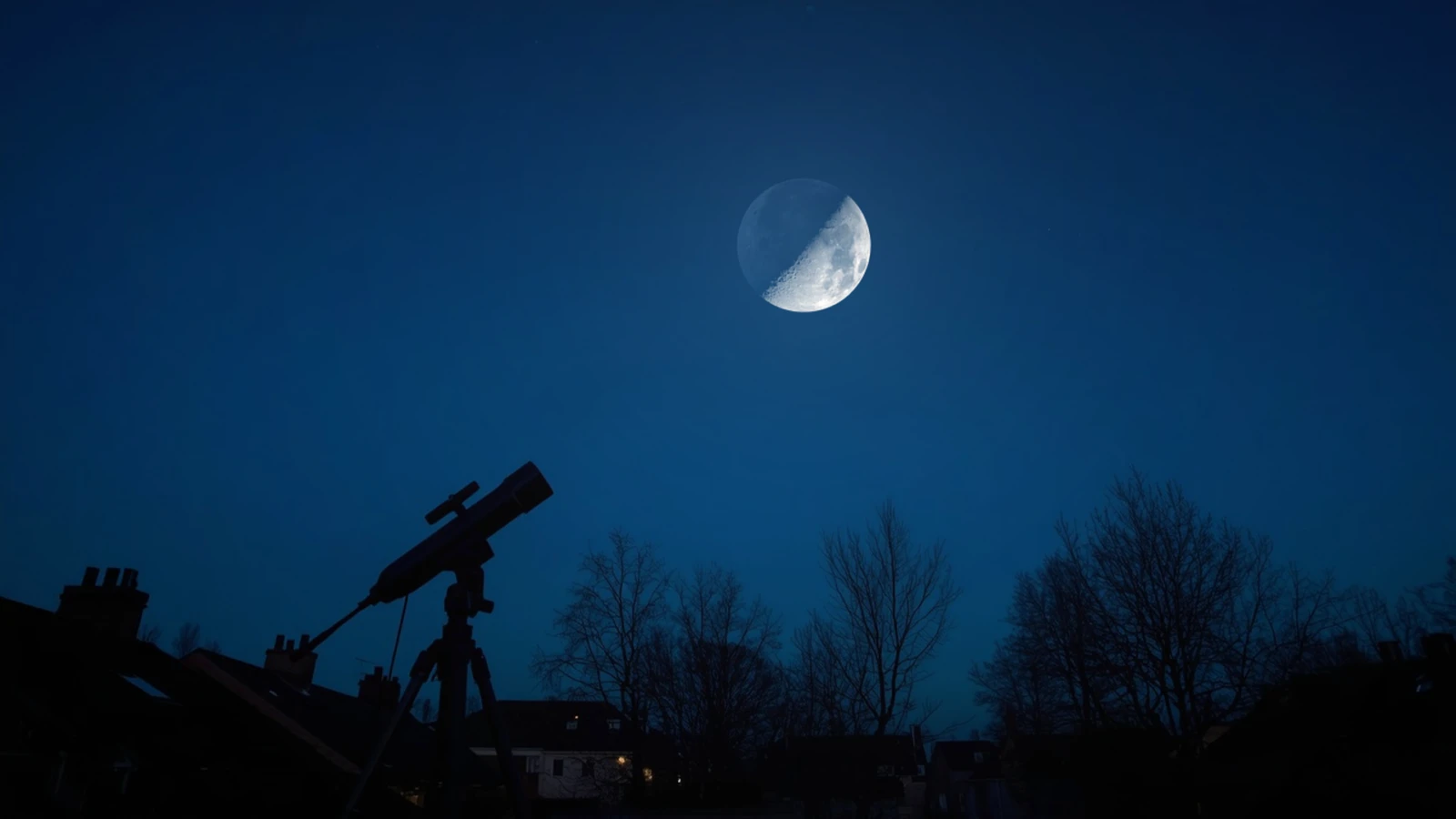
The line dividing the lit part of the Moon from the dark part is called the terminator. Along it the Sun is rising, if the Moon is waxing, or setting, if it is waning. Sunlight there arrives almost flat, so a crater wall a few kilometres high throws a shadow tens of kilometres long, and a slope too gentle to notice at noon stands out like a cliff.
The terminator moves. It crosses about 12 degrees of lunar longitude a day, which is roughly 370 kilometres at the Moon’s equator, so every evening a new strip of ground comes into morning light and the strip that was dramatic last night flattens out. That is the reason to look often. The Moon you see on Tuesday is not the Moon you saw on Monday.
Evening by evening
The dates on a calendar drift, so the list below goes by how much of the disc is lit, which fixes where the terminator is. The day counts are approximate. Everything named shows in a small telescope at 50 times magnification, and the larger features in steady 10x binoculars.
- Thin crescent, 5 to 15 percent lit, about day 3. The dark oval near the curved edge is Mare Crisium, a lava plain 550 kilometres across. Just inside the terminator sit the big craters Langrenus and Petavius. The dark part of the disc glows faintly with earthshine.
- About 28 percent lit, day 5. Three craters in a curving chain, Theophilus, Cyrillus and Catharina, lie right on the terminator beside the dark patch of Mare Nectaris. Theophilus is 100 kilometres wide with a central mountain that catches the light before its floor does.
- Half lit, first quarter, day 7. The best single night for a beginner. The terminator runs down the middle of the disc through the roughest ground on the Moon. For a few hours the rims of three craters make the Lunar X, and just after it a line of three great walled plains, Ptolemaeus, Alphonsus and Arzachel, comes into view.
- About 58 percent, day 8. The Straight Wall, a fault 110 kilometres long, shows as a thin dark line in Mare Nubium. In the north the Apennine Mountains curve along the edge of Mare Imbrium, with the dark-floored crater Plato beyond them. In the south, Tycho and the huge crater Clavius, 225 kilometres wide, fill with shadow.
- About 68 percent, day 9. Copernicus stands alone on the terminator, 93 kilometres across, with terraced walls and a group of central peaks. Many observers call it the finest crater on the Moon.
- About 70 to 73 percent, day 10. The mountains around the bay of Sinus Iridum catch the sunrise while the bay floor is still dark, and for a night they hang out into the blackness as the Jewelled Handle.
- About 80 percent, day 11. Gassendi, a crater with a cracked floor, sits on the shore of Mare Humorum.
- About 87 percent, day 12. Aristarchus, the brightest spot on the whole Moon, comes into the light near the western edge.
- Full, day 14 to 15. No shadows. Look for the rays of Tycho, the shapes of the seas and the slight differences in their colour.
After full Moon the same features come back in reverse order with the shadows falling the other way, as the sunset line crosses them. The view is just as good. The catch is the hour: a waning Moon rises later each night, so it belongs to night owls and early risers.
What you need
- Your eyes show the seas, the bright highlands and, on a thin crescent, earthshine.
- Binoculars at 10 times show the terminator’s larger craters, the mountain ranges and Mare Crisium’s outline. They need to be steady: lean against a wall or rest them on a fence. Our guide to measuring the sky explains why the Moon, half a degree wide, looks so small in them.
- A small telescope at 50 to 100 times shows hundreds of craters, and everything in the list above.
Two habits improve any view. Look while the sky is still blue, in twilight, when the Moon is less glaring against its background. And look when the Moon is high, because the air near the horizon makes the image boil. The first-quarter Moon of December stands 54 degrees up at nightfall from Dallas, comfortably clear of it.
The evenings to use this month
New moon is on December 8, and the evening Moon returns three days later. For Dallas in Central Standard Time, at about 7 PM:
- Friday, December 11: 8 percent lit, low in the south-west, setting at 7:37 PM. Mare Crisium and earthshine.
- Monday, December 14: 29 percent, setting at 10:30 PM. Theophilus and its chain are on the terminator.
- Wednesday, December 16: 48 percent, 54 degrees up, first quarter at 11:42 PM. Ptolemaeus, Alphonsus and Arzachel have just come into the light. The Lunar X falls at about 10:30 UTC that day, which makes it an evening event for East Asia and Australia; by nightfall in the Americas it has blended into the lit surface.
- Thursday, December 17: 58 percent, 62 degrees up. The Straight Wall, Plato, Tycho and Clavius.
- Friday, December 18: 69 percent. Copernicus, and the Jewelled Handle forming at Sinus Iridum.
- Saturday, December 19: 78 percent. Gassendi.
- Sunday, December 20: 87 percent. Aristarchus.
- Wednesday, December 23: full at 7:28 PM, the closest full Moon of the year. Enjoy it rising. Then put the telescope away until the terminator comes back.
The moon calendar gives the phase and the rise and set times for your city on any date, so you can work out the same list for any month.