The Moon grows from a half to the Hunter’s Moon this week, which makes it a week for bright targets: Saturn beside the Moon on Friday and Saturday, the Orionid meteor shower in the dark hours before dawn on Wednesday, Venus slipping behind the Sun, and the full moon rising at sunset on Sunday. Times below are for Dallas in Central Time; every page linked here converts them to your city.
The Moon: waxing to full
- Monday, October 19: 60% lit, rising at 3:16 PM and setting around 2 AM.
- Wednesday, October 21: 78% lit, rising at 4:15 PM, setting at 2:54 AM on Thursday morning.
- Friday, October 23: 92% lit, rising at 5:10 PM.
- Saturday, October 24: 97% lit, rising at 5:40 PM, an hour before sunset.
- Sunday, October 25: the Hunter’s Moon, rising at 6:13 PM and exactly full at 11:11 PM.
With the Moon up most of the night, faint objects are off the menu until next month. The moon calendar has rise and set times for your city.
Wednesday morning: the Orionids
The Orionid meteor shower peaks at 4:24 AM on Wednesday, October 21. The gibbous Moon spoils the evening, but it sets at 2:54 AM, leaving three dark hours before dawn with the radiant near Betelgeuse high in the south. Expect up to 20 fast meteors an hour under a dark sky, fewer from town. Tuesday and Thursday mornings are nearly as good, with the Moon setting at 1:54 AM and 3:53 AM. Our Orionids guide has the full plan.
Friday and Saturday evenings: the Moon beside Saturn
On the evenings of October 23 and 24 the bright gibbous Moon sits about 9 degrees from Saturn, a fist-width at arm’s length, with Saturn the steady cream-coloured point to the Moon’s lower left on Friday and lower right on Saturday. The two are closest, about 6 degrees apart, during the day on Saturday. Saturn is 13 to 17 degrees up in the east at dusk this week and 59 degrees high in the south around midnight, at magnitude 0.7; a small telescope shows the rings, and the Moon’s glare does not hurt Saturn at all. The Saturn page has its height at any hour from your city.
Friday night: Venus passes the Sun
Venus reaches inferior conjunction at 10:35 PM on Friday, October 23 (03:35 UTC on the 24th), passing between the Earth and the Sun. It has been invisible for a couple of weeks already and stays hidden for another two, then reappears in the east before dawn in early November as the Morning Star. Our Venus guide explains the switch and gives the dates to look.
Sunday: the Hunter’s Moon
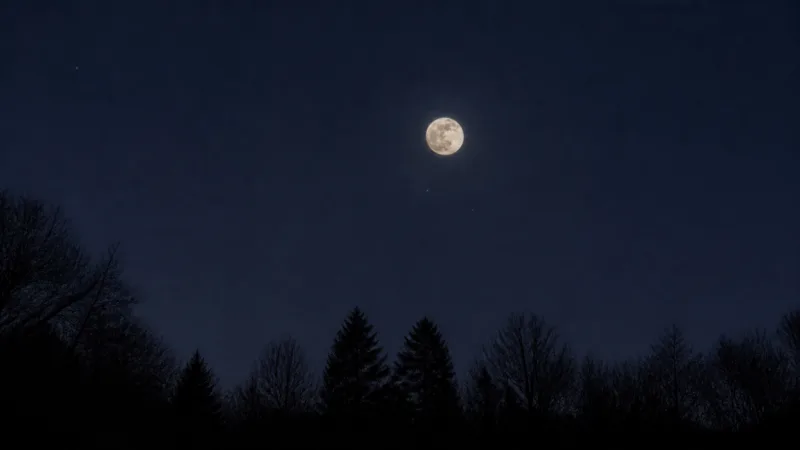
The Hunter’s Moon rises at 6:13 PM on Sunday, half an hour before sunset, and is full at 11:11 PM. Monday’s moonrise at 6:52 PM, just after sunset, gives the classic view of a huge orange Moon in twilight. It is an ordinary-distance full moon, 368,900 km away, not a supermoon. The October full moon page has moonrise for your city.
Before dawn: Jupiter and Mars
Jupiter is brilliant at magnitude -2.0, 57 to 61 degrees high in the south-east at dawn, with Mars above it at magnitude 0.9. They stay well placed all week regardless of the Moon. Mercury, meanwhile, is leaving the evening sky, only 3 to 5 degrees up at dusk and fading fast.
Looking ahead
Next Tuesday, October 27, the Moon passes in front of the Pleiades star cluster for much of North America; our guide to that night is coming on October 20. Clocks go back on Sunday, November 1, in the United States and Canada, so evening darkness arrives an hour earlier from then on. The Taurid meteor showers follow in early November, and Venus returns to the dawn. The full list is on the events calendar.