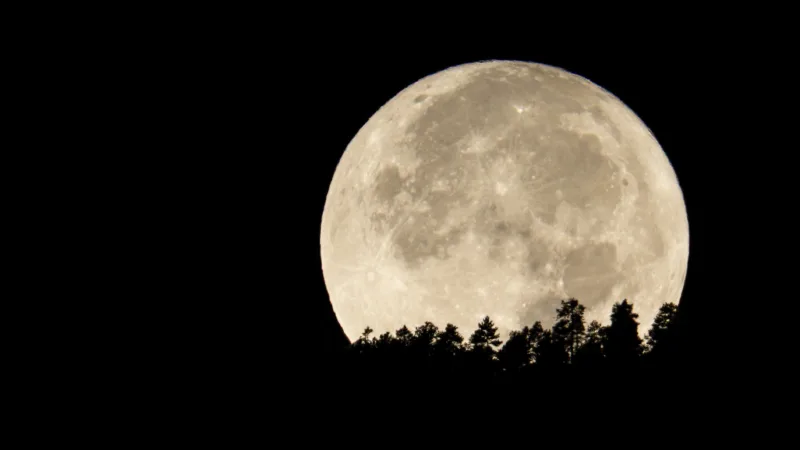
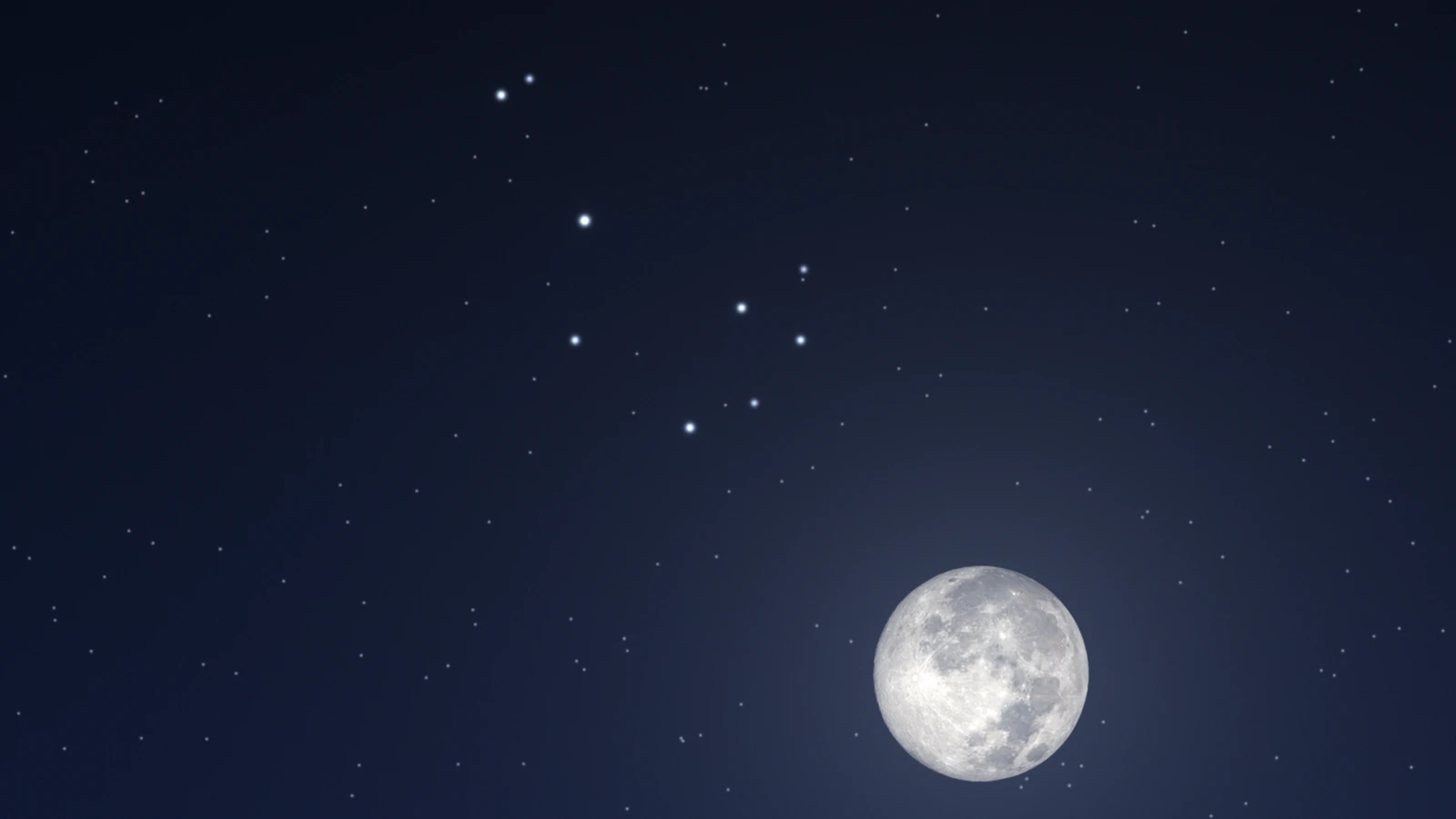
Through the night of Monday, November 23, 2026, the full Beaver Moon closes in on the Pleiades, and before dawn on Tuesday the 24th it slides across the northern half of the cluster. From the central and western parts of North America the Moon covers several of the Seven Sisters as it sinks in the west; from East Asia the same passage happens in the evening of the 24th with the Moon climbing in the east. It is the hardest kind of Pleiades occultation to watch, because the Moon is full and dazzling, but the pairing itself needs nothing more than binoculars. Times below are for Dallas in Central Standard Time unless a city is named.
The night at a glance
- Monday, 4:25 PM: the Moon rises, 99 percent lit, an hour before sunset.
- 7 PM to 9 PM: the Pleiades are 6 degrees below and to the left of the Moon at 7 PM and 5 degrees away at 9 PM, three fingers at arm’s length. This is the comfortable time to look.
- Midnight: the gap is under 4 degrees and the Moon is 81 degrees up, almost overhead.
- 3 AM to 5 AM, Tuesday: 2.5 degrees at 3 AM, 1.5 degrees at 5 AM, when the Moon is 24 degrees up in the west-north-west and the sky is still fully dark.
- 6 AM: the Moon’s centre is 1 degree from Alcyone, the brightest Pleiad, 13 degrees above the horizon, and its edge is reaching the cluster’s northern stars.
- About 6:10 to 6:35 AM: from Dallas the Moon covers Taygeta at about 6:10 AM and Maia at about 6:30 AM, 10 and 7 degrees up, in brightening twilight. They stay hidden until the Moon is on the horizon; it sets at 7:15 AM, ten minutes after sunrise.
Full moon itself is at 8:53 AM on Tuesday, so the Moon is as round as it gets for the whole event. The contact times come from our own engine and should be good to within a few minutes; a planetarium app set to your town will refine them.
Where the Moon covers the stars
Because the Moon is close, its position against the stars shifts by up to a degree depending on where on Earth you stand. From the north it appears farther south and covers more of the cluster; from the tropics it passes clear to the north. Astronomy magazine describes this one as a run of occultations of the northern part of the cluster before dawn across the western half of the United States, and the International Occultation Timing Association lists it among the year’s Pleiades passages. Our calculations for a few cities, to the nearest five minutes of local time:
- Seattle and Vancouver: Taygeta at about 3:45 AM and Maia at about 4:05 AM, with the Moon 35 degrees up in a fully dark sky. The best seats in the lower 48 and southern Canada.
- Denver: Taygeta at about 5:05 AM, Maia at about 5:20 AM, Moon 17 to 21 degrees up, sky still dark.
- Chicago and Minneapolis: Taygeta at about 6:00 AM and Maia at about 6:15 AM, with the Moon only 7 to 15 degrees up as dawn begins.
- Los Angeles, San Francisco and Phoenix: only the northernmost stars. Taygeta goes at about 4:15 AM in Los Angeles, 4:05 AM in San Francisco and 5:15 AM in Phoenix; Maia and Alcyone are missed.
- Anchorage and Fairbanks: Electra, Taygeta and Maia between about 2:00 and 2:30 AM, Moon 45 to 50 degrees high.
- The East Coast: the Moon sets as it reaches the cluster. From New York, Atlanta and Miami there is nothing to time; watch the approach instead.
- Tokyo and Seoul, Tuesday evening: Electra at about 6:30 PM in Tokyo and 6:20 PM in Seoul, Maia at about 6:45 PM in both, with the Moon 20 to 30 degrees up in the east.
- Shanghai, Taipei and Manila, Tuesday evening: low in the dusk. Maia is covered at about 5:35 PM in Shanghai and 5:30 PM in Taipei. In Manila it goes at about 5:25 PM, when the Sun has only just set and the Moon is 5 degrees up, and reappears about 40 minutes later against a darker sky.
Alcyone itself is covered only from a band much farther north, through Mongolia and eastern Siberia. Everywhere else it sits just off the Moon’s southern edge: a quarter of a degree clear at moonset from Dallas. From Europe, Africa, South America and Australia the Moon simply passes near the cluster, a degree or more away.
Why this one is hard
A star does not fade as the Moon approaches. It is there, and then it is gone, in a fraction of a second. On a crescent Moon the star vanishes against the dark, unlit edge and the moment is easy to catch in binoculars. At full Moon there is no dark edge. Every star goes out against sunlit rock, and the stars are faint next to it: Alcyone is magnitude 2.9, Electra 3.7, Maia 3.9, Taygeta 4.3. The Moon is also near its closest point to Earth, about 361,000 kilometres away and 33 arcminutes wide, which makes it both a wider and a brighter obstacle than average.
What each instrument shows:
- Naked eye: a full Moon in an apparently empty patch of sky. The cluster is washed out once the Moon is within a few degrees.
- Binoculars: the brighter Pleiades beside the Moon while the gap is 2 degrees or more, so up to about 4 AM in Dallas. Put the Moon just outside the edge of the view and the cluster pops out.
- Telescope, 80 to 150 times: the only way to see a star actually vanish. Use enough magnification to push most of the Moon out of the field, find your star a few minutes early, and hold your eye on it. From North America the stars disappear at the Moon’s upper edge as it sets; from Asia at its lower edge as it rises.
From Texas the occultation proper is a challenge: 7 to 10 degrees up, in twilight, through the thickest air. The realistic goal there is the binocular view between 3 and 5 AM, with the Moon closing on the cluster in a dark sky and a clear west-north-western horizon.
Watch the Moon move
The best part of this event needs no optics and no alarm clock. On Monday evening the Pleiades are 5 degrees ahead of the Moon, below and to its left. On Tuesday at 7 PM the Moon, now just past full, has moved 9 degrees beyond them: the cluster is above it and the orange star Aldebaran is 10 degrees to its right. That is the Moon’s own orbital motion, about 13 degrees in 24 hours, and two looks a day apart show it better than any diagram. Our guide to measuring the sky with your hand turns those degrees into fingers and fists.
Why the Moon keeps meeting the Pleiades
The Pleiades lie 4 degrees north of the ecliptic, and the Moon’s orbit is tilted 5 degrees to it, with the tilt swinging round once every 18.6 years. For a few years in each cycle the Moon’s path runs far enough north to cross the cluster every month. The present run began in 2023 and continues until 2029, with a different part of the world favoured each time: North America had the last one on October 27, and the next passage is on December 21. If you want to know the cluster on a dark night, our guide to finding the Pleiades has the star-hop and what binoculars show.
While you are out
Uranus is within about 10 degrees of the Moon all night, a day short of its opposition and quite invisible in the glare. Before dawn on Tuesday, brilliant Venus is 29 degrees up in the south-east with Mercury 12 degrees up below it, and Mars is under 2 degrees from the star Regulus, high in the south beside Jupiter. The Beaver Moon rises again at 5:17 PM on Tuesday, five minutes before sunset; our Beaver Moon guide covers the name and the supermoon question, and the moon calendar has moonset for your city on the 24th.