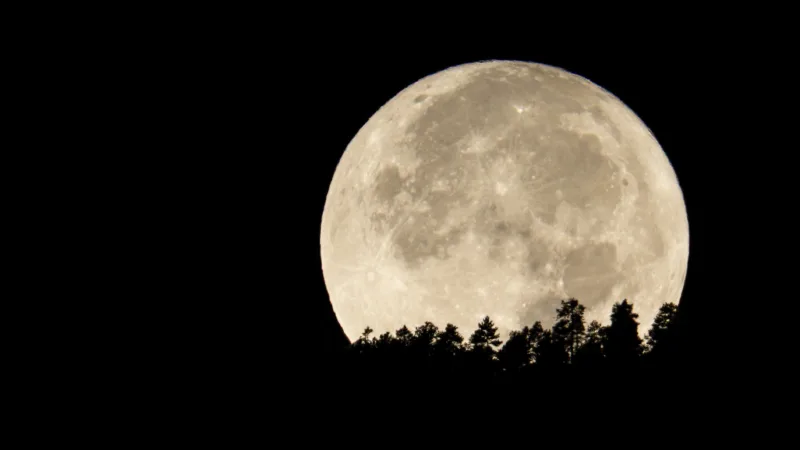
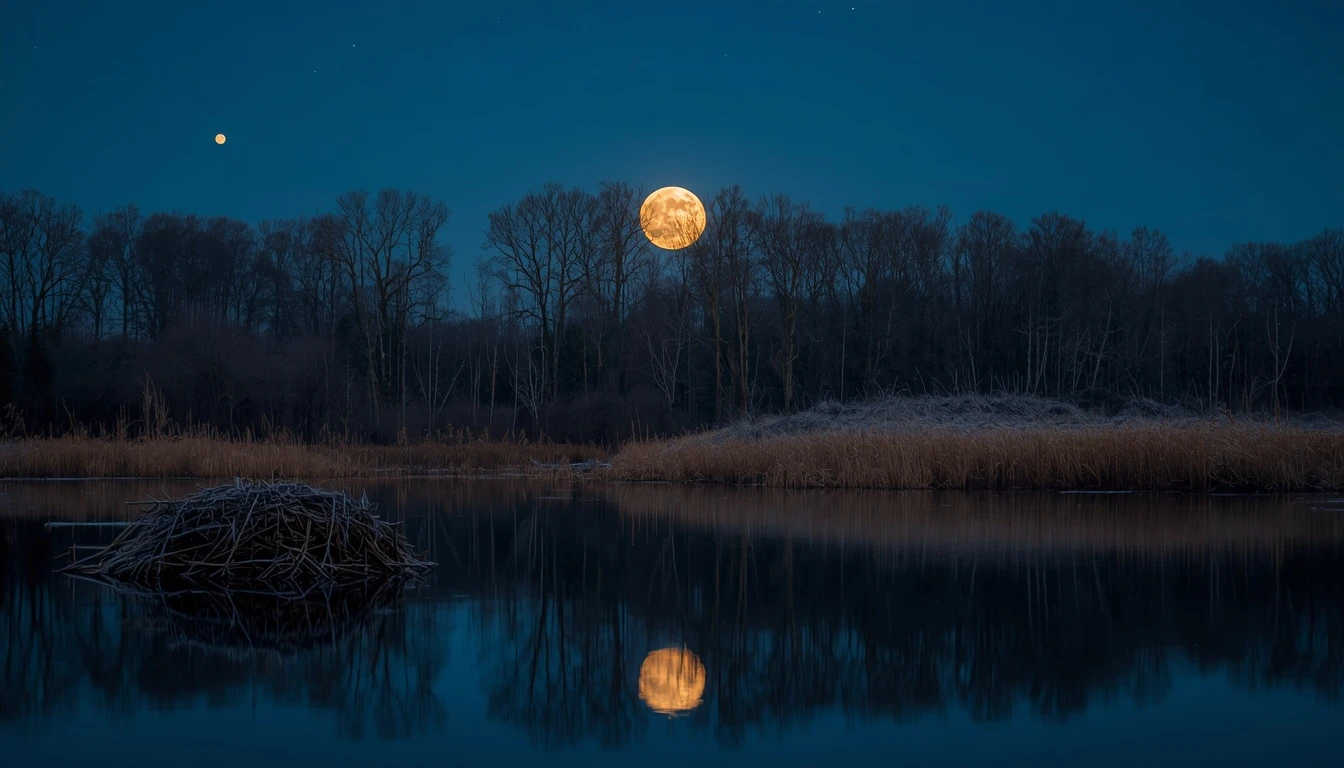
The Beaver Moon of 2026 is full on Tuesday, November 24 at 14:53 UTC, which is 8:53 AM Central Standard Time, mid-morning in the Americas and late evening in Asia and Australia. It is the closest full moon of the year so far, 360,768 km from Earth, and it rises at sunset on the 24th into a sky it will own for the next 14 hours. Whether you call it a supermoon depends on whose rule you use. Times below are for Dallas; the November full moon page converts them to your city.
When to watch
- Monday, November 23: the Moon rises at 4:25 PM, an hour before sunset, 99 percent lit. It is highest, 81 degrees up in the south, at 11:46 PM.
- Tuesday, November 24: full at 8:53 AM, two hours after it set at 7:15 AM. It rises again at 5:17 PM, five minutes before the 5:22 PM sunset, still 99.8 percent lit, and this is the classic moonrise: a huge orange disc coming up in the north-east as the sky darkens.
- Wednesday, November 25: rises at 6:19 PM, 98 percent lit, an hour after sunset into a dark sky.
All three evenings show a Moon the eye cannot tell from full. Because the exact moment falls in the morning for North America, Monday evening and Tuesday evening are almost equally close to it, 15 hours before and 9 hours after.
Is it a supermoon?
A supermoon is a full moon near perigee, the closest point of the Moon’s elliptical orbit, and the trouble is that nobody owns the definition. This site, like timeanddate and several almanacs, uses a simple cutoff of 360,000 km. The Beaver Moon is 360,768 km away at the moment of full, so by that rule it misses by 768 km, two tenths of a percent, and our calendar lists it as an average full moon. The other common rule, from astronomer Fred Espenak, counts any full moon within 90 percent of the way from apogee to perigee for that orbit, and by that rule November, December and January 2027 are a run of three supermoons, which is why you will see the Beaver Moon called one in many places.
What the numbers mean in the sky: compared with an average full moon at about 384,000 km, this one is 6.5 percent wider and 13 percent brighter. Compared with the micromoon of May 31 at 406,135 km it is 12.6 percent wider. That is real but not dramatic; side by side the difference would be obvious, a month apart it is not. The December 24 Cold Moon, at 356,740 km, is the closest full moon of 2026 and a supermoon by every definition. Our supermoon explainer goes through the rules and the history of the word.
The highest full moon since January
Late-autumn full moons ride high because the full Moon sits opposite the Sun, and in November the Sun is low in the south, so the Moon is high in the north. Add this year’s large lunar declination, 24 degrees north on the 24th, and the Beaver Moon passes 81 degrees above the southern horizon from Dallas near midnight, nearly overhead, and stays up for 14 hours. From Britain it is up for 16 hours. It is the highest full moon of the year so far, and only December’s will beat it. The moonlit landscape under a Moon this high and this close is bright enough to read by, and casts short, sharp shadows. Our guide on where the Moon rises explains why it comes up so far to the north-east, 58 degrees from north, almost where the midsummer Sun rises.
What to look for
- The rising Moon’s colour. The first half hour after moonrise is the orange show, as the light crosses the thickest air; see why the rising Moon looks orange.
- The southern limb. Libration tips the Moon’s south pole toward us by 6.5 degrees, its maximum, on the nights of November 23 to 26, so the rugged south polar highlands and the crater Bailly are as well presented as they get. A full Moon has no shadows to help, but the limb itself is foreshortened and worth a look in binoculars. Our libration guide has the details.
- Rays and seas. With the Sun overhead across the whole near side, the bright ray systems of Tycho and Copernicus are at their most striking, and the dark seas show their full outlines. A pair of sunglasses or a Moon filter makes a telescope view comfortable.
- Uranus. The planet reaches opposition the next day, November 25, and on the night of the 24th it sits only about 7 degrees from the full Moon, in the same binocular field as the glare. At magnitude 5.6 it will be hard to pick out that night; a week earlier or later it is an easy binocular object 5.5 degrees from the Pleiades.
Why “Beaver”
November’s full moon was the time, in the lore of the north-eastern United States and Canada, when beavers finished their dams and lodges before the freeze and when trappers set their traps for thick winter pelts. The other traditional names are the Frost Moon, for the first hard frosts, and the Mourning Moon, in some traditions the last full moon before the December solstice. In most years it is also the last full moon of autumn; in 2026 the solstice is on December 21 and the Cold Moon follows on the 24th. Our full moon calendar lists every name with its origin.
The nights around it
The bright Moon washes out the faint sky for about a week either side, so the Taurid and Leonid meteor showers are over by the time it arrives. What it leaves are the planets: Jupiter and Mars rising before midnight and high at dawn, Venus at its brightest in the morning on the 27th, Mercury low below Venus, and Saturn in the evening. The Thanksgiving Moon on Thursday the 26th is a 93 percent gibbous rising at 7:29 PM. On the morning of Monday, November 30 the 56 percent Moon sits 2 degrees from Jupiter. The November guide has the full month, and the moon calendar gives moonrise and moonset for every night from your city.