The Moon returns to the evening sky this week, growing from a hair-thin crescent on Monday to first quarter on Sunday. Mercury reaches greatest elongation on Monday, Mars finishes its passage through the Beehive Cluster, Saturn is high in the south by late evening, and the Orionid meteor shower is building toward next week’s peak. Evenings are still dark for most of the week, since the crescent sets early. Times below are for Dallas in Central Time; every page linked here converts them to your city.
The Moon: a growing evening crescent
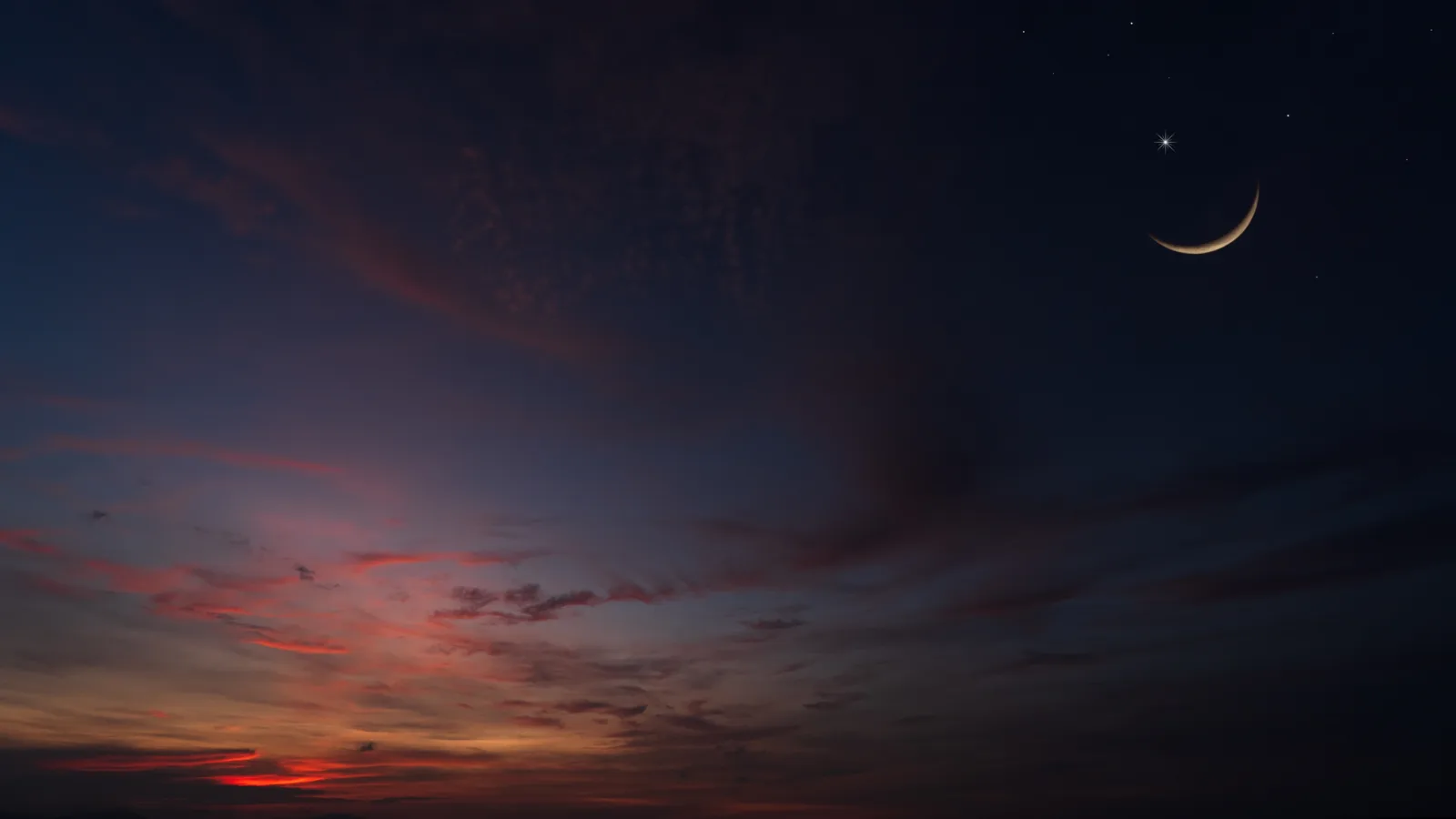
- Monday, October 12: 5% lit, setting at 7:54 PM. Very low in the west-south-west at dusk, near Mercury.
- Tuesday, October 13: 10% lit, setting at 8:33 PM. The best evening for earthshine.
- Thursday, October 15: 24% lit, setting at 10:06 PM.
- Saturday, October 17: 41% lit, setting at 11:57 PM.
- Sunday, October 18: first quarter at 11:12 AM. The half Moon is high in the south at sunset and sets around 1 AM.
Look for earthshine, the faint glow on the dark part of the crescent, from Monday to Thursday. The moon calendar has rise and set times for your own city.
Monday: Mercury at greatest elongation
Mercury is 25 degrees from the Sun on Monday, October 12, its widest separation of this appearance. From the northern hemisphere it is a difficult target all the same: about 7 degrees above the west-south-west horizon 20 minutes after sunset, setting before 8 PM. You need a flat horizon, a very clear sky and binoculars, and the window is roughly 7:10 to 7:25 PM. On Monday a thin crescent Moon sits about 3 degrees to Mercury’s left as a guide. Southern hemisphere readers get a far better view, with Mercury high in the west for over an hour after sunset. Our Mercury guide has the step-by-step method.
Monday morning: Mars leaves the Beehive
Before dawn on Monday, Mars is at the eastern edge of the Beehive Cluster, after passing through its middle on Sunday. By Wednesday it is nearly two degrees beyond the cluster, and both still fit in one binocular field. Look east between 4:30 and 6 AM: Jupiter is the brilliant one, Mars is the orange point above and to its right, 64 degrees high at dawn, and the cluster is the faint swarm of stars beside it.
Saturn in the evening
Saturn, a week past opposition, is 9 degrees up in the east at dusk on Monday and 13 degrees by Sunday, climbing to 57 degrees in the south around midnight. At magnitude 0.7 it is the brightest point in that part of the sky, steady and cream-coloured. Any small telescope shows the rings, tilted 7 degrees toward us. Neptune is 9 degrees to its west for binoculars. See the Saturn page for its height at any hour from your city.
Jupiter and Mars before dawn
Jupiter blazes at magnitude -1.9 in Leo, 51 degrees high in the east at dawn on Monday and 56 degrees by Sunday. Mars is above it, fainter at magnitude 1.0. Both are climbing higher each week and will dominate the evening sky by late winter.
The Orionids are building
The Orionid meteor shower peaks before dawn on Wednesday, October 21, but it has a broad maximum and rates rise through this week. Any morning from about 2 AM, once Orion is well up in the south-east, you may see a few fast meteors streaking away from a point above Betelgeuse. The Moon sets before midnight until the weekend, so mornings are fully dark. Our Orionids guide has the plan for the peak.
Deep sky while the Moon is thin
The first half of the week is still good for faint objects. The Pleiades rise in the east-north-east before 9 PM, the Andromeda Galaxy is high in the east by 10 PM, and Uranus, magnitude 5.6, is 6 to 7 degrees from the Pleiades for binoculars. Astronomical darkness begins at about 8:15 PM.
Looking ahead
Next week brings the Orionid peak on the morning of October 21, with the Moon setting before 3 AM, Venus at inferior conjunction on October 24, and the Hunter’s Moon on the night of October 25. On October 27 the Moon passes in front of the Pleiades for much of North America. The full list is on the events calendar.