The full Beaver Moon runs this week. It closes in on the Pleiades through Monday night and covers some of the cluster’s stars before dawn on Tuesday, turns full that morning, and then rises an hour later each evening, giving the dark back by Thanksgiving. Uranus reaches opposition on Wednesday, Mars makes its closest pass of Regulus on Wednesday and Thursday mornings, Venus is at its greatest brilliancy by Sunday, and late on Sunday night the Moon rises beside Jupiter. Times below are for Dallas in Central Standard Time; every page linked here converts them to your city.
The Moon: full on Tuesday, later every night
- Monday, November 23: 99 percent lit, rising at 4:25 PM and up all night, 81 degrees high at midnight. The Pleiades are 5 to 6 degrees below and to its left in the evening.
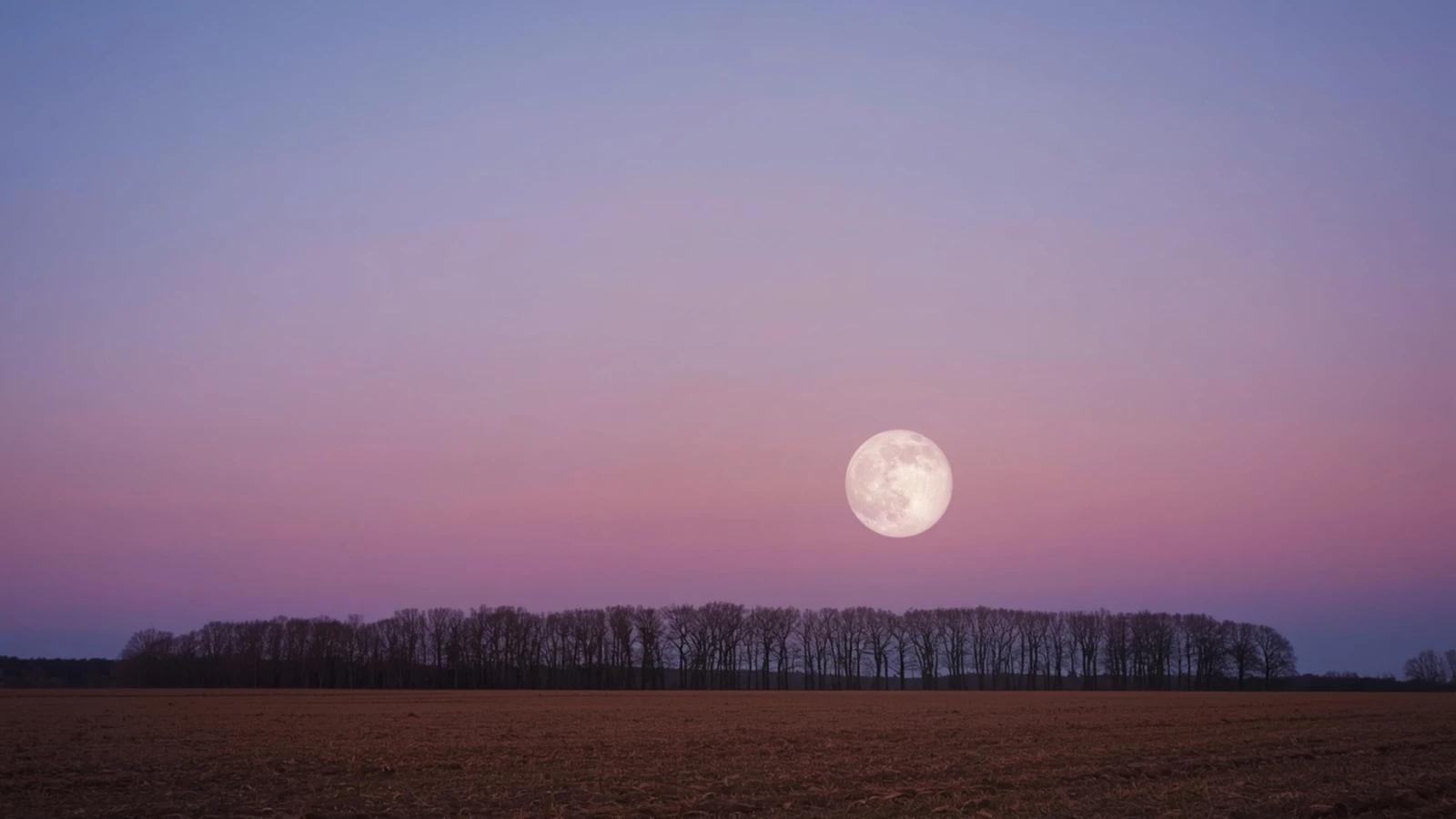
- Tuesday, November 24: full at 8:53 AM. The Beaver Moon rises at 5:17 PM, five minutes before sunset, with the Pleiades now 9 degrees above it and Aldebaran 10 degrees to its right. Our Beaver Moon guide covers the name and the supermoon question.
- Wednesday, November 25: 98 percent, rising at 6:19 PM, about 3 degrees from Elnath, the star at the tip of the Bull’s northern horn.
- Thursday, November 26: the Thanksgiving Moon, 93 percent, rises at 7:29 PM. Our Thanksgiving sky guide has the whole evening.
- Friday, November 27: 86 percent, rising at 8:43 PM, 5 degrees from Pollux in Gemini.
- Saturday, November 28: 77 percent, rising at 9:55 PM, 4 degrees from the Beehive cluster.
- Sunday, November 29: 67 percent, rising at 11:04 PM with Jupiter 1.4 degrees away.
Sunset is 5:22 PM on Monday and 5:21 PM on Sunday, and the sky is fully dark by 6:48 PM. That leaves 40 moonless minutes on Thursday, two hours on Friday, three on Saturday and more than four on Sunday. The moon calendar has the times for your city.
Monday night into Tuesday: the Moon and the Pleiades
The Moon’s centre is 4 degrees from the Pleiades at midnight, 1.5 degrees at 5 AM on Tuesday and 1 degree at 6 AM, when it is 13 degrees up in the west-north-west. From the central and western United States and Canada its northern edge then covers several of the cluster’s stars: from Dallas, Taygeta at about 6:10 AM and Maia at about 6:30 AM, low in the dawn; from Denver an hour earlier by the clock in a dark sky; from Seattle at about 3:45 and 4:05 AM with the Moon high. East Asia sees the same passage on Tuesday evening. A full Moon makes it a telescope event, but binoculars show the cluster beside the Moon until about 4 AM. Our guide to the full Moon and the Pleiades has city-by-city times and how to watch.
Wednesday: Uranus at opposition
Uranus is opposite the Sun at 4:23 PM on Wednesday, November 25, its closest and brightest of the year at magnitude 5.6 and 18.44 astronomical units, about 2.76 billion kilometres. It is 46 degrees up in the east at 9 PM, 5.3 degrees to the lower left of the Pleiades. The 97 percent Moon is only 23 degrees away that night, so treat the date as a marker, not an appointment: the planet is just as bright all through December, and the evenings of December 1 to 14 are moonless. Our binocular guide to Uranus has the star-hop, and the opposition page gives the moment for your zone.
Before dawn: Mars at Regulus, Venus at its brightest
High in the south at 6 AM, 70 degrees up, Mars slides past Regulus, the brightest star of Leo. It is 2.0 degrees from the star on Monday, 1.7 degrees on Wednesday and Thursday, its closest, and just over 2 degrees again by Sunday, at magnitude 0.6 brightening to 0.5. Jupiter, magnitude -2.2, sits 3.8 to 3.5 degrees from Regulus, while the gap between the two planets widens from 2.9 to 4.9 degrees. All three fit in one binocular field all week. Our conjunction guide follows the pair.
Low in the south-east, Venus is 28 degrees up at civil dawn on Monday, about 6:38 AM, and 31 degrees by Sunday, shining at magnitude -4.7. Greatest brilliancy is around Sunday the 29th, but the peak is a plateau and every morning this week is within a hundredth of a magnitude of it. In binoculars it is a crescent, 21 percent lit and 44 arcseconds across on Monday, 27 percent and 40 arcseconds on Sunday. Spica, which Venus passed last week, is 2.4 degrees from it on Monday and 4.5 by Sunday. Our Venus guide explains why a crescent outshines a full disc.
Mercury is past its best but still easy: 13 degrees up at civil dawn on Monday and 11 by Sunday, at magnitude -0.6, well below and to the left of Venus. This is the last week it stands a full fist above the horizon; the Mercury guide has where to look.
Evenings: Saturn and the winter stars
Saturn is 49 to 52 degrees up in the south-east at 7 PM and highest in the south at 8:49 PM on Monday and 8:25 PM on Sunday, 58 degrees up at magnitude 0.9. It sets around 2:50 AM at the start of the week and 2:30 AM at the end. Orion rises at about 7:50 PM on Monday and 7:25 PM on Sunday, and Sirius follows at about 9:40 PM and 9:20 PM. By 10:30 PM the whole Winter Hexagon is above the horizon, and on the nights before moonrise at the end of the week it is worth watching Sirius come up, flashing through its colours; our explainer on why stars twinkle says what you are seeing.
Sunrise moves from 7:04 AM on Monday to 7:10 AM on Sunday. With the average date of North Texas’s first freeze only just past, the bright Moon is also a good prompt to check the garden at dusk: our guide to the full Moon and frost explains the link, and the gardening calendar marks November 25 to 30 as the root-crop window.
Looking ahead
Before dawn on Monday, November 30: the 59 percent Moon is 2 degrees from Regulus, under 3 degrees from Jupiter and 4 degrees from Mars, close enough to fit, just, in one binocular field, 68 degrees up in the south; the event page has the timing for your city. Tuesday, December 1: last quarter at 12:08 AM. Friday, December 4: the crescent Moon is 3.4 degrees from Spica at dawn, and on Saturday the 5th it is 8 degrees from Venus. Tuesday, December 8: new moon at 6:51 PM. The night of Sunday, December 13: the Geminids, the strongest meteor shower of the year, peak with only a 22 percent crescent Moon that sets in the evening; the Geminids page gives the peak for your zone. Monday, December 21: the Moon meets the Pleiades again. Wednesday, December 23: the Cold Moon, the closest full moon of 2026. The November guide has the rest of this month.